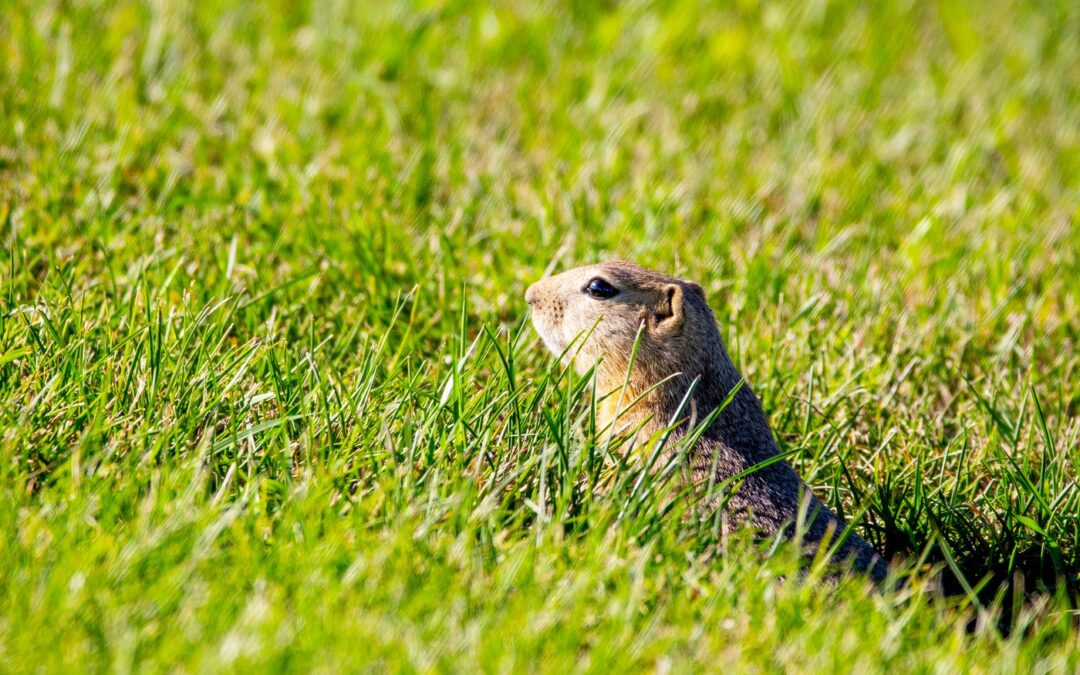
Photo: So they can see their predators, Richardson’s ground squirrels prefer short grasses to tall-standing crops. That means gophers are happy to build their homes and families in green spaces in urban areas. / George Lee, Local Journalism Initiative Reporter
By George Lee
Local Journalism Initiative Reporter
The Macleod Gazette
A return to strychnine-laced battles against Richardson’s ground squirrels would generate more drawbacks than first meet the eye, a conservationist said last week.
Harms caused by the powerful neurotoxin would ripple beyond the farm and ranch, said Ruiping Luo, a conservation specialist with the Alberta Wilderness Association.
And producers themselves could face unintended consequences down the road, she said.
Gophers appear to be a keystone species with an important role in the entire prairie ecosystem, Luo said.
Richardson’s ground squirrels are “ecosystem engineers,” she said.
“We’re learning more and more about this as we start to study what their impact is.”
Richardson’s ground squirrels, ubiquitous in much of southern and south-central Alberta, serve farmers by loosening and aerating soil, allowing it to soak up water for plant growth. They create homes taken over by other animals like burrowing owls and badgers. And they’re a food source for predators like the ferruginous hawk.
Health Canada’s Pest Management Regulatory Agency decided Feb. 2 to reject an emergency use application for two per cent liquid strychnine by producers, saying risks to non-target species like the swift fox and the burrowing owl are too great for approval.
For similar reasons, Luo’s organization supports the federal rejection.
“Given the proven harmful effects of strychnine on non-target species, AWA doesn’t believe any mitigating measures would be enough to ensure the safe use of this poison,” Luo said. “We support the continued ban of this pesticide.”
The oldest conservation group in Alberta, AWA is a not-for-profit dedicated to the protection of the province’s wild spaces and biodiversity.
Today with about 7,500 members and supporters, the organization has since 1965 advocated for protected areas to preserve habitat for species at risk in areas like the Eastern Slopes of the Rockies and the native grasslands of the Palliser’s Triangle.
In their joint application to the PMRA, Alberta and Saskatchewan said a gopher crisis has unfolded on farms, pastures and ranch lands since strychnine was banned three growing seasons ago.
Decision Called Devastating
Since the recent ruling, the office of Alberta Agriculture and Irrigation Minister R.J. Sigurdson has called on the feds to “immediately reinstate” strychnine for farmers and producers to deploy against ballooning gopher populations.
Rejection of the emergency-use proposal is “devastating for many in the agriculture sector,” the minister’s office said an emailed response to Macleod Gazette questions.
“We are urging the PMRA to reconsider this decision and immediately reinstate the use of strychnine as a practical solution for our farmers and ranchers.”
Health Canada, meanwhile, has acknowledged “significant agricultural impacts from ground squirrels, including damage to farm fields, risks of injury to cattle and crop losses, particularly in canola.”
An emailed response from the department’s media relations staff continued: “Health Canada considered this information, but under the Pest Control Products Act, environmental and health safety requirements take priority.”
The department said: “In this case, the environmental risks of strychnine, including secondary poisoning of non-target animals and species at risk, could not be mitigated to acceptable levels.”
The Role of Resilience
Environmentally safe approaches to gopher control are important —ones that work within a larger and longer-range view, Luo said.
“This is more of a personal opinion than an employer opinion, although I don’t think AWA would be that opposed to it,” she clarified.
“But I think it’s important to build resilience so that we don’t have these emergencies and we don’t have conditions that mean ground squirrel populations explode and cause this much damage.
“I think that’s a much better approach than constantly falling back on a pesticide that we know is toxic and harmful to the rest of the ecosystem.”
Richardson’s ground squirrels are notorious in the agriculture industry for the damage they cause pastures, crops, equipment and livestock.
About the size of a pudgy rat — but beige and often considered cute — gophers dig elaborate burrows and create mounds that put equipment and livestock at risk. They clear neighbouring vegetation at their burrow entrances so they can see predators.
“We do acknowledge and understand that ground squirrels can be a huge problem for farmers,” said Luo. “But I’d also like to point out that a lot of the time when ground squirrel populations really explode, there are environmental causes like drought and loss of control from predators.”
The Need for Predators
AWA is also concerned about the effects of hunting and predator removal. “We feel that there’s been a lot of targeted removal of predators, of wolves and coyotes but also of cougars and bears. Often they’re what control ground squirrel populations in the first place.”
Although resistance among strychnine’s target species hasn’t shown up yet, it’s not uncommon with other pesticides. Also, predators die from eating poisoned gophers, and it can take a longer time to recover than it takes gophers.
“So then you have this effect of needing more and more strychnine in order to control the population, until that’s the only thing that you know of that’s effective,” said Luo.
Alberta and Saskatchewan did propose mitigating measures like no surface baiting and requiring the deep burial of carcasses. They proposed a limited baiting window and mandatory user training, combined with chain-of-custody measures for the poison itself like registration, reporting and tracking.
But Health Canada was unconvinced that the measures were improvements over what it had seen in the past and didn’t think they’d be effective in preventing poisonings from going up the food chain.