
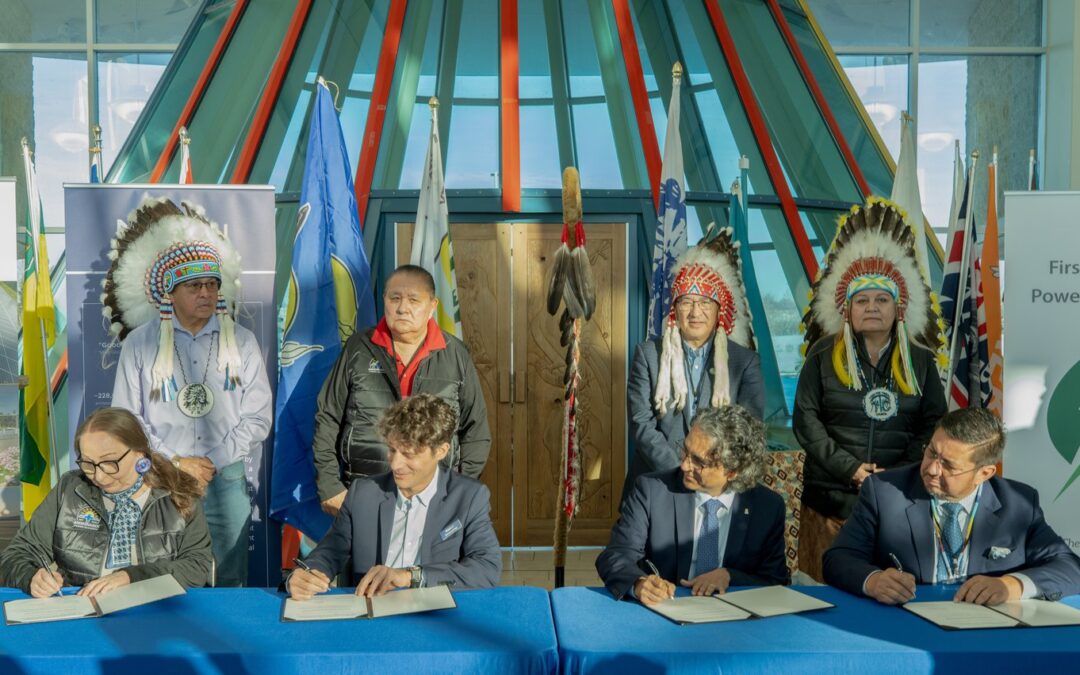
Photo: Leaders from four Treaty 4 Nations — Zagime Anishinabek, Kinistin Saulteaux, Cote, and The Key First Nations — are partners in Mino Giizis. Through the Anishinabek Power Alliance, they hold a 50% ownership stake. / Photo submitted by Ryan Dick / Neoen
By Sonal Gupta
Local Journalism Initiative Reporter
Canada’s National Observer
Last November, heavy, wet snow hit northeast Saskatchewan, snapping power lines and leaving Felix Thomas’s community without power. For a full day, homes stayed cold and dark. Many residents gathered at the local school, where a newly installed backup generator kept the heat on.
“Members were saying, ‘How can we be less reliant on outside power? Can we look at solar for our homes?’” said Thomas, chief of Kinistin Saulteaux Nation.
With solar panels already powering community buildings and charging electric vehicles in Kinistin, he said residents are familiar with how renewable energy could support their community. Their enthusiasm for the clean energy sources in their community led the Nation to expand their investment in solar initiatives.
Now, Kinistin Saulteaux Nation is set to become a part-owner of one of Saskatchewan’s largest solar farms. They and three other Treaty 4 First Nations have partnered with clean energy developer Neoen Canada to build a 100-megawatt solar project in the rural municipality of Lajord, southwest of Regina. The solar farm’s design will take advantage of southern Saskatchewan’s long summer days, with capacity allowing it to generate power earlier in the morning and later in the evening than many solar farms.
The nations will collectively hold a 50 per cent ownership stake in the Mino Giizis solar energy facility, which will generate enough electricity to supply 30,000 homes across Saskatchewan.
Equal footing with developer
The partners have signed a 25-year power purchase agreement with SaskPower, the province’s Crown-owned utility, to purchase all the electricity generated from the solar farm.
The farm is expected to begin operation in 2028 and produce about 228,000 megawatt-hours of electricity each year, said Ryan Dick, Neoen’s director for Alberta and Saskatchewan.
Neoen will handle permitting, construction and operations for the project and earn revenue from power sales over the life of the contract. The four nations, united under the Anishinabek Power Alliance, will own the other half and share equal voting power on the board for all key decisions.
Dick said the company sees that structure as essential to building trust. “Indigenous communities have been burned by business opportunities that didn’t work out,” he said. “We hope to not just have token Indigenous involvement. We want to work with our partners that own 50 per cent of the project to really optimize their benefits.”
Thomas said he hopes 50 per cent ownership becomes the new standard for First Nation energy deals, setting a template that shifts focus from haggling over equity shares to building skills through training, jobs and procurement. “Whether it’s a perfect deal, there isn’t… but at the same time, it’s as good as we can get,” Thomas said.
Partnership built on lessons
This outcome was years in the making. The idea began with Thomas, who first proposed teaming up for a SaskPower bid. Neoen initially paired with Kinistin and Zagime Anishinabek Nation on a project that offered 30 per cent Indigenous ownership — a proposal that didn’t make the final cut.
Later the nations regrouped and brought the Key and Cote First Nations on board to strengthen their internal agreements.
“All the nations are Anishinaabek, so it felt very fitting that we all joined together,” said Lynn Acoose, chief of Zagime Anishinabek and chair of Anishinabek Power Alliance holding company.
Acoose said nations spent time reaching agreement within their partnership and making sure Neoen could be trusted before proceeding.
SaskPower ultimately chose Neoen’s second proposal from among several bidders. The First Nations Power Authority evaluated proposals, assigning higher scores to those offering greater Indigenous ownership, more participating Nations and stronger hiring commitments.
Both SaskPower and the provincial government now require Indigenous participation in major power projects — a shift from a decade ago, Dick said, when companies tended to treat First Nations as stakeholders to be consulted, offering a handful of jobs, small infrastructure improvements or royalty payments.
Dick said Neoen spent about two years building relationships with the First Nations. Company representatives hosted open houses, met several times with chiefs and councils and spent time in communities. “They want to look you in the eye and gauge your intentions,” Dick said.
Neoen has started working with employment agencies that train First Nations and Métis workers. They aim to hire as many local members as possible during both construction and operations. Plans include on-site workshops and monthly sweat lodges open to both Indigenous and non-Indigenous workers.
Acoose pointed out that many provincial policies still underestimate how Indigenous communities collaborate.
Saskatchewan’s system often assumes First Nations must partner through formal political bodies such as the Federation of Sovereign Indigenous Nations. But Acoose said cooperation often grows through personal and cultural connections that cross treaty and provincial lines. The province’s attempt to show broad Indigenous participation by casting the net wide has sometimes slowed progress rather than advancing it.
Neoen and the Nations are expecting financial support from the Canada Infrastructure Bank, which prioritizes clean energy projects with Indigenous ownership. One or two private lenders, Canadian or international, are expected to provide loans, while the partner nations will contribute additional equity, Dick said. The total cost and power purchase value have not been disclosed.
For the participating nations, the solar project represents more than income. Acoose said renewable energy is tied directly to environmental stewardship and each community’s top priorities. In a community-based plan, she said members ranked renewable energy and green technology as top goals alongside food security and food sovereignty.
“This revenue will be not harmful, not harmful to our future generations,” she said. “It’s revenue that we can be proud of that we are holding on to our Anishinaabe principles and laws that say whatever you do on the earth, you must give back.”