
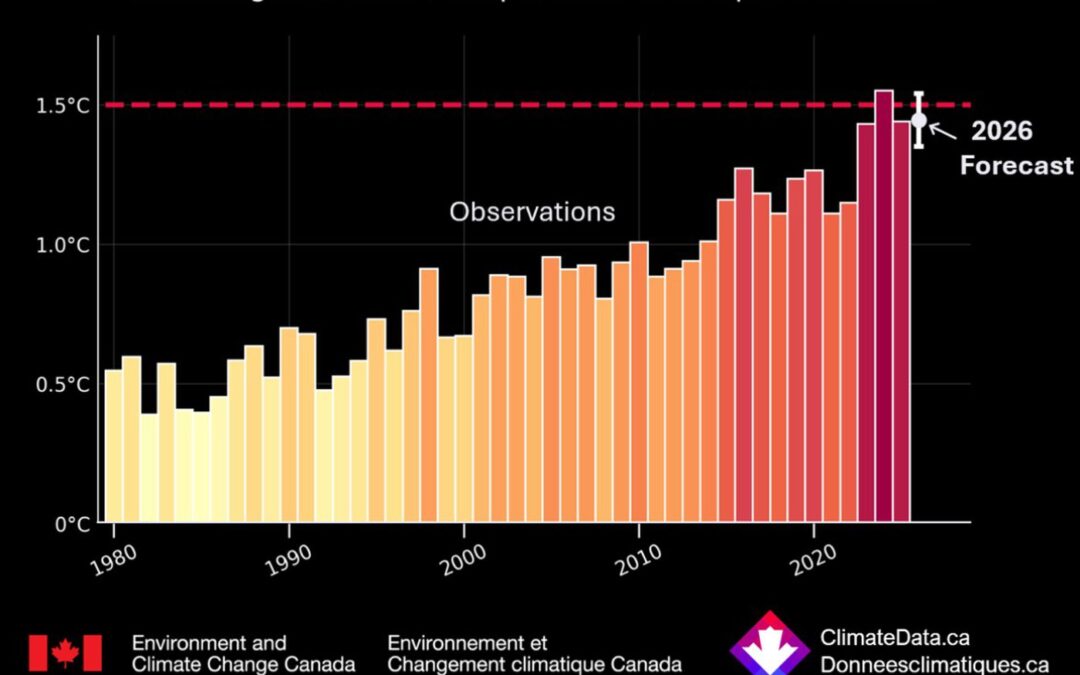
Photo: The observed annual global mean temperatures for each year from 1980 to 2025 are shown relative to the pre-industrial global mean temperature (1850-1900, before most human-caused warming occurred). The modelling found in 2026 the global mean temperature is predicted to fall in the range of 1.35 °C and 1.53 °C above pre-industrial levels. Chart by Climate Data Canada
By Natasha Bulowski
Canadian scientists are “virtually certain” 2026 will be among the four hottest years ever recorded, according to new global forecasts produced by Environment and Climate Change Canada.
The prediction is in line with other global temperature forecasts that also anticipate a scorcher of a year. Nevertheless, Canada is falling short of its commitments to reduce planet-warming greenhouse gas emissions.
This will be the 13th consecutive year in which global temperatures surpass pre-industrial levels by at least 1.0 degree Celsius, according to the analysis by ECCC’s Canadian Centre for Climate Modelling and Analysis. This year, there is a 12 per cent chance global temperatures will exceed the Paris Agreement threshold of 1.5 degrees — an international benchmark aimed at limiting global carbon emissions to avoid the most extreme impacts of climate change.
ECCC says it “doesn’t constitute a failure” of the Paris Agreement if the global average temperature exceeds 1.5 degrees but noted the long-term forecasts predict this troubling trend will continue, with 2026 to 2030 likely to be the hottest five-year period on record.
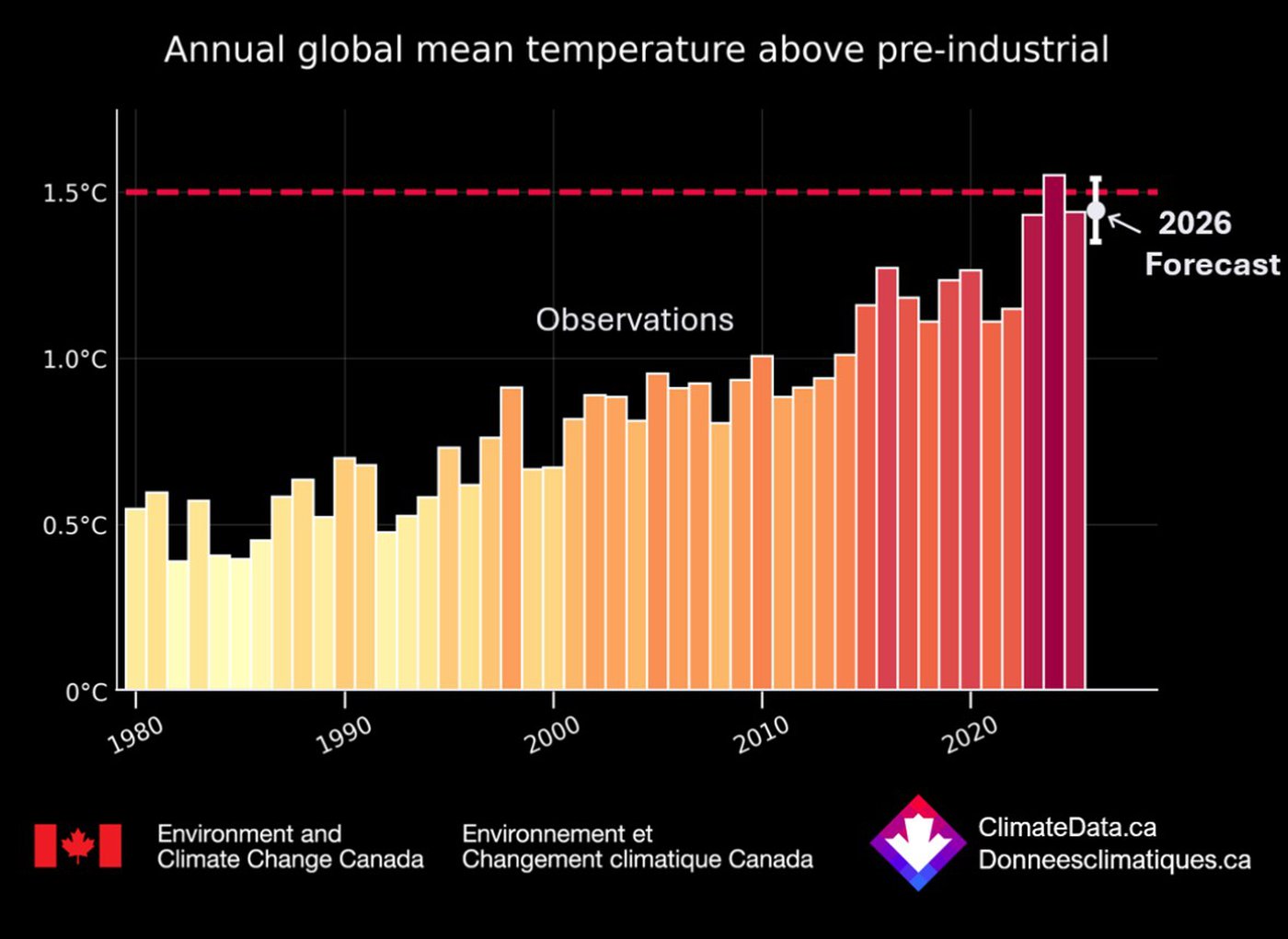
The observed annual global mean temperatures for each year from 1980 to 2025 are shown relative to the pre-industrial global mean temperature (1850-1900, before most human-caused warming occurred). The modelling found in 2026 the global mean temperature is predicted to fall in the range of 1.35 °C and 1.53 °C above pre-industrial levels. Chart by Climate Data Canada

Right now, Canada is on track to miss both its 2026 and 2030 emissions reduction targets, according to a government report published in mid-December. The national target is a 40 to 45 per cent reduction relative to 2005 levels by the end of the decade. However, under the current policy mix, Canada is set to achieve a 21 per cent reduction. If policies that have been announced but not implemented are factored in, that rises to 28 per cent by 2030, still well short of the national target.
“How can the federal government say that fighting climate change is ‘a moral obligation’ and ‘an economic imperative’ and then put its support behind new LNG projects, a carbon capture pipeline, and perhaps a new bitumen pipeline — all of which need significant federal subsidies to move forward?” Keith Brooks, programs director at Environmental Defence, said in a press release on Jan. 19 2026.
In a new release about the global forecasts, the federal government pointed to its commitment to strengthen methane regulations. Yet it has granted Alberta, the province responsible for the largest share of national emissions thanks to its oil and gas sector, five extra years to meet methane targets.
This carve out could result in an additional 1.9 million tonnes of methane released into the atmosphere, equivalent to 53 million tonnes of carbon dioxide or the annual pollution from roughly half the cars on Canada’s roads, according to analysts at the Calgary-based Pembina Institute.
Climate change is driven largely by burning fossil fuels such as coal, oil and gas, so it is essential to tackle emissions from the oil and gas sector if Canada is to meet its climate targets. The federal government also routinely points to its commitment to strengthen Canada’s industrial carbon price including by working with Alberta to ensure the province has a strong system in place. A lot is riding on the federal government’s negotiations with Alberta to hammer out an agreement by April 1, 2026, but it remains to be seen whether Alberta Premier Danielle Smith will play ball. Some opposition MPs and climate experts think she will not.
On average, Canada is warming at more than twice the global rate and Northern regions are even worse off, warming about three times as quickly as the rest of the world, ECCC noted. These rising temperatures have been accompanied by increasingly extreme heat waves like the deadly 2021 heat dome in British Columbia. Canadian scientists have attributed these extreme heat events to climate change.
Although 2026 will be hot, 2024 will most likely retain the number one spot with its record high temperature of 1.55C, according to the global analysis. The authors added that “the unprecedented global temperatures over the last few years can be partly attributed to the strong El Niño event in 2023-2024, compounded by ongoing human-induced global warming.”