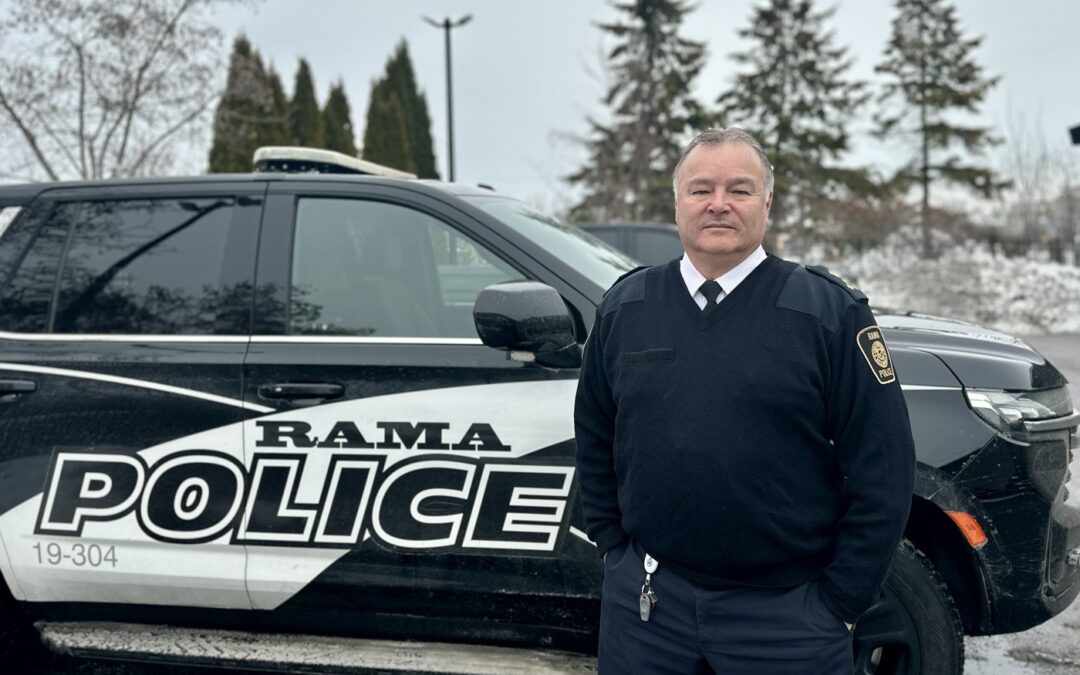
Photo: Rama Police Chief Jerel Swamp is pictured. / Danielle Pitman LJI
OrilliaMatters.com
The Rama Police Service (RPS) is one of nine standalone First Nation police services in Ontario.
Last November, the Anishinabek Nation declared a state of emergency over public safety due to a lack of funding and a rise in crime rates. It cited increases of drug trafficking, organized crime, and violent crimes targeting elders and youth, as well as a growing mental health and addictions emergency.
“We see similar challenges when it comes to the influx of drugs in our community,” said Rama Police Chief Jerel Swamp.
These severe crimes are often from outside sources, he explained.
Crimes like drug trafficking stem from metropolitan areas and transfer to First Nations communities, where they then thrive. Fewer police officers and a greater geographical area create an environment for criminal operations to grow.
“They take advantage of that,” said Swamp.
When he came to Rama in 2018, he realized there had been no additional government funding for resources, positions or programs in 17 years.
In that time, Swamp noted, there was a 20 per cent increase in Rama’s population, on top of additional infrastructure and new businesses. He wanted the police service to match that growth.
“That’s when I got Canada and Ontario to the table here. I kind of shamed them, said that is uncalled for in North America,” he said.
Four positions have since been added, and RPS is once again recruiting constables and experienced officers.
About 20 per cent of calls come from Casino Rama, said Swamp, while another 20 per cent are from outside Rama. Being dispatched from Ontario Provincial Police, if they are the nearest to an incident, Rama police will immediately respond.
Roughly 60 per cent of RPS officers are Indigenous, whether from Rama or other First Nation communities. Knowledge of the culture, history and people is part and parcel of the work, Swamp explained.
“We police with a lot of empathy. We police with a lot of trauma-informed practices, and it makes us very unique in how we police the community. It creates that connection,” he said.
“As a police leader, if I can have a more healthy community, then I don’t care about the stats that we get,” said Swamp, who previously served as president of the First Nations Chiefs of Police Association, representing the 36 First Nations police services across Canada.
Taking a personal approach to each call is an effective way to de-escalate situations, said the 34-year veteran of policing.
No matter the number of calls, no matter the type, Swamp encourages officers to take a “perceptive” approach. What might look like circumstances of low significance to an officer could be life’s most traumatizing event for the civilian that day, that week or that month, he said.
RPS also has a mobile crisis response unit.
“It’s probably one of the most positive things that any police leader can implement in their service, in my opinion,” Swamp said, noting the benefits and recidivism related to its services.
It is staffed by a trained social worker who assists with grief, trauma, addictions, and mental health issues.
These services are extended to surrounding areas, such as Orillia, where First Nations individuals reside. When a trauma-informed and culturally sensitive response is crucial, the flexibility and haste of the mobile unit is beneficial, Swamp stressed.
Sadly, he said, those resources are in constant demand.
“In First Nation policing all across Canada, if you look at the crime severity indexes, First Nation communities have about 37 per cent higher violent crimes in our communities, but we use a lot less lethal force,” he said.
A 2024 report from the Government of Canada notes although Indigenous people account for only five per cent of the population, they accounted for 25 per cent of all homicide victims in 2023.
One of the biggest challenges First Nation communities face in Canada is the need for specialized services, said Swamp. Without the appropriate government funding, they cannot support homicide units, canine units, drug units, or victim services units, despite having higher crime indexes, he explained.
The Anishinabek Nation is calling for First Nation policing to be regarded as an essential service.
Swamp comments on the disadvantages of First Nation policing being considered a program. It also limits what he can offer recruits.
“I would love to say, ‘I’m going to give you 30 years in First Nation policing,’ but I can only promise to my next funding agreement, because it’s a program,” he said, noting the longest agreement in Rama, to his knowledge, was five years.
Although he calls the role officers have in their communities a “juggling act,” it is a rewarding one. For those who want to do something that makes a tangible difference, Swamp said, RPS is a good place to work.
Rama officers are engaged with the people they serve — involved in more than 150 community events throughout the year — and aim to have a positive presence with the youth they serve.
“We’re looking at either experienced officers or individuals that are mature, open to learning, that have some sort of education,” he said.
Police foundations, law or security are not required courses. Swamp believes various backgrounds can be advantageous in police work.
After generations of mistreatment and negativity between Indigenous people and the police, improving connections and establishing a common trust is part of the vision for Swamp.
“I think we’re always progressing to be better and I think each police service and each agency that serves the public and the communities, they always strive for that. So, I know that, in the future, we will be better.”
More information about RPS, including how to apply for a position, is available at ramapolice.ca or by calling 705-325-7773.