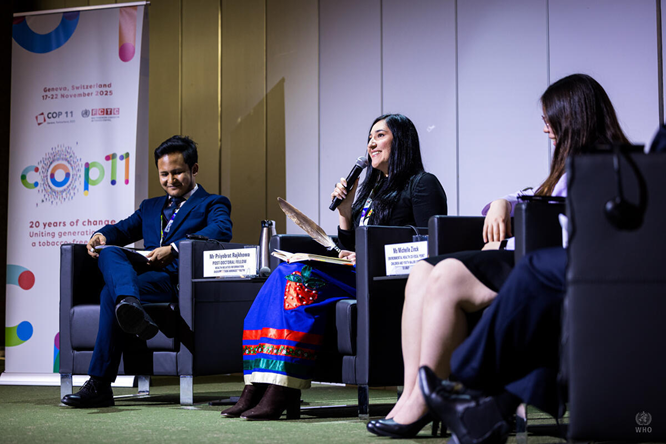
Photo: Michelle Zinck at the COP-11 conference in Geneva, Switzerland / Provided by Michelle Zinck
By Danielle Dufour
MBC News Freelance Correspondent
Michelle Zinck, a Dene from Fond Du Lac Denesuline First Nations and a master’s student studying Indigenous studies at the University of Saskatchewan, recently attended COP-11 in Geneva, Switzerland.
COP-11 is the 11th conference of the parties for the World Health Organization (WHO) Framework Convention on Global Tobacco Control.
“I was invited to the high-level strategic dialogue, the opening of the conference,” said Zinck. “To speak from a youth perspective as well as an Indigenous youth perspective to provide opening remark to the intersections of the harms of tobacco production, not only on human health and youth health but also on the health of the environment.”
Zinck wanted to shift the narrative and spoke from a Dene point of view.
“Indigenous people need to be respectfully included to make decisions because we hold Indigenous knowledge and Indigenous science that has the insight into sustainable solutions,” said Zinck. “We see now that Western science is just catching up to this Indigenous science, recognizing the interdependence between humans, animals, plants, the environment, and health…we’ve always known this.”
Zinck stated the room had about 1000 representatives from member states and different countries from around the world to work on the global tobacco treaty. They included diplomats, health ministers, policy makers, academics, and representatives from different member states.
“The aim of it is to transition into a tobacco-free world,” said Zinck. “They are doing this by developing policy on the global tobacco treaty where the different resolutions get adopted, and it’s up to the member states, the countries, to adopt this policy and implement it within their country.”
Zinck explained the disconnect that happens because we don’t often see these global policies being adopted and the importance of being included in tobacco control development.
“We introduced tobacco to the settlers,” said Zinck. “We use tobacco, it’s a sacred medicine not meant for recreational use, but it’s sacred and used in ceremony; it’s how we relate to the land and how we relate to one another.”
Zinck was very honoured to be invited and included on the panel.
“It got me reflecting on my ancestors, the hardships and the surviving that they have done,” said Zinck. “My work that I do is really growing from them and their way of life and their stories.”
Zinck was the only Indigenous panelist.
“So, me coming in there, it was really to bridge this gap just speaking to the environmental intersections,” said Zinck.
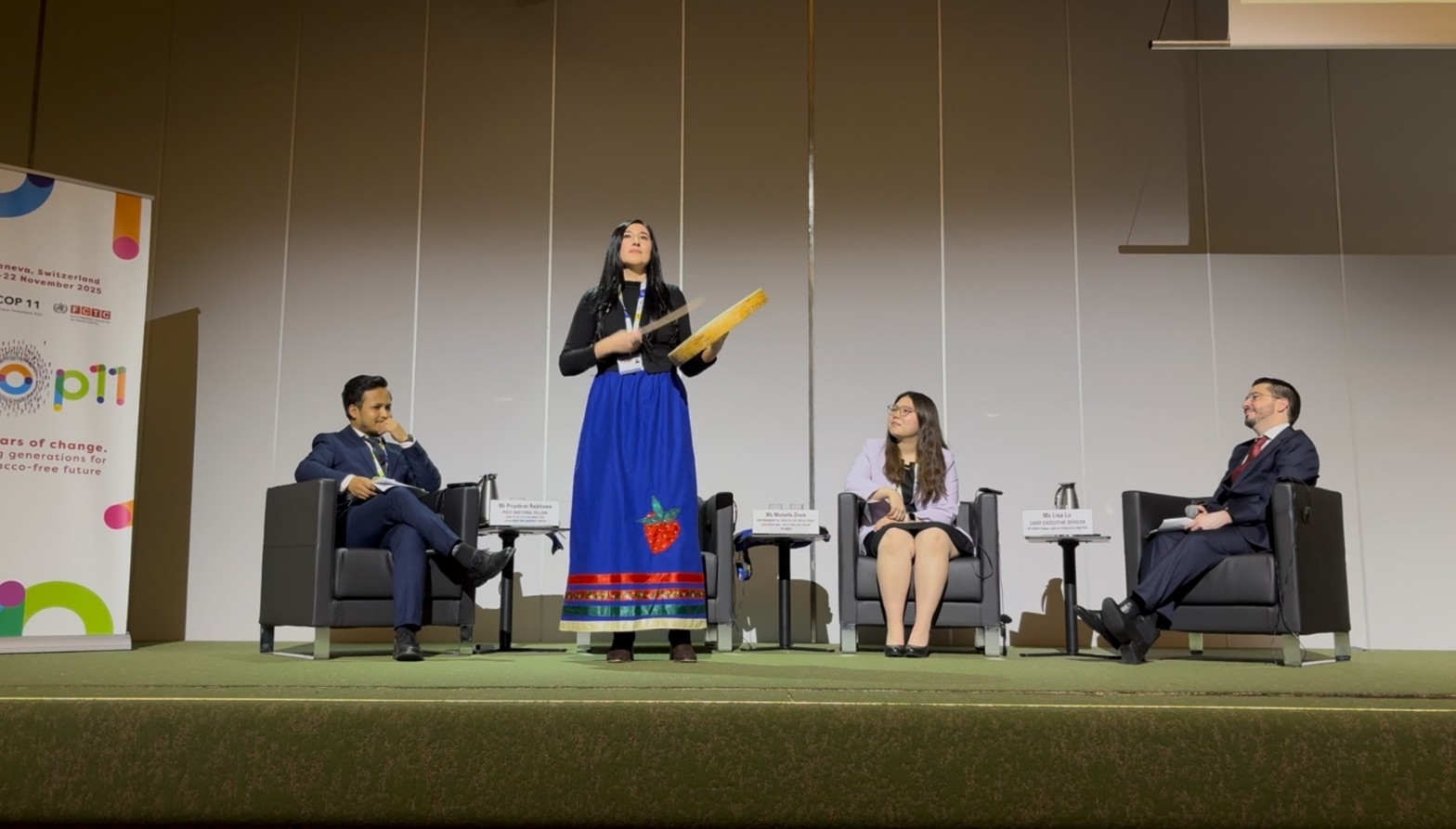
Zinck began her presentation by playing the caribou drum
“I used this drum to bring the land into this high-level colonial room,” said Zinck. “It was a way for me to teach about Indigenous science and creation to help shift this narrative that we’re not just vulnerable people in experiencing all these environmental health inequities, but we have insight into sustainable development.”
Zinck explained that we are now at a point where we need to move beyond us going into these spaces and asserting our rights “Just for our lands to be continually extracted from.”
“It was a high honour, but I almost come back disappointed because I know that the Government of Canada is not going to take our perspective and our knowledge systems seriously,” said Zinck.
Zinck initially got into Indigenous health research wanting to amplify Indigenous perspectives of health and knowledge systems which move beyond the human body but extends to the community and the environment.
“We are finding a Dene health framework used for behavioural interventional programming for youth suicide prevention, specifically focusing on Dene use,” said Zinck.
“When the pandemic hit, I had just completed my coursework in the first year of my master’s program,” said Zinck. “Youth in our community in Fond Du Lac and Dene communities throughout the Athabasca basin, we were experiencing the highest rates of suicide.”
Zinck recalls at one point where every weekend there was an attempted suicide or an actual suicide.
“We have the highest rates provincially and even nationally, and it’s not an isolated event, as Indigenous youth around the globe are experiencing this,” said Zinck.
Zinck explain that this is occurring because of a disconnect from the land and because of settler colonial land violence that is still occurring today coupled with historical trauma.
“And now this environmental violence that we see, because of anthropogenic changes,” said Zinck. “Climate change is an example of this, as well as the COVID-19 pandemic.”
Zinck believes that reconnecting back to the land through targeted behavioural interventions by prioritizing Indigenous worldviews and knowledge systems would aid in suicide reduction.
“We had all these stressors we were coping with, and I was just getting into my research on land health relationships, thinking I can’t do research about the land without going back to the land,” said Zinck.
After applying for a grant through Jordan’s Principle, Zinck partnered with her home community, and with the youth care worker they took 33 youths to the Athabascan sand dunes for a pilot land-based healing camp project.
“This was to reconnect us to the land in our protective cultural factors, such as storytelling and our bush skills and hunting and plant medicines, all this Indigenous science that can help them cope with these stresses that we’re facing,” said Zinck.
Zinck was pleased with the outcome of this pilot project.
“It worked,” said Zinck. “For one year we did not have a youth suicide.”
In 2023, Zinck took ten youth up to ancestral lands in Rainy Lake, NWT.
“We did interviews and took an intergenerational perspective on the land health relationship,” said Zinck. “We are using that to build a Dene health framework, which will be the framework for a behavioural intervention prevention program.”
Zinck is currently completing her research now and plans to pursue a PhD in Indigenous health to strengthen Indigenous land-based approaches to address the anthropogenic changes on health.
Zinck has previously attended the UN Environment Assembly and the Global Youth Environment Assembly in 2023.
She also attended COP-16 on the biodiversity framework in Columbia last November.
“I’m the environmental health co-focal point for the children and youth major group to the UN Environment Program,” said Zinck. “In my role I strive to amplify this Indigenous perspective and knowledge of Indigenous health, working to include youth in these global environmental governance and policymaking.”
Zinck expressed her frustration over Indigenous people having to continuously reassert their inherent rights while not being respectfully included.
“Our world view and our knowledge systems are not being prioritized, nor are our inherent rights as outlined in the UN declaration of the rights of Indigenous people, so there is a disconnect,” said Zinck. “I am hopeful, and I try to amplify this Indigenous perspective of environmental health and how we’ve always known this and we need to be included.”