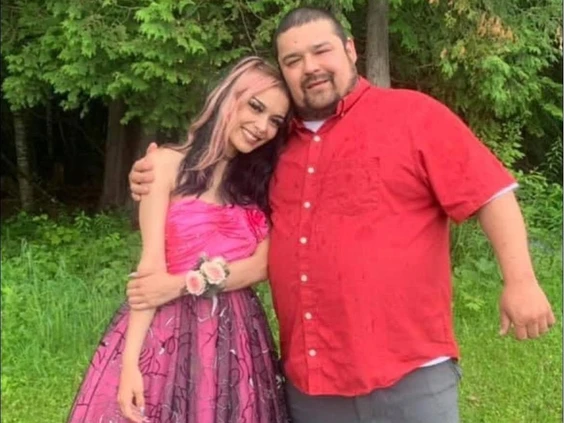
Photo: Bronson Paul with his sister Treasure Paul in her high school prom dress. SUBMITTED / By John Chilibeck, Local Journalism Initiative Reporter
By John Chilibeck
Local Journalism Initiative Reporter
The Daily Gleaner
The RCMP sign on the shuttered detachment in Neqotkuk has been defaced with red handprints – symbolizing blood and silenced voices – with one of the hands obscuring the huge bison head in the centre of the Mounties’ coat of arms.
The hashtag “Justice for Bronson” is scrawled across in black paint.
In another part of the community in northwestern New Brunswick – also known as Tobique First Nation – a black sign has been erected with the same hashtag and a large heart with the victim’s name. “We will never forget,” it states.
Just below, another sign has been posted in the snowbank, with a slur against “all cops.”
The RCMP shooting death of Bronson Paul, 40, a popular local community member, on Jan. 18, has upset and angered this tightknit First Nation of about 2,500 people, both on- and off-reserve.
Paul was a father of five and also had seven stepchildren.
“There’s still a lot of fear and anxiety – especially when it comes to people being scared of RCMP now,” Ross Perley, chief of Neqotkuk, said in an interview Thursday.
The six chiefs that make up the Wolastoqey Nation on New Brunswick’s western side called on Thursday for an Indigenous alternative to traditional policing, on top of their long-standing demand for a public inquiry into systemic racism in the justice system.
The police have not said much about the death, only that they responded for a call to service at a home for a domestic dispute and that Paul had come at them with “an edged weapon.” The authorities say they tried tasering him, but the energized weapon failed to stop him, and he was shot to death.
No details such as who shot him and how many bullets he took have been publicly disclosed. The investigation was turned over to the SiRT, or the serious incident response team, which is the case in the province whenever police kill someone. It is made up of independent investigators, often including former cops.
The family disputes the RCMP’s version, with his sister, Treasure Paul, saying her brother didn’t have a weapon and that he was inexplicably shot five times. She wasn’t there at the time of the shooting, but recounted what others had told her.
Perley said there’s been a huge emotional toll on the community, still reeling after Paul’s funeral. In the wake of his death, the chief and council asked the RCMP to close the detachment, which they did. The federal police force is still responding to calls for service in the community, including 911 emergency calls, but police who show up are being escorted by the First Nation’s security personnel.
It’s for the safety of community members and also the police themselves, Perley said.
He said bitterness is growing among locals because they don’t see any progress in the investigation.
“There’s a lot of frustration around it, because it doesn’t seem like there’s a lot of action to date.”
That frustration, Perley said, is rooted in concerns about whether justice will be served.
“There’s some frustration that maybe there won’t be justice, or maybe the investigation is not gonna be fair. And I understand that.”
Despite the anger and grief, Chief Perley said the community is focused on meaningful reforms rather than retaliation.
“We’re not just gonna sit back and do nothing. We are going to try and make change and make everyone safer – not just for people in Neqotkuk, but for all Indigenous people.”
When it comes to the damaged RCMP sign, Perley views the act as a heartfelt expression of his people’s beliefs.
“I don’t call it vandalism. I think it’s more frustration in the community,” he said. “I don’t have a problem with it. It’s washable paint, so it’s not anything to get upset about.”
Asked for comment, the J Division of RCMP, representing the New Brunswick force, issued a statement.
“We recognize that the First Nation of Neqotkuk is saddened by the recent tragic loss that has had deep repercussions for family, loved ones, and the wider community,” said Cpl. Hans Ouellette. “We are aware that Chief and Council have called for the closure of the RCMP detachment.”
But he said that didn’t mean the police had abandoned the First Nation.
“Whether answering calls for service from within or from outside the community, it is important for members of the public to understand that no matter the ‘status’ of the detachment, the NB RCMP is continuing to ensure public safety and expected service levels in Neqotkuk,” he wrote. “The NB RCMP is working together with the community leaders of Neqotkuk First Nation to ensure that policing services continue in a culturally appropriate way during this difficult time.”
In a statement released Thursday, the Wolastoqey chiefs said in the wake of the disproportionate number of tragic Indigenous deaths at the hands of the police, they wanted a Wolastoqey-led alternative to traditional policing and a public inquiry.
There have been four Indigenous people killed by police since 2020 in different parts of the province.
The previous Progressive Conservative government of Blaine Higgs resisted holding a public inquiry, and the Holt Liberal government has also been reluctant to call one.
Nonetheless, the chiefs are calling on provincial and federal counterparts for immediate changes to policing services in their communities. A longstanding priority, they say, is to set up a Wolastoqey police force, “guided by Wolastoqey values, and entirely run by Wolastoqey communities, for Wolastoqey communities.
“With such community-based policing, the Wolastoqey Nation can provide culturally relevant services and keep its members safe. Immediate steps need to be taken to make this priority a reality.”
They say until a Wolastoqey police force is fully funded and operating on the ground, they want to establish peacekeepers as an interim measure.
“Peacekeepers would be community-based first responders, focused on early prevention and de-escalation, by referring people to relevant services,” they stated. “Through assisting with things like wellness checks, community patrols, and occurrences reports, Peacekeepers can help build relationships between current police forces and community members.”
Such peacekeepers have already been established in Mi’kmaq communities on New Brunswick’s eastern side.
“Wolastoqey-led policing initiatives will emphasize community trust, safety, and connecting people to the services they need,” said Chief Allan Polchies of Sitansisk (St. Mary’s First Nation in Fredericton). “We have been in conversations with the province and federal government on establishing these initiatives and we have asked that it be prioritized in light of recent incidents.”
The chiefs argue that Indigenous-led policing initiatives have been successful in other Canadian communities, leading to lower rates of deaths at the hands of police, violence, arrests, charges, and incarceration.
But the chiefs are also upset over what they believe is little accountability over lethal force against Indigenous people.
“Previous investigations into these deaths are limited in scope and have done little to address the broader systemic issues of how race and colonialism impact policing of Indigenous people,” they said. “The Chiefs continue to push for a public inquiry to help us prevent such needless use of violence and death in the future.”
The statement was signed off by Perley and Polchies, who said, “We need to work together to restore the broken trust in our communities.”
Indigenous Affairs Minister Keith Chiasson told Brunswick News on Wednesday he hadn’t gone to the community following Paul’s death.
Instead, he’s been texting Perley to keep the lines of communication open.
“We want to be respectful to the community and the grieving they’ve been going through,” he said of not going personally to Neqotkuk. “We also need to be respectful of the work going on with SiRT.”
The last time he met with the chief and council was in September.
The minister said the call for peacekeepers wasn’t new. Over the last year, the Wolastoqey chiefs have discussed the need to establish such a measure.
He also said a group of Atlantic First Nations chiefs had recently met with federal officials to discuss community policing.
But Chiasson acknowledged he didn’t know how much a new peacekeeping force would cost the provincial and federal governments or a full-fledged Indigenous police force for that matter. He said that was a question for the Department of Public Safety.
Setting up a police force would be complex, he said, adding it might be difficult to do given the shortage of personnel that the RCMP and municipal forces have struggled with in recent years. Training to become a police officer is intense, usually six months at a college, and there’s a whole battery of rigorous tests the recruit must pass, including fitness, medical, and psychological.
Furthermore, Chiasson warned that differences had to be smoothed out over band council resolutions. Both the RCMP and municipal police forces have refused to enforce those resolutions because they said such measures don’t stand up in the Canadian legal system.
For instance, St. Mary’s and Oromocto First Nations have passed bylaws banning “undesirables” from their communities, people they suspect of being drug dealers or other kind of criminals. Such measures violate the Canadian constitution.
“That’s one part of the complexity, where the band council resolutions aren’t recognized by the provincial legal system,” Chiasson said.
The Wolastoqey chiefs are scheduled to meet the minister in Fredericton in a couple of weeks, and peacekeepers are on the agenda.
“Hopefully, I’ll get a chance to see Chief Perley in person,” the minister said.