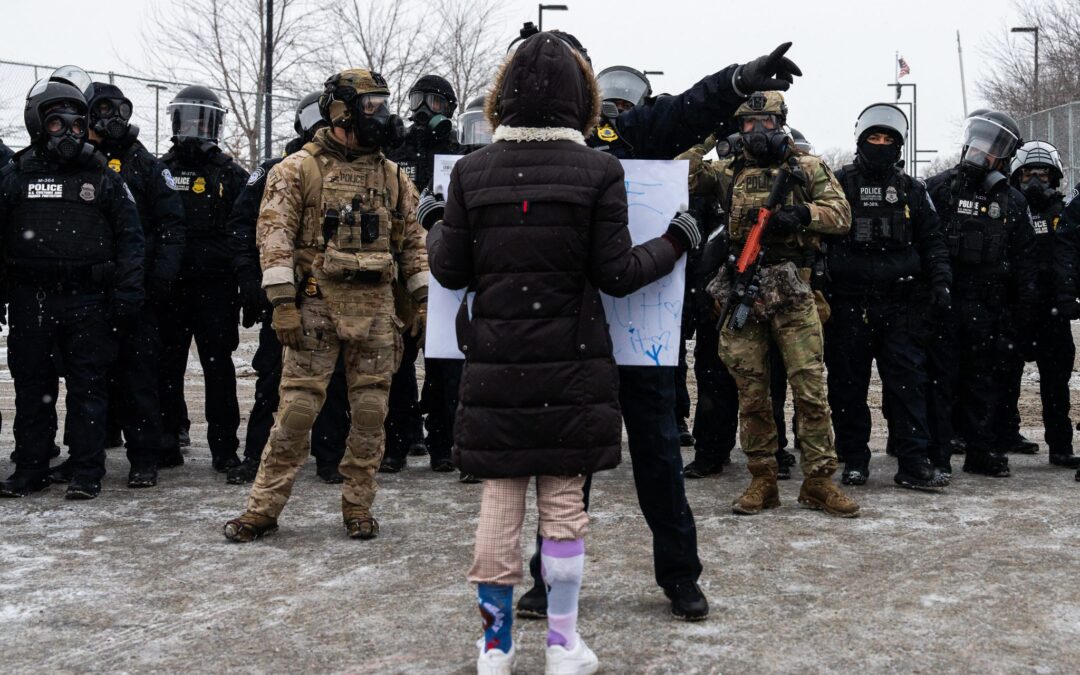
Photo: In ‘Minneapolis,’ a protester confronts U.S. Customs and Border Protection (BCP) tactical officers on Jan. 16, a week after Renée Good, 37, was gunned down in her van by an Immigration and Customs Enforcement officer. BCP agents would go on to shoot dead another 37-year old, Alex Pretti, a week later. Photo courtesy of Chad Davis
By Crystal Greene
Local Journalism Initiative Reporter
IndigiNews
Inuvik resident Harley Minakis was on his way home from visiting his daughter in Costa Rica last week — transiting via “Houston” airport — when a U.S. Customs and Border Protection officer stopped him.
Despite having his Canadian passport, Indian status card, and Gwich’in tribal card, he found himself turned over to Immigration and Customs Enforcement (ICE) agents.
They held him in a room for roughly two hours, he told IndigiNews, with about 20 other detainees on Jan. 22.
“‘You’re staying here,’” he recalls the agent saying.
“There were a whole bunch of other people that were detained in there. They were all speaking Spanish, but they look like they’re Native.”
Minakis said an agent told him his three identification documents were not enough, dismissing his federally issued Indian status card.
“One guy’s like, ‘Well, I was in Canada and they give those out like candy,’” he recalled. “I’m like, ‘How can you say that? We have to go through hoops, especially to get Indian status.’”
Officers insisted that if he wanted to be released from custody, he’d have to prove his so-called “blood quantum” of Indigenous ancestry, Minakis said.
His experience served as a reminder of the high stakes and growing fears about visiting the “U.S.” — anxieties shared by a growing number of Indigenous citizens within that country itself.
‘I’m scared … I’ll be detained again’
With global headlines dominated by scenes of violent arrests of migrants, including children — and agents killing two citizens protesting their actions — Indigenous people are finding themselves increasingly in the crosshairs.
A growing number of First Nations members are also being apprehended by ICE agents, sending shockwaves of anxiety across the continent on both sides of the border.
Now, as tensions on the streets flare — and resistance grows to the aggressive crackdown — multiple First Nations organizations have issued travel warnings against going to the “U.S.” at all.
And for those who must cross the border, they recommend people carry not only up-to-date passports — but even long-form birth certificates, Indian status cards, and a “blood quantum” letter from their band or tribal council.
In 1794, “Great Britain” and the newly independent “U.S.” signed the Jay Treaty — officially known as the Treaty of Amity, Commerce, and Navigation.
The pact enshrined the inherent right of “Indians dwelling on either side of the said boundary line freely to pass and repass by land or inland navigation, into the respective territories and countries of the two parties.”
But despite nothing in the treaty about criminal records or “blood quantum,” the “U.S.” insists that those exercising their Jay Treaty rights must prove at least 50 per cent “blood quantum” — a measure of ancestry not used to determine band membership or Indigenous identity north of the border.
“Blood quantum is a concept created by white settlers,” the Native Governance Centre states on its website, “that refers to the amount of so-called ‘Indian blood’ that an individual possesses … rooted in eugenics.”
During Minakis’s ordeal, the agents who detained him demanded more documentation, he said, before he would be released.
But he alleged the agents also told him they weren’t obligated to uphold the Jay Treaty at all.
“They said they don’t have to honor it, because some bands came after it,” Minakis said.
But as he frantically tried to comply with agents’ demands, an ICE supervisor then seized his phone.
Meanwhile, Minakis’s wife Aurelie sprang into action — having the Gwich’in Tribal Council draft and send a “blood quantum” letter urgently.
Thanks to their frantic efforts, eventually Minakis was released and reunited with his family, with just five minutes to spare before the gate closed for their connecting flight home to “Canada.”
“We ran like crazy … throughout the airport to get to where we were flying,” he recalled.
But the ordeal left him shaken — and reconsidering whether he’s ever willing to visit his daughter in Costa Rica again, even if he never transits through the “U.S.”
“I’m scared,” he said, “that if the plane malfunctions and goes down, I’ll be detained again.”
‘Taken into detention for looking a certain way’
On both sides of the colonial border, tribal and First Nations officials have issued statements advising people to make sure their status cards are up-to-date, and to have other identity documents ready for ICE encounters.
Nations in “North Dakota,” “South Dakota” and “Minnesota” have hosted pop-up identity document clinics in the Twin Cities area, too.
The Native American Rights Fund (NARF) issued a fact sheet and a know-your-rights flyer.
The organization reminds Indigenous people of their right to remain silent during encounters with law enforcement — urging them to stay calm, tell the truth, and not be seen to obstruct or resist ICE agents.
If targeted, however, NARF recommends people state they do not consent to being searched, and to ask agents if they are being detained or free to leave.
Rosanna Berardi, a lawyer with Berardi Immigration Law in “Buffalo, New York,” was previously a border immigration inspector.
“At the beginning of my career, which was 25 years ago, there was always confusion about the Jay Treaty,” she told IndigiNews. “some officers didn’t understand what that meant … it appears that there’s still that confusion.
“The issue with crossing the border is you just don’t know who you’re going to get and what level of experience they have.”
She advised that people can ask to speak to a border agent’s supervisor if the officer appears to not understand the Jay Treaty.
Although she acknowledges some have called for the historic treaty to be overturned, they haven’t succeeded.
“Presently,” she said, “the Jay Treaty is alive and well.”
Brad Regehr, a member of Peter Ballantyne Cree Nation and a Sixties Scoop survivor, is a partner at the Indigenous-owned Maurice Law in “Winnipeg.”
He said the ICE crackdowns have seen due process and rule of law “tossed out the window.” That makes crossing the border risky, despite First Nations members’ rights.
“Given the current administration, I don’t think it’s a very friendly time for Canadian First Nations or other Indigenous people to be going into the States,” Regehr said.
“My fear is that they would just be subject to the same discriminatory practices that we’re seeing — where they might say, ‘Well, you’re a Canadian Indian, you have no right to be here,’ and then, throwing them into the facility and eventually deporting them back to Canada.”
Regehr said, as a First Nations person from “Canada,” he’s opted not to travel across the border.
“It appears that the risks are just too great,” he said. “You get arbitrarily taken into detention for looking a certain way.”
Writer and organizer Harsha Walia, author of Undoing Border Imperialism, said the ICE raids have shone a light on state violence against immigrant and BIPOC communities.
In an interview with IndigiNews, the “B.C.”-based South Asian author said many people mistakenly think about immigration enforcement “as a kind of non-Indigenous, settler issue” — in either country.
“But Indigenous people from these lands on Turtle Island are some of the communities who are most impacted by immigration enforcement,” she said. “That is literally the imposition of colonial borders that divide people on their own territories.”
She described border policing as “part of the same system” of restricting people’s freedom of movement, including for Indigenous communities.
“The way that immigration enforcement is all about telling migrants, ‘You can’t be here, you can’t live here, you can’t do that,’” she explained, “comes from the same ideology of settler-colonialism — of telling Indigenous people that they could only live on reserves and reservations.”
‘It’s too dangerous’: A rez at the borderline
The colonial border isn’t always a straightforward divide for Indigenous nations.
For instance, Northwest Angle #33 First Nation, in “Ontario,” is so close to the “Manitoba-Minnesota” border that people must enter the “U.S.” before they can reach the nearest “Canadian” highway.
Community members who reside on one of the nation’s reserves do not have a year-round road, and depending on the season must travel by ice, boat or air.
And to access many off-reserve services such as shopping, school, or doctors, they have to transit through the “U.S.”
“I’m advising our members not to cross the border at this time,” the First Nation’s Chief Darlene Comegan wrote on Facebook on Jan. 15.
“It’s too dangerous. Someone’s brown and red status card was confiscated and not returned to them by ICE.”
Grand Council Treaty 3, which includes Comegan’s band, issued a statement confirming that “some First Nation citizens have experienced increased scrutiny, questioning, or enforcement” by ICE while traveling.
The council advised people to reach out to regional offices of Indigenous Services Canada who may “assist with prioritizing urgent cases related to cross-border travel, employment, or safety concerns.”
More than 35,000 Native Americans live in the Twin Cities of Minneapolis-Saint Paul.
“This is the heart of the Native community, but we also share our community with more recent immigrants,” said John Dionne, a member of Turtle Mountain Band of Chippewa Indians in “North Dakota,” in a Jan. 17 video posted to Facebook by the NDN Collective.
“When they [ICE] got here, they started really targeting everybody, including the Native peoples, and a lot of our Native peoples were living scared.”
His own family spans the colonial border. His wife, Rachel Dionne-Thunder, is a nehiyaw iskwew from Bigstone Cree Nation.
He recounted how she was nearly captured by ICE agents outside Pow Wow Grounds, an Indigenous-owned cafe in “Minneapolis.”
Up to 1,500 Native Americans live in the coffeeshop’s Little Earth neighbourhood, which hosts the first subsidized public housing project aimed at Indigenous people in the country.
Dionne-Thunder described her encounter with ICE agents at a Jan. 9 press conference of the Metropolitan Urban Indian Directors.
She said she was targeted by ICE agents while observing their operations on a Minneapolis street, as part of Indigenous Protectors Movement (IPM) patrols.
“ICE attempted to detain me,” the IPM co-founder said. “ICE was at my windows asking me to roll my windows down, to unlock my door, to show my ID.
“And I was not going to do any of those things. They were ready to break my window.”
Dionne-Thunder has proud Indigenous resistance in her blood; she descends from a line of American Indian Movement activists.
Before the “Minneapolis” crackdown — known as Operation Metro Surge — began last month, Dionne-Thunder and her husband had already led ICE-monitoring patrols since June, when she believes the force was “testing the waters of community response.”
“Ever since then, we have seen this escalation to where now we’re in this full occupation of the Twin Cities in Minneapolis.”
On Jan. 19, IPM posted a statement on Facebook stating that ICE agents’ “morale is low” and confidence eroding as a result of local communities uniting to monitor and document their actions.
“What we are doing is making a difference,” the organizers wrote. “They are being witnessed. They are being documented. And they know the community is organized, present, and unafraid to care for one another.”
And the group vowed to continue its efforts “regardless of what comes next,” it added.
“We protect our people. We care for our neighbors. We stay grounded in love, discipline, and collective responsibility.”
‘I’ll never forget the fear that we both felt’
Although the Trump administration has faced resistance in cities across the country, Operation Metro Surge is the largest ICE mission so far in “U.S.” history, involving 2,000 federal agents.
One of the citizens swept up in its aggressive crackdown was 23-year-old Nasra Ahmed, who was born and raised in “Minnesota.”
Agents violently arrested and detained the Somali-American for two days, after she witnessed officers pursue what appeared to be two Somali men.
She spoke in the Minnesota State Capitol at a press conference on Jan. 21, wearing a black hijab.
She told reporters she wasn’t given any reason for her apprehension — but alleged that agents called her the “N-word.”
She said she suffered a concussion and a deep cut from being assaulted by multiple ICE agents.
Ahmed recalled being held in a cell with a Native American woman.
“They shattered her windows,” she recounted. “She had blood on her jeans … and she was crying because she was so scared.”
In particular, Ahmed said the woman was distraught that officers separated her from her dog.
“She was so scared that her dog got hurt,” Ahmed said. “She was so scared for her life.
“We were both crying together. We were holding each other tight, and I’ll never forget the fear that we both felt in our hearts that day.”
ICE detained the pair in the Bishop William Whipple Federal Building, the controversial detention centre that’s become a flashpoint for protests and federal violence.
It’s not the first time in history the government used the site to incarcerate people.
The facility sits on the same land as Fort Snelling. In the harsh winter of 1862, it was once a concentration camp for more than 1,600 Dakotas — including Elders, children and women — amidst the “U.S.”-Dakota war.
It was also where two Dakota men were later hanged as part of a wave of dozens of executions after the government’s war against Indigenous tribes, the largest mass execution in the country’s history.
The federal government placed an Indian agency near the fort.
But to Dakota, it’s a sacred site, part of the nation’s creation story. Located where the Mississippi and Minnesota rivers meet, Dakota call the area Bdoté, “where two rivers come together.”
On the city’s Franklin Avenue — a hub for the Indigenous community — Dakota Elders have offered prayers and support, including a pipe ceremony, four days after Renée Good was shot to death by federal agents in her van.
The location has also become a supply and food depot for those affected by the ICE raids, and a staging ground for the community patrols tracking and documenting agents’ actions.
“We have our legal constitutional rights … we have the right to legally observe, we have the right to legally record these active ice abductions,” Dionne-Thunder said.
“We have the right to safely follow ICE vehicles and to report to community members where ICE is known to be; we have the right to blow whistles; we have the right to have our freedom of speech to actively speak to those agents during these abductions.”
She said that by coming together, local communities are demonstrating how ordinary people can stand up together against injustice and violence — regardless of whether it’s against immigrants or Indigenous peoples.
“When we are on patrol,” she proclaimed, “we’re acting as the eyes and the ears — boots on the ground.”