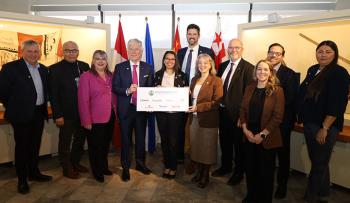
Photo: from the Canada Infrastructure Bank announcement Jan. 21 that equity loans will be provided to First Nation in Nova Scotia and New Brunswick for a new transmission line.
By Sam Laskaris
Local Journalism Initiative Reporter
Windspeaker.com
An agreement enabling First Nations to have an ownership stake in an Atlantic Canada clean energy project was announced on Jan. 21.
At a news conference held at Millbrook First Nation in Nova Scotia, officials from the Canada Infrastructure Bank (CIB) gave details about the $54 million in equity loans provided to strengthen First Nations’ ownership of the Wasoqonatl intertie, a new 345-kilovolt transmission linerunning 160 kilometres and connecting Onslow, Nova Scotia to Salisbury, New Brunswick.
This initiative is expected to be completed in 2028. The Wasoqonatl intertie will boost interprovincial electricity trade and further grid resilience and energy.
The CIB will provide a $36 million loan to the Wskijinu’k Mtmo’taqnuow Agency Limited (WMA), made up of 13 Mi’gmaq First Nations in Nova Scotia. The remaining $18 million loan will go to the Mi’gmaq First Nations in New Brunswick under the Mi’gmaq United Investment Network (MUIN) Transmission Limited Partnership.
“This really is the first time that these two Mi’gmaq groups, one from Nova Scotia and one from New Brunswick, are working together in partnership on a project,” said Hillary Thatcher, CIB’s managing director of investments who also spearheads the bank’s Indigenous relationships. “We hope to see this kind of collaboration happening across other jurisdictions.
“There’s going to be other interties and there’s proposals for them from B.C. to the Yukon, B.C. to Alberta, Saskatchewan (to) Manitoba, Manitoba (to) Nunavut. When you see that kind of collaboration between Indigenous communities, you know it’s just a sign of what’s coming in the future.”
The CIB previously invested $217 million in the Wasoqonatl intertie in March 2025 for construction costs.
“This was a really complex negotiation for the Indigenous communities to take their ownership stake in the project,” Thatcher said. “And so, we worked with patience with the two representative groups for the communities.”
Thatcher is pleased a resolution was found for both First Nations groups.
“It’s really positive,” she said. “And for me, that was a big part of this puzzle, getting both of those groups working together to co-own a major transmission asset. This is the first of its kind in this country and I think that’s really remarkable.”
Thatcher said CIB representatives are optimistic about the project.
“It’s extremely appealing,” she said. “Anything we can do to both reduce the cost of bringing new and clean power to the grids in both New Brunswick and Nova Scotia, but do it in a way with Indigenous communities.”
Thatcher said it is a positive step.
“It makes this project quite unique and just hugely beneficial to the region,” she said.
The CIB is involved with projects across Canada, including in the three northern three territories.
“But in Atlantic Canada we still are dealing with regions that are heavily reliant on fossil fuels and emitting energy sources,” Thatcher said. “And so, as we can start investing in things that will move clean electrons across both jurisdictions, it really helps to reduce greenhouse gas emissions, as well as (increase) affordability.”
WMA president Crystal Nicholas praised details of the project.
“Including Indigenous partners like the WMA and MUIN that represent First Nations communities in Nova Scotia and New Brunswick is a positive step towards environmental stewardship and economic reconciliation,” she said. “As original caretakers of the land, the First Nations people are invested partners in supporting green energy solutions and energy resiliency and are committed to active participation in this project.”
Rebecca Knockwood, the chief of Amlamgog First Nation in New Brunswick, also spoke highly of involvement in the initiative.
“We are proud to partner with our sisters and brothers in Nova Scotia on this project,” she said. “Not only will we work together to ensure the lands and waters in our ancestral territory are protected but we will have the ability to provide training and opportunities for our community members. We would like to thank the federal government for providing us with the ability to be part of this project that is important for the Maritimes.”
Gregor Robertson, the federal minister of housing and infrastructure, believes the CIB’s latest investment will help further economic reconciliation.
“This important investment demonstrates how major infrastructure projects can advance economic reconciliation while delivering real benefits for Canadians,” he said. “By supporting First Nations ownership through Indigenous equity loans, we are helping ensure long-term economic participation for Indigenous communities, greater grid reliability, and more affordable clean power for Nova Scotia and New Brunswick.”
Construction of the transmission line is expected to create about 600 jobs and generate $105 million in Gross Domestic Product.
“We are proud to support meaningful Indigenous reconciliation by enabling First Nations in Nova Scotia and New Brunswick to acquire ownership stakes in critical energy infrastructure,” said CIB’s CEO Ehren Cory. “By increasing our equity investment, we are ensuring ratepayers benefit from $200 million in savings while creating jobs and economic opportunities.”