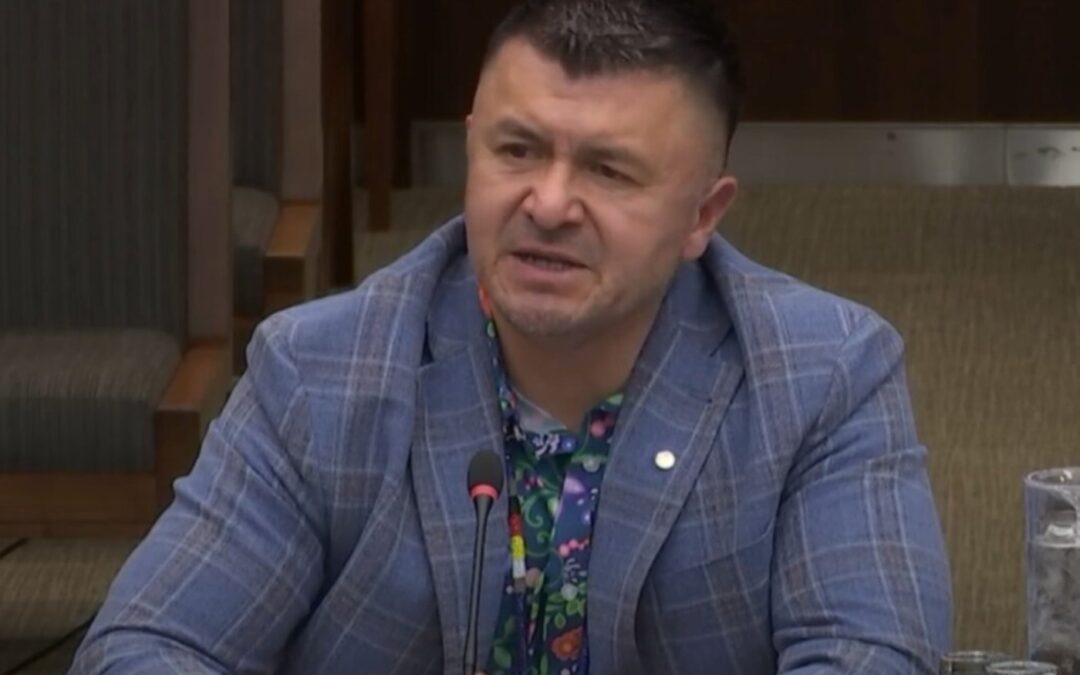
Photo: Eskasoni Chief Leroy Denny is shown speaking to a House of Commons Indigenous and Northern Affairs committee looking into First Nation policing and safety on Oct. 27 in Ottawa. / Rosemary Godin, Local Journalism Initiative Reporter
By Rosemary Godin
Local Journalism Initiative Reporter
Cape Breton Post
In the wake of the deaths of two Indigenous men who were shot within one week by RCMP, Eskasoni chief and council are assuring their community that the chiefs in the Atlantic region will meet to discuss what steps to take to address the well-being and safety of their people.
“These devastating losses have shaken our communities to the core and have caused immense pain, grief, and sorrow for the families, loved ones and all those affected,” wrote Eskasoni Chief Leroy Denny and his council in an open letter.
Denny spoke recently in Ottawa to a House of Commons committee looking at First Nations policing about his concerns with policing in Mi’kmaq communities and pleaded for change.
One of the two recent shootings was in Nova Scotia and five days later, another person was shot and killed by police in New Brunswick.
DARRELL AUGUSTINE
The first incident happened on Jan. 13 in Sipekne’katik First Nation (Shubenacadie) on mainland Nova Scotia. Both shootings are now under investigation by the Serious Incident Response Team (SIRT) in their provinces.
According to the initial RCMP report, on the morning of Jan. 13 this year, Sipekne’katik RCMP received a call related to a disturbance at a residence in Sipekne’katik First Nation.
An adult male, Darrell Augustine, 37, was reported to have a firearm and was threatening others before he left in a car. East Hants District RCMP and the Emergency Response Team also responded.
Officers located the man and deflated the vehicle’s tires with a spike belt, causing the vehicle to leave the road near an intersection with Hwy. 202.
Police say nonlethal options to apprehend Augustine were attempted, and then multiple shots were fired by officers.
Life-saving measures were provided by officers and paramedics. Augustine was pronounced dead at the scene.
According to its own website, “SIRT is responsible for investigating all matters that involve death, serious injury, sexual assault and intimate partner violence or other matters of a public interest that may have arisen from the actions of any police officer, on or off duty, in Nova Scotia or New Brunswick. Investigations are under the direction and control of an independent civilian director, who has the sole authority to determine if charges should be laid at the conclusion of an investigation.”
Augustine was a father of three whose partner died just last October. He was described as a person of good humour who loved music, basketball and powwows.
He was a seasonal fisherman and eeler.
After his death, Sipekne’katik First Nation put out a statement expressing its collective grief and asking for privacy.
BRONSON PAUL
SIRT was also called five days later in New Brunswick on Jan. 18 when RCMP in Neqotkuk (Tobique) First Nation reported a man had died in “a police-involved shooting” in the Maliseet community about 80 kilometres north of Woodstock.
According to a police report, on Jan. 18, 2026, at approximately 5:06 p.m., members from the Perth Andover RCMP detachment responded to a report of a domestic dispute at a residence on Main Street on Neqotkuk First Nation.
The report claims the situation “quickly evolved” and a man armed with an edged weapon advanced towards members.
Police used a taser but it apparently did not have an effect and a Mountie then discharged a firearm. The man, who has been identified as Bronson Paul, 40, was pronounced dead at the hospital.
Neqotkuk Chief Ross Perley and the band council issued a statement last Sunday.
“Currently, we are still determining the circumstances of what unfolded. We know that there was a call to 911. There was no request for assistance from the police to our tribal security members, council or outreach team.”
Perley and council noted that such contacts have helped to de-escalate such scenarios in the past.
“We are unsure why lethal force was used in this case; however, Bronson is another Indigenous man who was killed in the hands of the police,” the band council wrote.
“Therefore, chief and council are immediately closing our RCMP detachment in Neqotkuk until we know that it is safe for our community members.”
At present, if police are called to an emergency, they must be accompanied by a designated member of the community.
Members of Paul’s family are saying on social media that Paul was just getting out of a shower and was naked and unarmed when police shot him. They say his partner and two children, aged seven and eight years, were in the home when he was shot.
“Members of the SIRT team have spoken with Chief Perley and are committed to providing a thorough and transparent investigation,” SIRT wrote in a press release.
Six chiefs of the Wolastoqey Nation (Maliseet) issued a public statement the day after the shooting of Paul. They represent the six communities along the Saint John River valley area.
“Since 2020, four Indigenous people have been killed by police in New Brunswick,” they said.
“Our communities are grieving and outraged after tragic and heartbreaking losses. We grieve the lives lost and hold the families, especially the children, close in our hearts. Everyone must recognize this is a deep-seated issue and call it what it is: systemic racism leading to disproportionate and unnecessary deaths of Indigenous people,”
The chiefs renewed their call for community-based policing in Wolastoqey communities.
That was also the message Eskasoni Chief Denny took to the Senate committee last October.
“Look at the news,” Denny told the committee. “Our people are getting shot.”
He said Indigenous people are reaching out for mental health support and are sometimes hurt physically in the process.
On Tuesday, Denny said the Atlantic Chiefs will meet soon about community policing and recent events.
“We will not stop until a clear, meaningful plan and resolution are established – one that works in the best interests of our Indigenous communities and reflects our inherent rights, lived experiences, and calls for justice.”