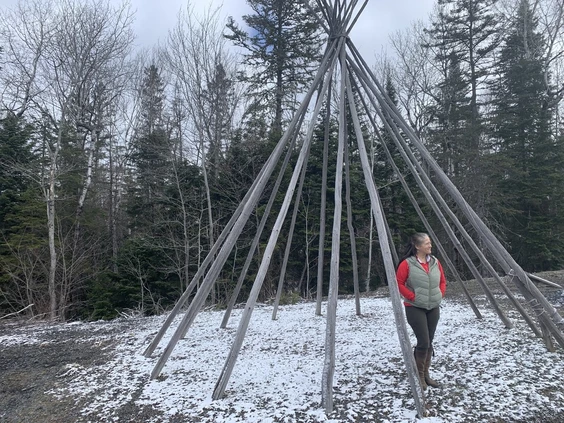
Photo: Patricia Bernard, the chief of Madawaska First Nation, says the Cowichan case in British Columbia will have an influence on the Wolastoqey Nation’s title claim for more than half of New Brunswick’s territory. Photo by John Chilibeck/Brunswick News
By John Chilibeck
Local Journalism Initiative Reporter
The Daily Gleaner
A decision last summer by a British Columbia court to recognize an Indigenous title claim on the lower Fraser River and in the city of Richmond has sent homeowners and business property owners into a panic.
B.C. Premier David Elby has tried to calm fears by telling a business crowd in November he’d “go to the wall” to protect their private property rights.
The NDP leader has pledged to appeal the court decision that was in favour of the Cowichan Tribes. He also says the provincial government will guarantee anyone’s mortgages that could be rejected by banks and other lenders who are worried about rightful property ownership.
The uncertainty the Cowichan victory has created in B.C. sounds a lot like what former New Brunswick premier Blaine Higgs warned could happen in his own province.
When the Wolastoqey Nation launched its own Aboriginal title claim in 2020 for more than half of New Brunswick’s territory on its western side, Higgs blasted the lawsuit, arguing it threatened every homeowner and business in the province.
Close to 400,000 people live in western New Brunswick, many of them homeowners. The Wolastoqiyik, who live in six communities along the St. John River and its tributaries, number fewer than 20,000. They argue the land was stolen from them, and the Crown, or today’s federal and provincial governments, should give it back to them or provide compensation.
The Wolastoqey side told the court they weren’t interested in taking over most people’s private property, calling them “strangers to the claim” in their litigation. Instead, its lawyers focused on the small amount of Crown land remaining in the area and the vast tracts of land owned by timber firms and NB Power.
Patricia Bernard, the chief of Madawaska near Edmundston and a driving force behind the title claim, says big companies like J.D. Irving, Limited, should pay heed to the B.C. decision.
“JDI’s arguments had pretty much been that fee simple private property rights negate Aboriginal title,” she told Brunswick News in early December. “But the Cowichan decision completely crushes this argument. We were quite happy with that decision, and I’m pretty sure the advisors and lawyers on the other side are saying, ‘what? That’s not what we were saying.’ Now, the Cowichan decision will be appealed, obviously, probably all the way to the Supreme Court of Canada.
“And if it sticks, that’s great.” JDI has declined to discuss the case outside of the courtroom.
Bernard was upset by the political reaction in B.C. to the Cowichan victory after 10 years in court, which has largely been negative.
“It’s pretty sad. It reminds me of the fearmongering that Higgs was doing when our title case came out. I can see the replication happening out West. This fear was being brought forward by the municipality of Richmond. It’s scary, but it’s only scary because you just believe that the worst intentions are going to come out. The Cowichan Tribes have said they will work with the city. They’re not planning on purging everyone off that land. It doesn’t make sense.”
The chief argued it was essential for the B.C. government to stop wasting time and negotiate a proper settlement with the Cowichan Tribes if it wants to remove uncertainty for private property owners. Given that the claim has been in the works for a decade, she said B.C. should have acted sooner.
But four days after that interview, New Brunswick’s Court of Appeal delivered a blow to the Wolastoqey case.
Justice Ernest Drapeau, writing on behalf of the three-judge panel, said there was no way private property rights could be taken away because the Crown had improperly granted the Wolastoqiyik’s land. The proper avenue, he suggested, was for the Wolastoqey Nation to pursue a compensation claim from Ottawa and the province.
The Wolastoqey side is now asking the Supreme Court of Canada to hear the case.
Daryl Branscombe was pleased with the New Brunswick decision. As a private property owner, he filed as an intervenor in the case, arguing his company EMS Enterprises, a real estate holding firm, and other land owners were at risk.
He said the Cowichan decision didn’t concern him.
“B.C. is a different province and has a different mindset,” he said in an interview. “I’m quite confident that the decision rendered here was good, and I believe it will reverberate across Canada.”
The Aug. 7 ruling by the B.C. Supreme Court sent shock waves among private property owners near Vancouver.
The Cowichan Tribes on Vancouver Island had argued they had traditionally boated across to the mainland to fish on the Fraser River and camped on Lulu Island that’s now part of the City of Richmond, just south of the city of Vancouver, to fish salmon.
The 730 acres of land, they said, was stolen from them. It is now home to a 179-acre industrial park, two golf courses, berry farms, condominium developments and multimillion-dollar homes.
The ruling had an immediate impact on private property owners. The owners of the Versante Hotel in Richmond said an unnamed buyer had backed out of a deal to purchase the insolvent property after it learned of the decision.
Another business owner, Montrose Properties, thought it had secured a tenant to build a warehouse on a 190,000-square-foot lot in the industrial park just south of Vancouver.
But the deal fell apart, after the tenant expressed dismay over the ruling and the bank that would have loaned the money for the development pulled out.
On Oct. 28, the city of Richmond organized a meeting for property owners to tell them the implications of the court ruling. The hundreds in attendance expressed dismay.
Premier Eby is now promising his NDP government will backstop mortgages in a part of the country where real estate is among the most expensive in the world. Two other First Nations are also appealing, arguing the Cowichan don’t have exclusive title to Lulu Island and the Fraser River.
Still, Branscombe thinks what happens in B.C. does not apply to New Brunswick and says Drapeau’s ruling, which he describes as common sense, will be difficult to appeal.
“I don’t know on what grounds it could be appealed because the ruling is pretty tight. But you never know. And it could be combined with an appeal on the Cowichan decision, but I’m not sure about that. They are slightly behind. In B.C., it was a lower court ruling, so they still have to go through the appeal court to get to the Supreme Court of Canada.”
Nicole O’Byrne, a law professor at the University of New Brunswick who has published papers on Indigenous-state relations, said the Cowichan decision was not binding in New Brunswick because it was heard at the Supreme Court of B.C., which is not that province’s highest court. The Court of Appeal for British Columbia is the final arbiter in that province.
“However, the decision conflicts in important ways from the recent decision issues by the New Brunswick Court of Appeal,” she wrote in an email to Brunswick News.
“In these circumstances, a higher court, in this case the Supreme Court of Canada, may take this into account when determining whether to grant leave to hear the New Brunswick case. In the past, the Supreme Court of Canada has combined Indigenous rights cases to give direction and provide some degree of uniformity across the country.”
There are big differences between the situation in B.C. and New Brunswick. The Cowichan tribes never signed treaties with the British Crown in the 19th century, whereas the Wolastoqey Nation signed the first of several Peace and Friendship treaties 300 years ago.
Those treaties, O’Byrne says, are imbedded in section 35 of the Constitution Act 1982, which would be very difficult to change. They recognize ongoing reciprocal “obligations between the Indigenous and non-Indigenous peoples who live in this territory,” she says.
As such, the professor doesn’t think the provincial government and the Wolastoqey Nation should continue fighting the case in court, arguing it is something that won’t be solved by litigation.
“No matter what a court decides, the governance issues will remain. This is why we have seen in the history of these types of disputes in New Brunswick, and throughout Canada, that whatever a court decides on whatever set of facts, the parties still end up at the negotiating table.”
She said for these reasons, “I strongly advise the parties in this current litigation to abandon the litigation and negotiate resource sharing agreements that benefit all concerned, including the taxpayers of New Brunswick. The focus on litigation and dispute resolution through judicial determinations is costly and ultimately fails to address the underlying and ongoing governance issues involved.”
She says a good guide is the tax-sharing agreements the Frank McKenna Liberal government signed with New Brunswick’s First Nations some 30 years ago. They set aside the complex constitutional issues and provided First Nations with revenue that could be used to directly improve their communities, the academic argues.
“In my opinion, these types of agreements recognized the true spirit and intent of the treaties to share resources and make decisions that respect Indigenous and non-Indigenous interests alike.”
Ken Coates, a Canadian historian who focuses on Aboriginal rights and indigenous claims, said the judge in the Cowichan case, Justice Barbara Young, surprised many people by ruling there was underlying Aboriginal title not just to public or Crown land where the tribes had always wanted a reservation, but to private land too.
“First Nations in New Brunswick have argued the very same thing. You may have given this land to forestry companies. You may have given it to private landowners, but it’s still ours. You haven’t resolved our title.”
Coates said the Cowichan used the land in Richmond for hundreds, if not thousands of years, travelling to Lulu Island seasonally to fish salmon when the run was in. They never gave up the land but were pushed out by settlers. The historian said this was similar to what has happened to the Wolastoqiyik losing their favourite hunting and fishing grounds throughout their territory.
“The Government of Canada, the Government of British Columbia and the Government of New Brunswick have really delayed the reckoning on these issues, really dramatically. They keep waiting and waiting for something to solve this for them.”
Complicating matters, says Coates, are innocent property owners who were granted land that’s now at risk. Because of the uncertainty that’s been created, he believes both cases will end up in the Supreme Court of Canada in the next couple of years.
However, he’s unsure if the two cases will be heard together because the circumstances are different. The Cowichan are after a relatively small but extremely valuable piece of developed land in one of the priciest real estate markets in the world.
The Wolastoqiyik want back vast land, mostly forested, bigger than the size of the Netherlands, where commercial property isn’t nearly as valuable.
“You have to come to some kind of resolution, and this is it,” the professor at the University of Saskatchewan said.
“This is going to come to a head very quickly.”
He said while B.C. has a modern treaty-making process that’s cost hundreds of millions, it has not gone very far in resolving disputes. The western province and New Brunswick should look to the examples set in Yukon, Labrador and northern Quebec for modern treaties that satisfied both sides, the academic said.
For this reason, he thinks the Holt Liberal government that took over from the Higgs Tory regime in October 2024 is taking the right approach by saying it wants to negotiate, rather than litigate title claims.
“You have to negotiate agreements. It’s pretty straightforward,” Coates said. “The only way to get rid of uncertainty is to create certainty. And whether that’s additional lands for Indigenous folks, additional tax revenue for their communities, some sort of revenue-sharing arrangement when resources are taken off the land, that a higher percentage goes to Indigenous communities, there’s a whole package of things that could work.
“Just take a look up North. The best resolutions of these issues are happening in northern Canada.”