
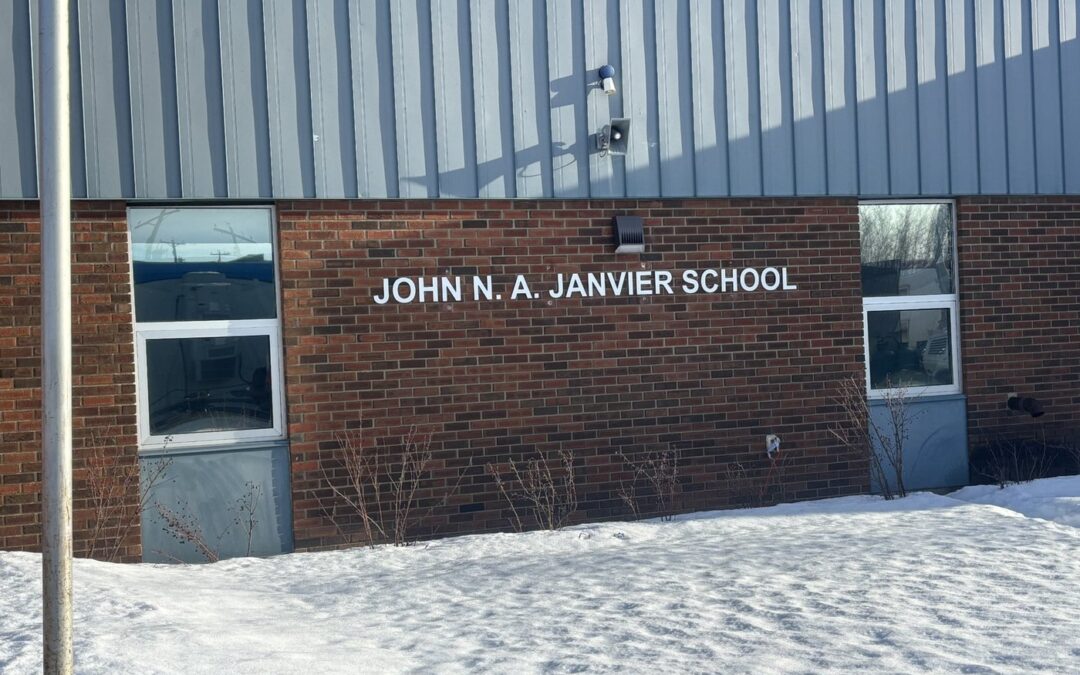
Photo: John N.A. Janvier School on Cold Lake First Nations was shut down in December in 2025 when asbestos was identified. / Chantel Downes, Local Journalism Initiative Reporter
By Chantel Downes
Local Journalism Initiative Reporter
Lakeland This Week
A planned infrastructure upgrade has led to the temporary closure of John N.A. Janvier School, after asbestos was identified during a hazardous materials assessment, prompting both Indigenous Services Canada (ISC) and Cold Lake First Nations to move into mitigation and contingency planning.
ISC confirmed the closure was ordered on Dec. 18, 2025, following the receipt of a testing report. Suzanna Su, speaking for ISC, said, “The presence of asbestos was identified as part of a hazardous materials assessment process conducted in support of a work plan to replace the air handling units in the school.”
Cold Lake First Nations and Indigenous Services Canada are developing temporary measures to support students and staff, including portable classrooms, to allow in-person learning to resume as early as Jan. 14, 2026, while mitigation and repair work continues.
The assessment found no airborne asbestos at the time of testing, but surface contamination was detected in limited areas. “Air sample testing at the school determined that there was no detectable asbestos fibre in the air. However, 12 surface samples were taken, of which two indicated detectable asbestos fibre,” Su explained. “Samples were taken from various surfaces such as classroom floors, staff rooms as well as cabinet and counter tops.”
Despite the air test results, ISC opted to close the building immediately.
“As a precautionary measure, ISC decided to temporarily close the John N.A. Janvier School effective immediately after receipt of the test report on Dec.18,” Su said.
Cold Lake First Nations echoed that the closure is precautionary and emphasized that student and staff safety remains the primary concern.
In a community update, the Nation confirmed the testing results, underscoring that while asbestos fibres were found in surface dust, air testing showed no detectable fibres at the time of sampling.
The Nation advised families that the school will remain closed throughout mitigation and repair work, which is expected to take several months. Repairs will be carried out carefully and methodically to ensure the facility is safe before reopening.
ISC said Cold Lake First Nations leadership has been informed and involved throughout the process. “Chief and Council were made aware of the situation and have been in regular communication with ISC on steps going forward,” Su said.
She added that, “ISC has worked closely with Cold Lake First Nations leadership and the school administration to keep the community, including parents, guardians, and students, informed throughout the process.”
As remediation planning is underway, timelines have not yet been finalized.
“Mitigation work to undertake repairs is expected to start as soon as possible,” Su said. “ISC officials are working with the Nation and John N.A. Janvier School administrators to review the situation and create a work plan to implement repairs as efficiently, safely and quickly as possible.”
ISC acknowledged the scope of work could extend over several months.
“Abatement may take a few months, and more information will become available once the detailed work plan is finalized,” Su said, adding, “A detailed work plan is in progress. Timelines will not be clearly defined until contractors are in place and required materials are acquired.”
Both ISC and Cold Lake First Nations acknowledged in their statements the emotional toll the closure may have on families. ISC highlighted the availability of the Hope for Wellness Help Line for immediate emotional and crisis support, while the Nation thanked families and staff for their patience and cooperation as the situation is addressed.
ISC reiterated its commitment to student well-being.
“Education is critical to the success of First Nations youth. Indigenous Services Canada (ISC) is committed to ensuring that students and educational staff can learn and work in a safe environment,” Su said.