By Shari Narine
Local Journalism Initiative Reporter
Windspeaker.com
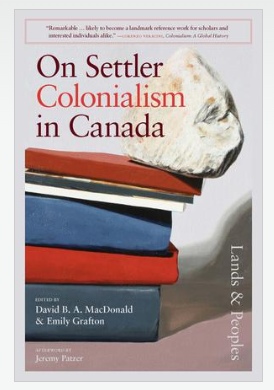
Settler colonialism and genocide against Indigenous people continue today, contend numerous contributors to On Settler Colonialism in Canada.
“I think it is a shock…and it is this moment of clarity,” said Emily Grafton of those claims.
Grafton, who is Métis, co-edited with David B. A. MacDonald the collection of 20 submissions to the book. MacDonald is Indo-Trinidadian and Scottish settler.
Contributing writers are Indigenous, as well as White, Black, Asian, South Asian and Jewish settlers. They all bring unique perspectives to the subject matter.
Settler colonialism as “a structure and not an event” is a statement put forward by scholar Patrick Wolfe in 2006, and a concept drawn on repeatedly by contributors.
“What Patrick Wolfe does…(is) he offers this moment for people to pivot their thinking around colonialism being in the past, and all of these things that we call legacies being in the past, and he points people’s focus and attention to today and tomorrow,” said Grafton.
Grafton also points out that these structures are “connected” to ongoing genocide of Indigenous people.
Structures include prisons, which see a high number of Indigenous people incarcerated; police welfare checks, which resulted in the deaths of three Indigenous people in 2020 during COVID-19; hospital stays that result in deaths (Joyce Echaquan [2020] in Joliette hospital, and Brian Sinclair [2008] in Winnipeg Health Sciences Centre); racialized policing including Starlight Tours in Saskatchewan (resulting in the deaths of Neil Stonechild [1990] and Rodney Naistus and Lawrence Wegner [2000]).
For non-Indigenous people, looking at colonialism as a structure and not an event presents “a shift in thinking…in analyzing the Canada that’s around them,” said Grafton. But for Indigenous people “it’s naming a concept that they’re aware of. Now they have…a concrete term to put around it.”
On Settler Colonialism in Canada is an unsettling read and that’s something that contributors, including Chris Lindgren and Michelle Stewart, encourage. The pair, Lindgren, who is Neil Stonechild’s brother and a Sixties Scoop survivor, and Stewart, a settler scholar, co-write the chapter “Reckoning and Unreconciled: Neil Stonechild, Starlight Tours, and Racialized Policing in the Settler State.”
“For the settlers, take care and read slowly and with intention. A key part of your privilege is being able to opt in and out of discussions or engagement. Please check that privilege…Take time to read and become unsettled,” write Lindgren and Stewart.
“Settlers being implicated and being complicit in colonialism…that might make people feel uncomfortable,” said Grafton.
In the chapter “Being and Knowing Home,” British Columbian Joyce Green, who is Ktunaxa and Cree-Scots Métis, writes, “Colonialism begins with land theft and imposition of alien and racist priorities, laws and policies. Here on Turtle Island, and on ?amak?is Ktunaxa, colonialism has never ended.”
As Canadian Prime Minister Mark Carney pushes toward “nation-building projects” in Canada’s fight against the United States’ tariffs, the mining of critical minerals and his willingness to lay a pipeline in traditional First Nations territories are promoted with little to no consultation with impacted First Nations. Potential court action by First Nations and Indigenous groups to fight such action has the possibility of creating anti-Indigenous sentiment with some settlers.
It’s critical, says Grafton, that settler populations “keep in mind that centrality of inherent rights as first and foremost, existing long before any imagined Canadian state. So, (inherent rights) ought to be uplifted by the Canadian state. They ought to be respected. They ought to be protected when it comes to creating these kinds of projects.”
Already Coastal First Nations president Marilyn Slett has called Canada’s lack of consultation on a pipeline that is supposed to carry oil from Alberta to B.C.’s north coast “not honourable and is fundamentally at odds with Canada’s constitutional, legislative and international obligations to Coastal First Nations.”
Last week Canada signed a memorandum of understanding with Alberta that furthers potential development of a bitumen pipeline.
Grafton and MacDonald write that their work is “genocide aware in that we recognize that genocide against Indigenous Peoples has taken place in the creation and maintenance of Canada as a settler state.”
In the chapter “B’Chol Dor v’Dor: In Each and Every Generation,” Canadian Jews Bernie Farber and Len Rudner discuss the Holocaust, genocide and antisemitism.
“But if we can honestly look at the effect of the residential schools on Indigenous Peoples in Canada, we as settlers can perhaps finally understand that it is not necessary for the schools to be presented or understood as concentration camps for us to see them as genocidal,” write Farber and Rudner.
The release of On Settler Colonialism in Canada: Lands and People coincides with the 10th anniversary of the final report from the Truth and Reconciliation Commission on Indian residential schools. The second volume of this collection of essays, On Settler Colonialism in Canada: Relations and Resistance, will be released in May 2026 which marks the 30th anniversary of the landmark Royal Commission on Aboriginal Peoples.
“Those two commissions, as well as the National Inquiry on (Missing and Murdered Indigenous Women and Girls), are just some things that haven’t necessarily moved the needle on settler-Indigenous relations. So drawing some more attention to that, I think it’s really important,” said Grafton.
“That’s not to say that folks haven’t done that work, but the work needs to be ongoing. We need to pull more people into that work, and it needs to not get forgotten,” she added. “I think that Canada has potential when it comes to reconciliation and decolonialism, and to really step into that potential, we have a lot of work to do here.”
On Settler Colonialism in Canada: Lands and People is published by the University of Regina Press and can be ordered at https://uofrpress.ca/Books/O/On-Settler-Colonialism-in-Canada-Lands-and-Peoples
Windspeaker.com