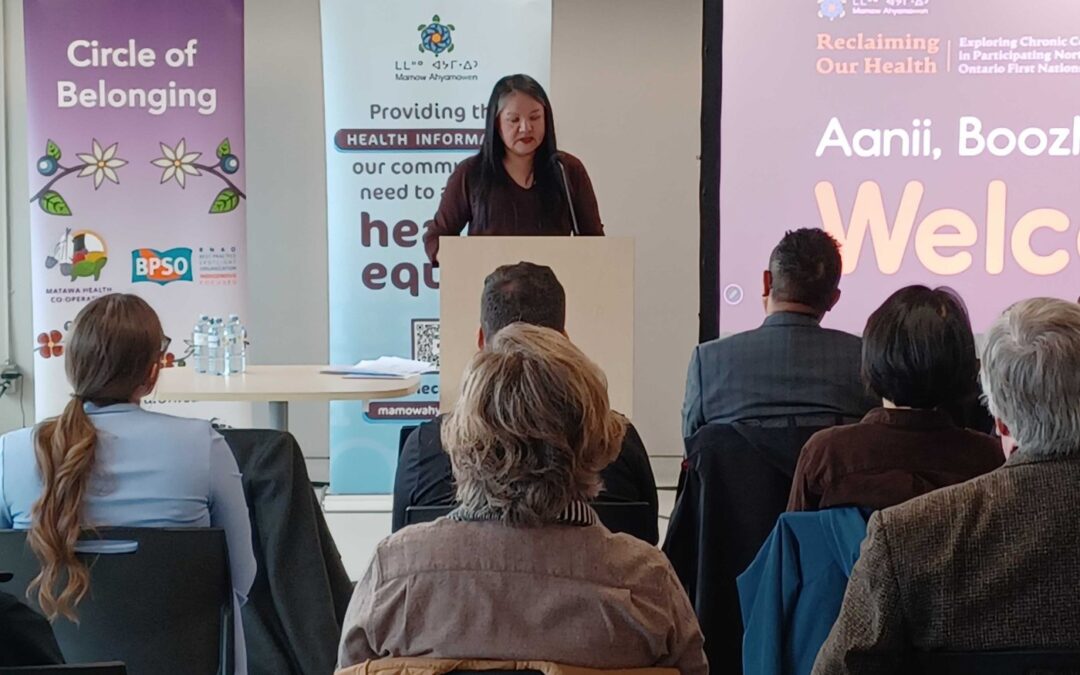
Photo: Sharon Nate of Matawa First Nations Management speaks during a media event for the release of Reclaing Our Health, a report on chronic conditions in northern First Nations, on Nov. 19, 2026, in Thunder Bay. / Mike Stimpson, Local Journalism Initiative Reporter
By Mike Stimpson
Local Journalism Initiative Reporter
SNnewswatch.com
A new report gives First Nations hard data on chronic health conditions in their communities, and Sharon Nate says that could make a big difference.
Nate, chief executive officer of Matawa First Nations Management, said Thursday she expects the data presented in Reclaiming Our Health: Exploring Chronic Conditions in Participating Northern Ontario First Nations will “make huge impacts” in infrastructure, programming and outpatient support.
Reclaiming Our Health reports data on chronic conditions in 70 First Nations across northern Ontario. It was released Tuesday by Mamow Ahyamowen (“everyone’s voices”), an alliance of 11 First Nations health and social services organizations serving 70 First Nations.
“First Nations having ownership over this data gives them strength and also support in moving forward when negotiating and working with the provincial and federal governments,” Nate said in an interview after the report’s release.
“And also it will give us the opportunity as First Nations to actually change the narrative on how non-insured and (other) health services are being provided to our First Nations.”
“We hope it’ll be incredibly useful,” said Maureen Gustafson, a knowledge translation and exchange specialist for Mamow Ahyamowen.
Data from the alliance’s 2020 study on mortality was used in three ways, she said.
It helped organizations “strengthen funding applications” and improve their program planning and evaluation, she said.
Plus, she added, there were improvements in “kind of a catch-all category for the unique ways that communities and organizations use data to meet their needs.
“So for example, one of the organizations (in) the alliance has told us that they use that data in their orientation for new staff and volunteers.”
The new report has data on the occurrence of 22 chronic conditions in 70 First Nations from 2003 to 2022, and how that compares with provincewide data.
Mood and anxiety disorders, substance use disorder and other mental health conditions were among the most common conditions recorded in the Mamow Ahyamowen study.
The report also says some chronic conditions, including pancreatitis and rheumatoid arthritis, are much more common in the communities studied than in Ontario overall.
Nishnawbe Aski Grand Chief Alvin Fiddler said the report is “important work, and we cannot allow this to become just another report that will be shelved in some bureaucrat’s office in Toronto or Ottawa.”
“As you read this report, we encourage you to keep in mind that behind each number is a person,” the Mamow Ahyamowen steering committee writes in its introduction to the report.
“They are children, cousins, parents, grandparents, aunties, uncles, friends, and community members. We see this report as one step in the journey to reclaim the wellbeing that our people have always known.”
Data in Reclaiming Our Health was compiled from administrative records of doctor and hospital visits in the communities.
A news release from Mamow Ahyamowen said the next phase of the health data project will look at community members living with more than one chronic condition at a time, and how those individuals use health services.