
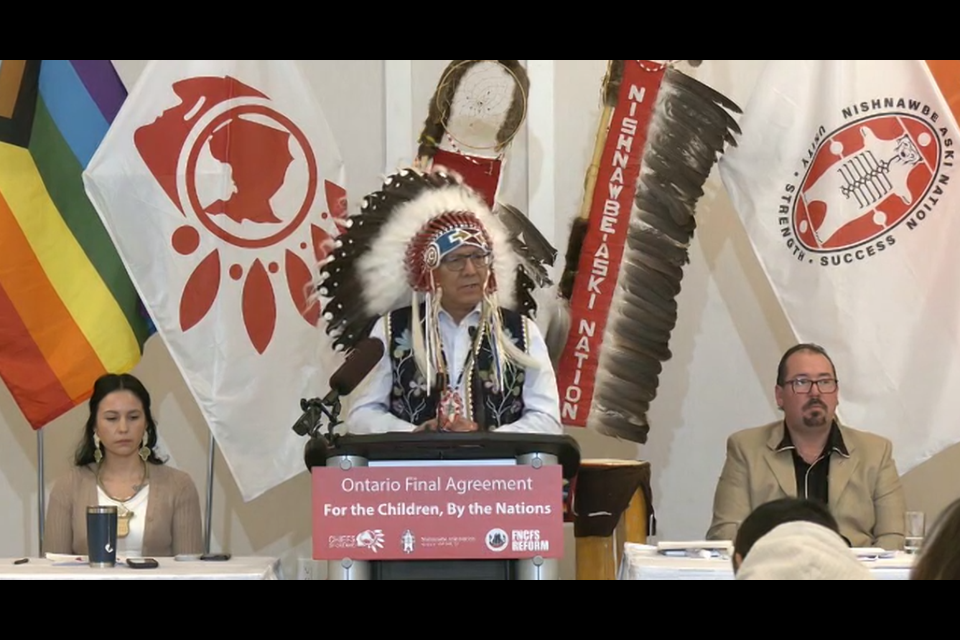
Photo: File photo of NAN Grand Chief Alvin Fiddler
By Maya Ekman
Local Journalism Initiative Reporter
NWOnewswatch.com
Chiefs are questioning how economic and resource development is happening on the doorsteps of First Nations communities when they’re facing challenges from unsafe drinking water and depleted infrastructure to barriers in accessing health care and high youth suicide rates.
Last month’s First Nations-First Ministers’ meeting heard many conversations between the First Nation chiefs that attended and Prime Minister Mark Carney as well as provincial leaders about these topics.
One of these conversations included Nishnawbe Aski Nation Grand Chief Alvin Fiddler addressing the prime minister about a letter he sent more than a year ago, asking Carney to meet with NAN leadership.
Fiddler said he still hopes the federal government will honour their request to meet.
The grand chief’s address to the prime minister was provided as a statement in a news release.
“Forty per cent of boil water advisories nationally, and 60 per cent provincially are in our communities. Our communities face these pressures while losing young people to addictions and suicide, and while trying to address the impacts of climate change, as we saw this summer with forest fires and evacuations,” Fiddler said.
“They are trying to navigate systems that are supposed to be there for them, like health care,” Fiddler continued, and referenced the recent death of Miranda Mamakwa who was part of the Non-Insured Health Benefits (NIHB) program.
NIHB and boil-water advisories are just a few on a long list of challenges that “communities are navigating while dealing with pressure to open up their lands and territories,” Fiddler said.
“How can you expect a community like Marten Falls to effectively negotiate a meaningful agreement while trying to access clean water for themselves? They have been on the boil water advisory list since 2004,” he explained.
In an emailed response to Newswatch, Indigenous Services Canada (ISC) said that they know there is more work to be done, and that they’ll continue to work with Grand Chief Fiddler and other leadership “to support community-led solutions.”
Spokesperson for ISC, Eric Head, said that they invest in and support projects to improve unsafe drinking water in First Nations, referencing their Marten Falls file on their website.
Chief Bruce Achneepineskum of Marten Falls First Nation told Newswatch that while they’re actively negotiating with the province, “Treaty #9 was signed with Ontario and Canada, so I think one party is missing at the table.”
“We’ve been saying for quite some time that any development should include Canada and frankly they’ve been absent at the table in terms of providing support to our First Nation and our neighboring First Nations that are going to be affected by the Ring of Fire,” he said.
According to Achneepineskum, “investments have to go into communities if we’re going to be part of the overall economic picture regarding development in our territories.”
A new relationship being sought in the First Nations-First Ministers’ meeting is “fine,” he said, but it has to be action rather than words.
Fiddler’s message toward the end of his speech read that “our treaties should not be seen as obstacles to your economic agenda. They should be viewed as the foundation of our relationship.”
ISC’s spokesperson said that the federal government is committed to the treaty relationship and will “uphold the legal and constitutional duty to consult and, where appropriate, accommodate Indigenous Peoples where proposed conduct may affect Aboriginal or treaty rights.”
Head directed questions about the Ring of Fire and consultations with Indigenous groups to Natural Resources Canada or the Impact Assessment Agency of Canada, as it is their responsibility to fulfill consultation obligations.
“Canada is also engaged in self-government negotiations with NAN toward a final self-government agreement that will restore the participating First Nations’ control over their own education system,” he continued.
“A final education self-government agreement will help ensure that students in the participating First Nations have the tools they need to succeed and thrive, remaining proudly connected to their culture and language.”
In response to the additional challenges affecting Indigenous peoples as mentioned by Fiddler including mental health and the death of Miranda Mamakwa, Head listed some of ISC’s efforts to address these issues.
Through the Mental Wellness Program, they are providing $141.9 million in 2026 and 2027 for programs and services unique to each First Nation. They also provide funding for 11 treatment centres for Ontario First Nations through the program with the goal of culturally-sensitive treatment for the opioid crisis, said Head.
ISC is also working on a comprehensive patient safety review on the circumstances that led to Mamakwa’s inability to secure transportation to follow-up appointments following a surgery, according to Head. They have previously told Newswatch that they will fully comply should police investigate the death.