
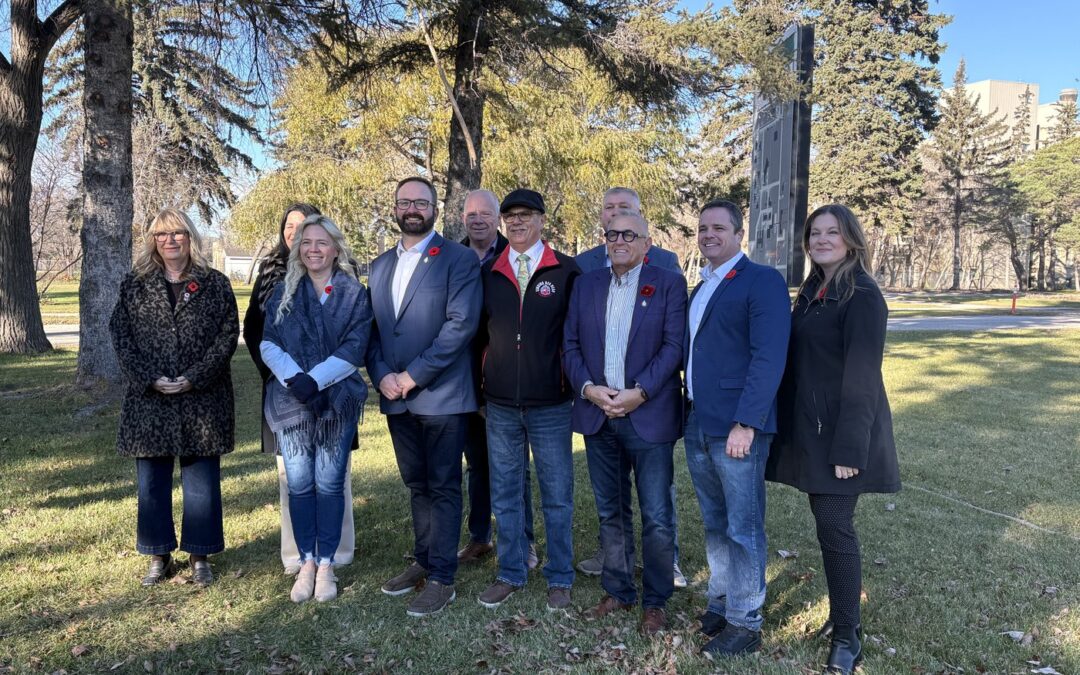
Photo: PC members with Joseph Fourre after the announcement at the former MDC.
By Renee Lilley
Local Journalism Initiative Reporter
Portage Graphic Leader
The former Manitoba Developmental Centre (MDC) in Portage la Prairie could become Manitoba’s first large-scale addictions recovery campus under a proposal from the Progressive Conservative Party, with supporters emphasizing the need to put recovery and mental health ahead of political differences.
PC interim leader Konrad Narth and Portage la Prairie MLA Jeff Bereza announced the proposal Monday, Nov. 9, alongside addiction recovery advocate Joseph Fourre, founder of the Singing Red Bear Foundation.
The proposed campus would transform the former provincial institution into a treatment and recovery centre offering support to Manitobans struggling with substance use disorders, mental health challenges and the long-term effects of addiction.
Bereza said the project would move forward if the Progressive Conservatives form government following the next provincial election.
“A Progressive Conservative government, elected in the next election, will make this the first recovery campus in Manitoba, and one of the premier facilities in Canada,” Bereza said.
While the proposal comes from the opposition party, speakers at the announcement stressed the importance of addressing addictions as a broader humanitarian issue rather than solely a political debate.
Fourre, a Red River Métis man who has been in recovery for more than seven years, shared his personal experience of struggling with addiction for four decades.
He described using numerous substances before becoming addicted to heroin and crystal methamphetamine, experiencing multiple overdoses and living on the streets.
At the height of his addiction, Fourre said he had lost hope until his daughter reached out and asked him to return home so he could walk her down the aisle at her wedding, no matter the condition he was in.
Despite his willingness to seek treatment, he said detoxification services were unavailable when he returned to Manitoba, while treatment waiting lists stretched for months.
With support from his family, he went through withdrawal without medical assistance and began his recovery.
“No family should have to endure the detox process they witnessed,” Fourre said.
His family later experienced another devastating loss when his son, Harlan, died from fentanyl poisoning in 2023 after taking what Fourre described as a recreational drug contaminated with the substance.
“He wasn’t an addict. Just made a bad choice,” Fourre said.
The loss continues to affect his family, particularly during holidays and celebrations.
Fourre said the proposed recovery campus could provide an opportunity for people who want treatment but cannot access it quickly enough.
“When the window opens for someone wanting treatment, we need to be ready,” he said. “Because that window closes quickly.”
Fourre also criticized supervised consumption sites, arguing that preventing fatal overdoses without providing sufficient access to recovery services does not address the underlying addiction.
Supervised consumption services are intended to reduce overdose deaths and other health risks, while treatment and recovery programs address different aspects of substance use. The approaches are not necessarily mutually exclusive.
Fourre believes Manitoba needs a stronger recovery-focused system that allows individuals to access treatment when they are ready.
His organization, the Singing Red Bear Foundation, advocates for people and families affected by addiction. Fourre also noted the recovery site proposed could also include various aspects of support such as land-based learning, cultural supports, but also religious or Alcoholics Anonymous-type 12-step programs.
“The main purpose is getting in, getting stabilized,” said Fourre. “We wouldn’t be excluding any opportunities that would be working. We would give them the safe space to do that.”
Concerns about the availability of treatment were also raised by Winnipeg residents who travelled to Portage la Prairie for the announcement.
Tanya, who has lived in Winnipeg’s East Exchange neighbourhood for 10 years, said she has witnessed increasing homelessness, open drug use and public safety concerns in her community.
She said residents began discussing the issue after learning about plans for a supervised consumption site in their area.
Despite the concentration of social services downtown, Tanya questioned why so many people continue to struggle without stable housing or access to treatment.
“I’m just a citizen, and I think all of us are asking that question. Is it helping?” she said.
Tanya said she regularly encounters people appearing to be in medical distress along downtown streets and walking paths. She worries residents are increasingly being expected to recognize overdoses and respond to emergencies without adequate support.
She also questioned whether enough is being done to connect people using harm-reduction services with medical assessments, addiction treatment, and housing.
“How are you protecting the people within the facility that you’re using? How are you protecting the people that live around it? What’s the plan?” she asked.
Although critical of the current approach, Tanya said her concerns come from witnessing people in distress rather than a lack of compassion for those experiencing addiction.
She believes people need opportunities to stabilize their lives in environments where treatment, housing and other supports are available.
In Portage la Prairie, Bereza said the former MDC property presents an opportunity to develop those services on a significant scale.
The facility, which closed in 2023, was once among the city’s largest employers and housed people with intellectual disabilities for generations.
Bereza acknowledged the site’s history while pointing to the possibility of giving the property a new purpose.
He said the province has spent years considering expressions of interest for the vacant facility, but believes its existing infrastructure could support a comprehensive recovery campus.
“We need a campus that encompasses a place where people at different stages of their drug addiction can all get help,” Bereza said.
The proposed campus could also create employment opportunities in health care, food services, education, maintenance and skilled trades.
Speakers suggested the site could incorporate vocational training and workshops, allowing residents to develop practical skills while rebuilding their lives.
Bereza pointed to the Bruce Oake Recovery Centre in Winnipeg as an example of how people who have completed treatment can eventually help others experiencing addiction.
He said a similar model could help establish a supportive community within the former MDC grounds.
The announcement also drew comments from Portage resident David Panko, who spoke about the impact addiction has had on his family and the difficulties loved ones face when attempting to access treatment.
Panko described family members struggling with addiction and long waits for available treatment spaces.
Bereza thanked Panko and the Winnipeg residents for speaking publicly about their experiences.
“We need to do better. It’s our job to do better,” Bereza said.
Although the proposal has been announced, the Progressive Conservatives have not committed to beginning construction under the current government. Bereza confirmed the plan is contingent on the party winning the next provincial election, though both Bereza and Narth hope the current NDP would “steal their idea” and immediately green light the plan.
He said the City of Portage la Prairie has been made aware of the proposal, although no formal municipal agreement was announced. City officials attended the announcement on the MDC grounds.
For Fourre, the urgency extends beyond elections and political platforms.
He said people experiencing addiction need to know recovery remains possible and that support will be available when they seek it.
“Their lives matter. Help is there. They shouldn’t give up that hope,” he said. “I know what it’s like to suffer with addiction. I know what it’s like to be lost, but I also know what it’s like when people have compassion, care, and invest in me. Today, I’m successful. I work in the film industry, I’m advocating, and I’m happily married. It was a complete transformation.”
The NDP government did not reply to a request for comment before publication deadlines.