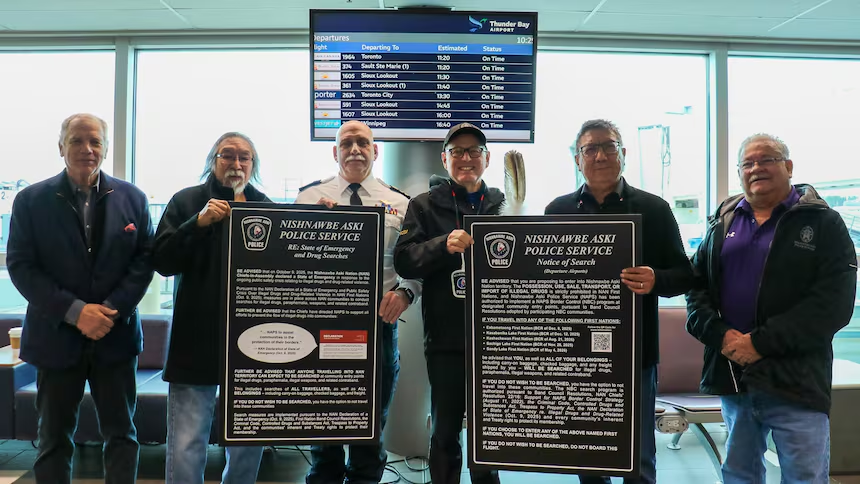
Photo: The Nishnawbe Aski Police Service (NAPS) border control pilot program was officially launched on Monday at the Thunder Bay International Airport in northern Ontario. (Nishnawbe Aski Nation/Facebook)
By Carl Clutchey
Local Journalism Initiative Reporter
The Chronicle-Journal
A pilot project aiming to weed out illegal drugs entering five remote Indigenous communities north of Thunder Bay by air rolled out this week, with passengers firmly put on notice that they will be subject to searches upon arrival.
“If you wish to enter (a) community, be aware that you will be searched,” a joint news release between Nishnawbe Aski Nation (NAN) and Nishnawbe Aski Police Service (NAPS) emphasized this week.
The news release added: “Notice of search has been extensively publicized at connecting airports, community entry points, and inside each of the pilot communities.”
Known as the NAPS Border Control (NBC), the program was conceived by NAN officials four years ago in response to an “escalating drug crisis” in the remote North.
The five First Nation communities participating in the border control project are: Eabametoong, Kasabonika, Kashechewan, Sachigo Lake and Sandy Lake.
Searches to take place upon landing in the respective communities are to be overseen by NAPS special constables.
Special constables “know their communities and its people, and have a vested interest in helping to maintain its safety and security,” NAPS board chair Frank McKay said in the news release.
If contraband is found, NAPS officers may seize illegal drugs, make arrests, lay charges or eject “trespassers,” the news release said.
It adds: “Anyone who does not wish to be searched has the option to return to their departure point.”Nishnawbe Aski Nation Grand Chief Alvin Fiddler called the border control program rollout “a step in the right direction.”
Fiddler said border control in remote communities should go beyond a pilot project.
“It should be standard,” he said. “Every First Nation in NAN deserves this protection.”
Meanwhile, a NAN spokesman said the agency continues to advocate for additional services to help those in remote communities combat drug addiction, which remains “a very complex issue.”
“I think it is safe to say there is never enough support,” the spokesman said. “We have advocated on this for years.”