
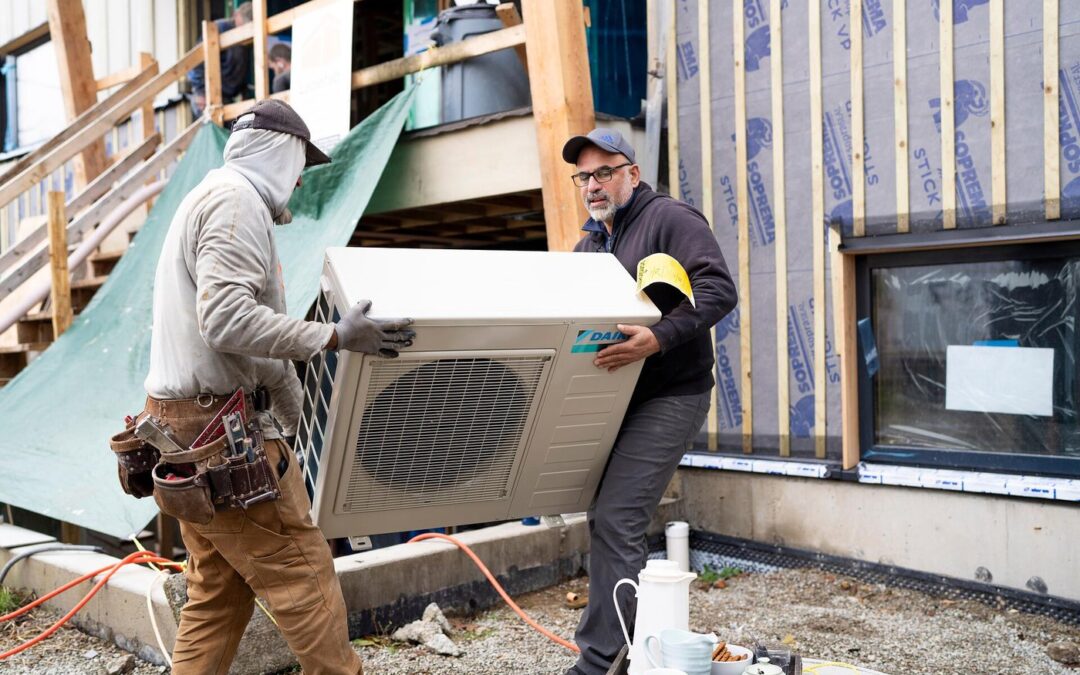
Photo: Chan Virk and Manj Bhandal carry a heat pump to be installed at a house in Vancouver. / File photo by Jimmy Jeong / The National Observer
By Sonal Gupta
Local Journalism Initiative Reporter
Canada’s National Observer
A new federal rebate meant to make home heating cheaper and cleaner could have an unintended consequence in Saskatoon: higher electricity bills for homeowners and, in some cases, more greenhouse gas emissions.
“We do recommend heat pumps as part of the solution, but we also caution that they can lead to even higher emissions in some cases,” Amber Weckworth, Saskatoon’s climate manager, told Canada’s National Observer Wednesday.
Prime Minister Mark Carney’s government recently announced a $2-billion investment to support home energy upgrades across Canada, including heat pump rebates of up to $10,000 for eligible households below the median income, and $2,000 for other eligible homeowners.
Heat pumps use electricity to move heat into a home in winter and out of it in summer, providing both heating and air conditioning. The rebate lowers the cost of buying the equipment, but the true value of energy savings across the lifetime of the device depends on what the heat pump replaces.
The federal government estimates households replacing oil, propane or electric baseboard heating could save an average of more than $1,400 annually.
That estimate does not cover homes switching from natural gas — and in Saskatoon, about 83 per cent households are heated primarily with natural gas or propane. But because Saskatchewan’s electricity grid relies heavily on coal and natural gas generation, the environmental efficiency of heat pumps is lower there than it is in Quebec or British Columbia, which produce most of their power through hydroelectricity. Depending on the heat pump’s efficiency and how it is used, the carbon emissions involved in running it in Saskatoon can exceed those from heating the same home with a gas furnace, Weckworth said.
Right now, buildings account for about 61 per cent of Saskatoon’s greenhouse gas emissions, according to the latest city figures.
However, that math could change over time as Saskatchewan’s electricity grid gets cleaner, Weckworth said. Installing a heat pump now, sized for the home and used alongside a furnace, could prepare homeowners for that shift. “It’s just not a one and done type of initiative,” she said.
Efficiency upgrades
Nearly four in five Saskatoon homes are older — built before the city’s mid-2000s real estate boom. An energy assessment can help homeowners identify which improvements would save the most money and should come first, Weckworth said.
Saskatoon’s Home Energy Loan Program lets residents borrow for insulation, windows, heat pumps and solar panels, then repay the city through their property taxes. Borrowers must have their homes assessed, and the program offers a $1,000 rebate to help cover that cost, she said.
The city has also introduced a Commercial Energy Loan Program for larger buildings, including apartment buildings and commercial properties. Like the homeowner program, it finances improvements such as insulation, heat pumps and solar panels, with owners repaying the city through their property taxes, Weckworth said.
Residents can also use the city’s online Home Energy Map to estimate upgrade costs and savings before paying for an assessment.
Homeowners should expect to keep their gas furnaces as part of their heating systems, Weckworth said. Running a heat pump extensively, particularly in very cold weather when it needs more electricity to keep a house warm, could increase electricity bills.
Weckworth said homeowners should consider a heat pump alongside improvements such as installing insulation and sealing gaps that let heated air escape. Otherwise, they could spend thousands on new equipment without addressing where their homes are losing heat.
She expects the strongest interest for new heat pumps to come from homeowners replacing older air conditioners. “I expect that’s probably the biggest area where we’ll see uptake,” she said.
Weckworth expects homeowners may be able to use the federal rebate toward a heat pump while borrowing from the city for other upgrades, but said they should check the federal eligibility requirements.
Saskatoon intends to continue its loan program with municipal funding when its current federal funding arrangement ends in mid-2028, she said.
Greg Poelzer, a political scientist focused on renewable energy at the University of Saskatchewan, said home renovations can also support local economic activity at a time when affordability and trade tensions have dominated public concerns.
“It’s not a nation-building program per se like large infrastructure. But it is in a different way,” Poelzer told Canada’s National Observer in August.
The benefits of individual renovations add up across thousands of homes, he said, but governments need to support programs on a larger scale and sustain them. “They can’t be little pilot projects for a couple of years,” Poelzer said.