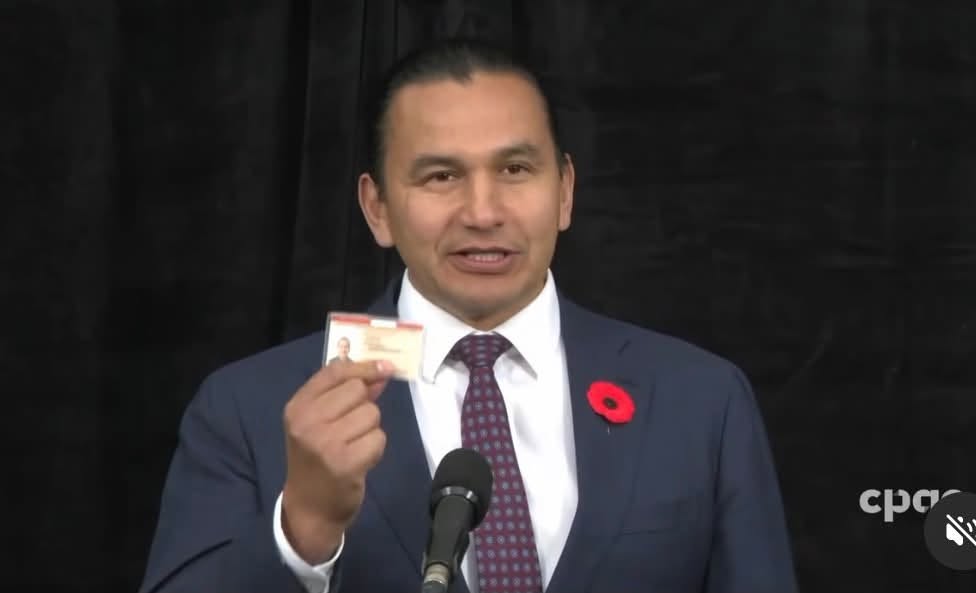
Photo: Manitoba Premiere Wab Kinew holding his status card / CPAC Screenshot
By: Mike Stimpson,
Local Journalism Initiative Reporter
SNnewswatch.com
Manitoba’s premier says the Indian Act should be scrapped, and Kiashke Zaaging Anishinaabek Chief Wilfred King agrees.
“But the issue,” King said in a recent phone interview, “is then what to we replace it with?”
Premier Wab Kinew, who is Anishinaabe from Northwestern Ontario, said last week that “it’s time to abolish the Indian Act.”
Prime Minister Mark Carney told reporters he is open to the idea of scrapping the old statute but details would need to be worked out.
Repeal of the Indian Act is “long overdue,” King said. “It’s an archaic piece of legislation that basically dictates the life of a First Nation person from the day they’re born until they’re dead.”
There have been few significant revisions to the act since Parliament passed it 150 years ago, he noted.
“There are provisions in the act that afford First Nations people some protections, but overall I think it has to be completely repealed and something needs to be in its place.
“But again, we have to determine what is going to replace the Indian Act.”
King said the Indian Act could be replaced by another act of Parliament or “some form of an agreement that First Nations have more jurisdiction and control.”
Canada and its Indigenous Peoples “should be talking about constitutional reform and the issue of inherent rights and rights that are protected under Section 35,” he said.
Section 35 of the Constitution Act, 1982 affirms “existing aboriginal and treaty rights” of First Nations and other Indigenous Peoples in Canada.
King said the “paternalistic” Indian Act should be repealed, but the process of repeal and replacement could take years.
In the meantime, he added, some First Nations “are negotiating self-government agreements. And that’s one way of extricating yourselves from the shackles of the Indian Act — negotiate a self-government agreement or other form of agreement that allows greater autonomy and jurisdiction.”
Critics have long said the Indian Act is outdated, paternalistic and racist.
A research paper presented in 2008 to the National Centre for First Nations Governance, for example, said the statute came out of a colonial view of Canada’s Indigenous Peoples as “incapable of managing their (own) affairs” and needing assimilation.
Kinew hails from Ojibways of Onigaming, a First Nation near Kenora.
Onigaming Chief Jeffrey Copenace said Kinew is on the right track.
“There seems to be a real division, at least on social media,” Copenace said. “But in my conversations with other chiefs, I’ve never heard anyone against repealing the Indian Act.
“My belief is that the Indian Act is really intended to control us and make all our decisions for us.”
Copenace added, however, that there needs to be a process to make sure people are heard before deciding what will replace the legislation.