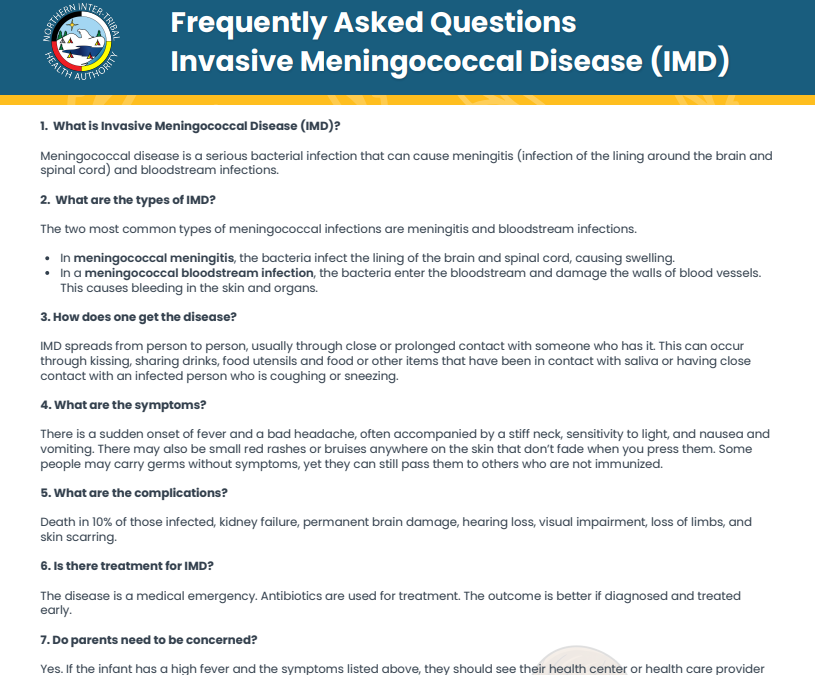
Photo: Screenshot NITHA FAQ on Meningococcal Disease
By Nicole Goldsworthy
Local Journalism Initiative Reporter
SaskToday.ca
The Saskatchewan Health Authority (SHA) is expanding meningococcal immunization efforts as the province continues to experience elevated rates of invasive meningococcal disease (IMD) caused by serogroup W-135, a rare but serious bacterial infection that can rapidly lead to hospitalization and intensive care.
In an interview with SaskToday, Saskatchewan chief medical health officer Dr. Saqib Shahab said the province recorded 16 cases of IMD W-135 in 2025 and 15 cases in 2026 to date, for a total of 31 cases since January 2025. The recent increase follows just two cases reported in 2023 and one in 2024.
Prior to 2025, Saskatchewan typically recorded fewer than five IMD cases of all serogroups annually and fewer than two W-135 cases each year, according to SHA. Since January 2025, the province has reported 31 W-135 cases.
The Saskatchewan Health Authority says the increase reflects the emergence of a newer W-135 strain that has also been observed elsewhere in Western Canada.
While cases have been reported across Saskatchewan, the highest concentrations continue to be identified in the Far North, Regina and southeast Saskatchewan. Additional cases have also been reported in Saskatoon.
The outbreak has not affected all populations equally.
“We have seen an increase not just overall, but especially in Indigenous populations and, within those populations in 2026, particularly among infants and children under five years of age,” Dr. Shahab said.
The Saskatchewan Health Authority confirmed the outbreak has disproportionately affected Indigenous populations, particularly infants and children under the age of five.
According to the Saskatchewan Health Authority’s September immunization bulletin, infants younger than 12 months currently have the highest rates of infection in the province.
Although meningococcal disease is far less common than illnesses such as measles, the SHA stresses it is often much more severe.
Nearly all patients diagnosed with IMD W-135 during the current outbreak have required hospitalization, and some have required treatment in intensive care units, Dr. Shahab said.
Meningococcal disease can progress rapidly, causing symptoms such as fever, headache, vomiting, drowsiness and a sudden deterioration in health over a matter of hours.
The SHA said immediate medical attention should be sought if symptoms develop.
The disease spreads through respiratory droplets and close contact, including coughing, sneezing and sharing items that come into contact with the mouth, such as water bottles, utensils, cigarettes or vaping devices.
The SHA said Saskatchewan already has several meningococcal immunization programs in place.
All children in Saskatchewan are routinely offered a meningococcal vaccine at 12 months of age. In May 2026, Saskatchewan switched its routine 12-month immunization program to the Men-C-ACYW-135 quadrivalent vaccine, which protects against meningococcal serogroups A, C, Y and W-135.
The vaccine is also recommended for individuals with medical conditions that increase their risk of invasive meningococcal disease, including certain immune-suppressing conditions, the SHA said.
In response to the outbreak, Saskatchewan expanded eligibility in September 2026 to provide earlier protection for infants considered at higher risk, according to the SHA.
Under the enhanced program, infants aged six weeks to under 12 months who live in a Saskatchewan First Nations community, travel to a Saskatchewan or Manitoba First Nations community, or receive visitors from those communities may be eligible for one or two additional doses of the quadrivalent meningococcal vaccine before their first birthday.
Infants younger than six months may receive two additional doses, while those between six and 11 months may receive one early dose before receiving their routine immunization at 12 months.
According to the Saskatchewan Health Authority, the targeted response was developed through collaboration between the Saskatchewan Ministry of Health, Saskatchewan Health Authority, Indigenous Services Canada and the Northern Inter-Tribal Health Authority.
Dr. Shahab said Saskatchewan has historically maintained strong meningococcal vaccine uptake, with approximately 85 per cent coverage among children receiving the routine 12-month vaccine and students participating in school immunization programs.
The SHA would like that figure to reach 95 per cent, a level that provides stronger community protection against vaccine-preventable diseases.
Because the updated 12-month vaccine was introduced only a few months ago and expanded infant eligibility began in September, Dr. Shahab said it is too early to determine uptake rates for the new program.
Beyond vaccination, Dr. Shahab encouraged families to limit infants’ exposure to respiratory illnesses, particularly during colder months when people spend more time indoors.
According to the Saskatchewan Health Authority, parents and caregivers should avoid exposing young infants to crowded settings when possible, practise good hand hygiene, cover coughs and sneezes, and avoid sharing drinks, food utensils and other items that come into contact with the mouth.
The Saskatchewan Health Authority says the overall risk to the general public remains low; however, vaccination and early recognition of symptoms remain important tools in preventing serious illness.