
Provincial authorities are investigating a rare wild animal encounter after a contractor sustained non-life-threatening injuries during a wolf attack in a remote northern region of Saskatchewan.
The incident occurred on Saturday, October 17, 2026, along Highway 914.
Following the encounter, the victim traveled to Cameco’s nearby Key Lake mill site to receive medical care.
Officials from Saskatchewan’s Ministry of Community Safety confirmed the victim received treatment and is currently recovering.
According to officials, the Saskatchewan Conservation Officer Service’s Wildlife Human Attack Response Team (WHART) promptly launched an investigation into the attack. Traps were deployed across the area, leading to the capture of the wolf believed to be involved.
“While wolf attacks are rare, the Conservation Officer Service takes incidents involving public safety very seriously,” the Ministry said in a statement.
Following its capture, the animal was euthanized and transported to Prairie Diagnostic Services in Saskatoon, where specialists will perform a necropsy to examine its physical health and determine whether underlying conditions, such as illness or rabies, contributed to the unusual aggression.
Safety Guidelines for Wildlife Encounters
While wolves are common throughout Saskatchewan’s heavily forested northern regions, provincial officials emphasize that they typically avoid interaction with humans. In the wake of the incident, workers, residents, and travelers in northern wilderness areas are urged to practice heightened safety measures:
- Secure Food & Waste: Never leave food, trash, or scraps accessible, as attractants can lure wild animals into human activity zones.
- Maintain Awareness: Stay vigilant of surrounding environment when outdoors or traveling remote highway corridors.
- Do Not Approach: Never attempt to feed, tame, or approach a wild wolf.
If confronted by a wolf in the wild, provincial safety protocols advise:
- Do not run or turn your back on the animal, as running can trigger a predator pursuit response.
- Face the wolf directly and make yourself look as large as possible by raising your arms or holding equipment above your head.
- Back away slowly while maintaining eye contact, ensuring the animal has a clear route to leave the area.
Reporting Incidents
Any sightings of wolves exhibiting aggressive, unusual, or habituated behavior should be reported to the province’s Turn in Poachers and Polluters (TIPP) line at 1-800-667-7561. For immediate threats to life or emergency situations, contact 9-1-1 or local police immediately.
The investigation into the incident remains active.
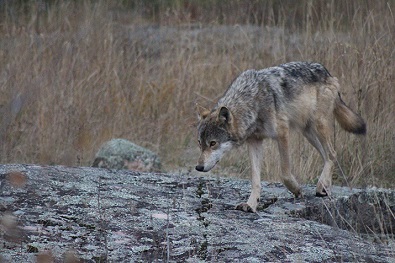
(TOP PHOTO – file photo of a wolf)