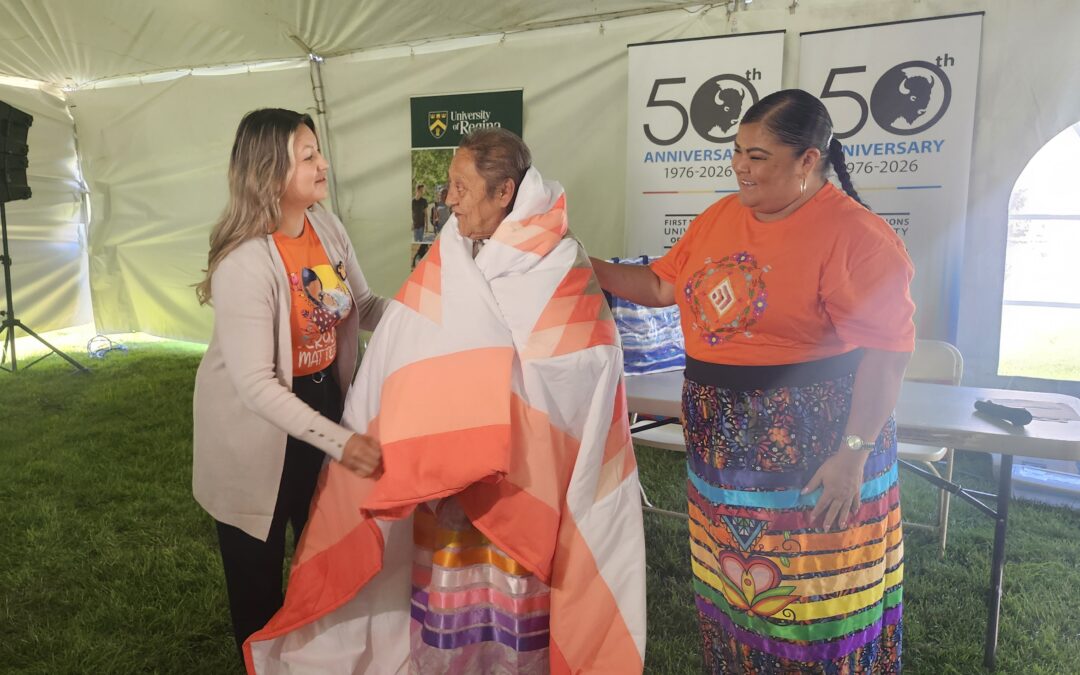
Photo Of: Elder Sharon Strongarm from the Wah-pi-moos-toosis Indian Reserve shared her story of attending a residential school and received this blanket as a gift.
Photo By: Danielle Dufour
The First Nation University of Canada hosted a Truth and Reconciliation ceremony followed by a community smudge walk on Thursday in Regina.
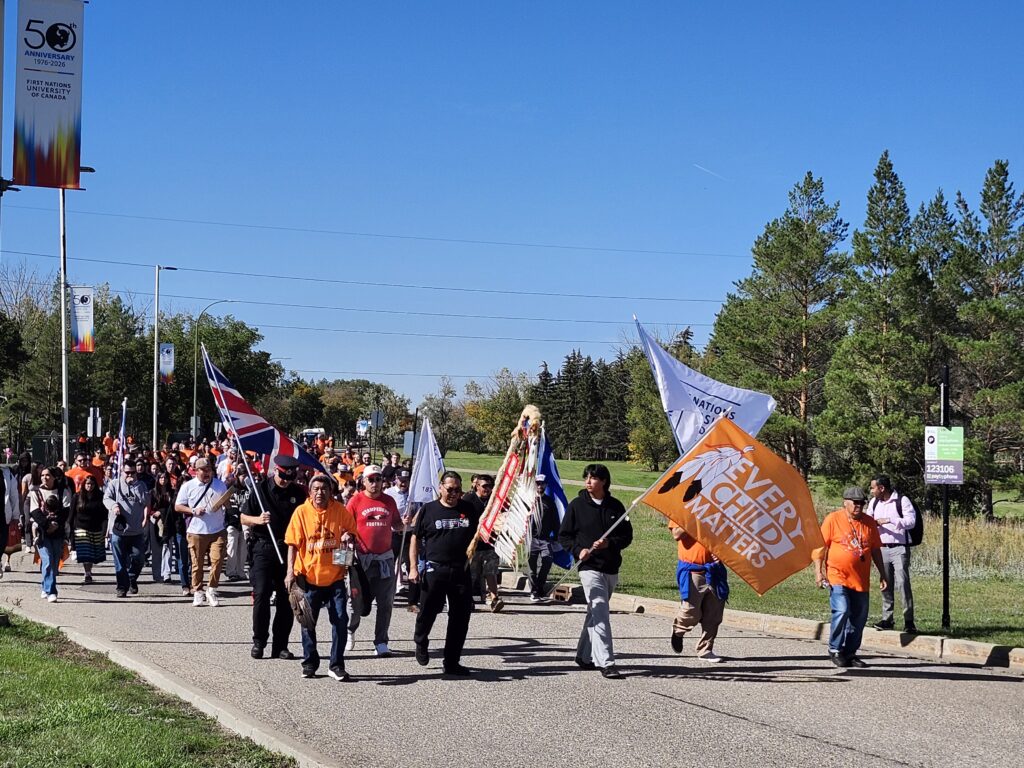
FNUniv Annual Smudge Walk
Photo By: Danielle Dufour
“Today we recognize Indian residential schools and those children that attended those schools,” said Dr. Jacqueline Ottmann President of the First Nations University of Canada (FNUniv). “Children that did not come home.”
“Survivors courageously shared their story so Canada could learn the truth,” said Dr. Ottmann. “In spite of the tremendous suffering they experienced, those survivors hoped for reconciliation, for healing in our communities, for Canadians and the world to learn from an educational policy gone wrong. Their hope was for systemic change.”
Guest speaker Elder Sharon Strongarm, from the Wah-pi-moos-toosis Indian Reserve shared her story of attending a residential school.
“It was a very dark part of my life, I still hurt,” said Strongarm. “I am here and I’m resilient.”
After being taken to the school she found out she wouldn’t see her parents or grandmother for a while and would be living at the school.
“I wondered why they didn’t come and get me or why they left me here,” said Strongarm. “I used to think that our mom didn’t love us, but little did I know they had no choice.”
After a few years, she wondered why the school staff would call the children by numbers rather than their names and said, “Even our clothes were numbered, our beds.”
Although she didn’t want to talk about the other abuse she experienced, she recalled an experience that stood out for her when as a child, she was forced to go to confession.
“We had to go and tell our sins to the father, and we didn’t know any, we didn’t have any sins,” said Strongarm. “What would we be confessing for? We didn’t do nothing so we had to lie and tell the father I did ‘this’ so he could pray with me.”
Strongarm thinks about her brothers and cousins that have gone on to “destroy themselves” because of residential schools and what they went through. “They would come home with burns on their legs or their arms.”
“Most of us were treated ugly, terrible,” said Strongarm. The nuns and the sisters used to call her by saying, “Come little savage” in French. She later understood when she learned the French language.
She thanks the Creator for carrying her through the trauma.
Orange shirts were being distributed to attendees at the event.
Phyllis Webstad, the founder of Orange Shirt Day, is a residential school survivor. While attending St. Joseph’s Mission Residential School, she said, “They stripped me, and took away my clothes, including the orange shirt! I never wore it again. I didn’t understand why they wouldn’t give it back to me, it was mine! The colour orange has always reminded me of that and how my feelings didn’t matter, how no one cared and how I felt like I was worth nothing. All of us little children were crying and no one cared.”
This became the inspiration for Orange Shirt Day, a day of remembrance in Canada, observed on September 30th and encourages Canadians to wear an orange shirt to honor the memory of Indigenous children who were taken from their homes to residential schools. The day has evolved into the National Day for Truth and Reconciliation, a statutory holiday for federal employees, and serves as a platform for education and reconciliation.