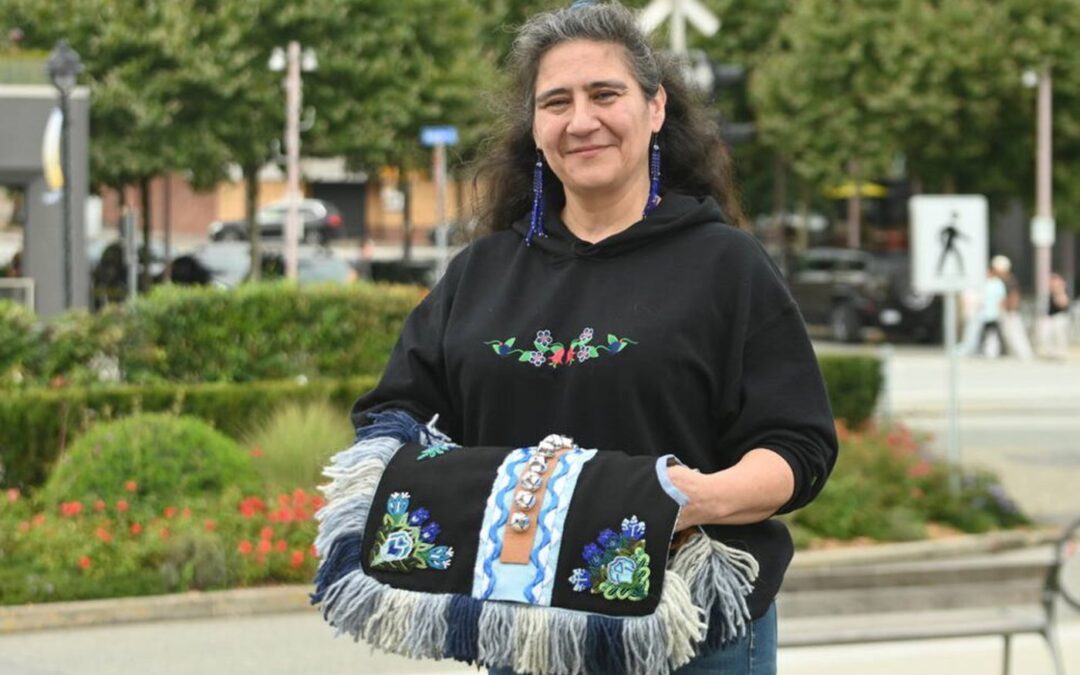
Photo: Adele (ᒪᐢᑿᓱᐤᐏᐢᑵᐤ) Arseneau, a Cree and Métis multidisciplinary artist, holds one of her blankets outside the Ferry Building Gallery in West Vancouver. | Abby Luciano / North Shore News / Abby Luciano, Local Journalism Initiative Reporter
By Abby Luciano
Local Journalism Initiative Reporter
North Shore News
An exhibition in West Vancouver is amplifying an almost lost practice from Northern Indigenous communities – beaded dog sled blankets.
Tāpis: A Love Letter to Our Dog Kin is the latest exhibit at the Ferry Building Gallery, showcasing nine intricate dog blankets crafted by four Indigenous artists.
“It is with great pride to be able to showcase this exhibit,” said Cree and Métis artist Adele (ᒪᐢᑿᓱᐤᐏᐢᑵᐤ) Arseneau. “It has been created to show the beauty and celebration of dog regalia as completed by Michif, Dene and other Nations to celebrate our valued dog kin.”
Tāpis
Originating from Métis, Northern Cree and Dene communities, tāpis are decorated blankets to drape over sled dogs, symbolizing respect.
Also called li tāpis by the French Métis and tuppies by the English and Scottish Métis, the blankets are made from wool, with each one carrying unique details in bead work, silk embroidery, moose or caribou hair tufting and bells.
In the Northern Prairies, the blankets served many purposes. They were used to keep dogs warm, to announce the arrival of a dog team into a village and identify people at a distance, said Arseneau.
“A mile away, you could hear the dog blankets,” she said.
The exhibit is an ongoing effort to revive the blanket tradition and rebuild cultural knowledge, which nearly disappeared due to colonization and the residential school system.
Arseneau began learning about tāpis in 2023 through a mentorship with Velma Olson, a beader of Northern Tutchone, Han and G’wichen descent living in Mayo, a small town in the Yukon.
Learning from Olson, Arseneau spent hours making a blue tāpis with snowflakes and flowers for her late purebred Alaskan Malemute Nīcimos.
“At that point, there were only two people who made dog blankets that I knew of,” Arseneau said.
With a lack of teachers who held knowledge in the practice, Arseneau decided it needed to be revitalized, inspiring her to lead a 20-week online residency. She received a grant to make it possible and taught four Indigenous beaders to create blankets to honour their own pups, sparking the exhibit’s first showing at the Seymour Art Gallery in 2024 and travelling to Fort Smith, Northwest Territories last year.
“I didn’t want people to have to pay for this knowledge, I want to make it accessible,” she said.
Now, the West Vancouver exhibit features a new cohort of Arseneau’s students – Dominique Caron, Danielle Courcelles and Suzan Kostiuk – all crafting their own blanket.
Each blanket took more than 200 hours to complete, Arseneau said, including her own.
Blankets on display
Arseneau has six pieces in the exhibit, including the first one she created in her mentorship. The blanket, Flowers for Nīcimos, was inspired by her Métis background and the history of Indigenous dogs.
In May 1885, Arseneau’s great-great grandmother had to dispatch her team of dogs to ensure the safety of the women with her during the occupation of Batoche.
Often mistaken for Huskies, malemutes are an old breed originally created by the Mahlmut Inuit, Arseneau said. They were nearly wiped out due to the Gold Rush in the 1800s, when loose dogs were shot on site and bred with imported dogs.
For this exhibit, Arseneau spent four months creating a four-blanket collection called Wedding for Kimo, named for the dog who brought her and her husband together.
“As a nehiyaw and Métis woman, traditionally the women in the family would work together to help create a set of blankets to be presented to a suitor as both a gift and a proposal of marriage,” she said, adding that her future husband’s dog Kimo was known for running away from other people, but he never ran away from her. “My husband would often get calls to come and fetch him miles away from his home. I’m honoured to say, I was the only person Kimo never left, and because of that, my husband married me.”
Kostiuk, an artist from the Acho Dene Koe First Nation in Fort Liard, Northwest Territories., created a blanket for her brindle pouch, Lou.
Lou came into Kostiuk’s life at a crucial time. After her mom and stepmom died unexpectedly last year, Kostiuk drove up to the Northwest Territories from Vancouver Island to attend the memorial. When coming back, her brother surprised her with a message asking if she wanted a puppy that was available in Dawson Creek, where they grew up.
“He’s been a huge part of healing and dealing with my parents’ deaths over the past year,” Kostiuk said. “It was really nice to have a blanket that really understood that relationship we have with our dogs. We do rely on them quite a bit.”
Lou’s Peace River Blanket has blue flowers with a traditional five petal Dene design, intertwining her background and the colour of Lou’s collar when she first got him.
Before eeting Arseneau, Kostiuk didn’t know much about the blanket practice. She learned the basics of two-needle beading from her mother, but was never able to keep up with it as the business of life always got in the way.
So when she began learning from Arseneau, it felt like a missing piece of knowledge.
“I’m really happy with it,” Kostiuk said. “I didn’t think I was capable of creating something like this.”
Kostiuk’s blanket also gives a glimpse into the country’s dark history. Six empty casings are on the blanket, representing the RCMP’s role in the killing of sled dogs.
In 2019, the federal government apologized to the Inuit in Nunavut for the killing of sled dogs, forced relocations and family separation that happened between 1950 to 1975.
The federal government also apologized to the Inuit in northern Quebec in 2024 for the killing of sled dogs in the region in the 1950s and 1960s, offering $45 million to help implement programs promoting healing and cultural revitalization.
“Education is important, so people realize this is part of our history,” Kostiuk said.
Passing the tradition on
Arseneau is passing the baton so others can continue to teach the tāpis tradition.
So far, the multidisciplinary artist has taught 10 people and hopes to see more learn the practice in the future.
Standing in the room full of tāpis at the Ferry Building Gallery, her heart feels full.
“If you saw a puppy with bells [jingling], wouldn’t that make you smile? You can’t help but feel joy,” she said.
“This was almost erased. [It’s important] to acknowledge that this is such an amazing thing to have and it should be nurtured, encouraged and revitalized,” she added. “It’s important to me that we replace what was broken, so that’s what I’m trying to do.”
Tāpis: A Love Letter to our Dog Kin is on at the Ferry Building Gallery until Oct. 4.
Abby Luciano is the Indigenous and civic affairs reporter for the North Shore News. This reporting beat is made possible by the Local Journalism Initiative.