
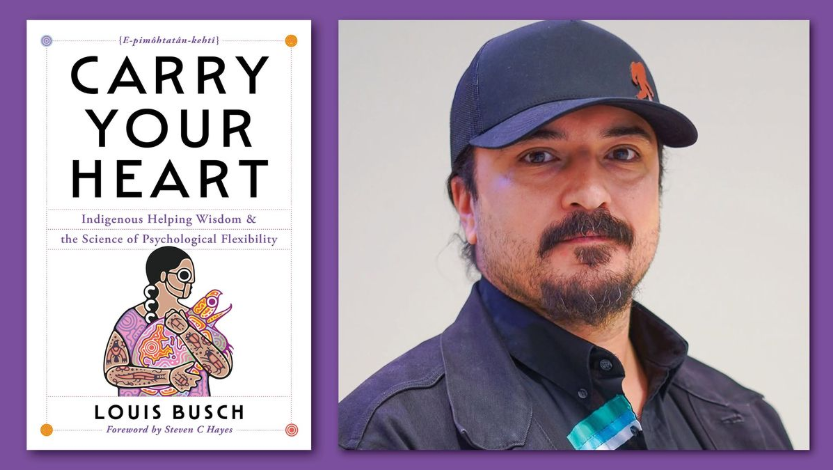
Photo: Carry Your Heart Book and Author Louis Busch
By Shari Narine
Local Journalism Initiative Reporter
Windspeaker.com
In Carry Your Heart: Indigenous Helping Wisdom and the Science of Psychological Flexibility, Elders and knowledge keepers use “beautiful metaphors” to offer teachings for those striving to live a life of meaning, purpose and vitality in the presence of grief, fear, anxiety and difficult experiences.
“I think when we are communicating there’s a lot lost in translation, especially the way that mental health professionals communicate about being well,” said author Louis Busch, a Cree psychotherapist and professor in psychology.
“But with these Elders, their stories (in the book), the way that they talk about these things paints such a picture in your mind that it stays with you more than any kind of training you might get or any kind of instructions you might get in therapy.”
Carry Your Heart brings Cree, Anishinaabe, and other Indigenous teachings into dialogue with the science of psychological flexibility, which measures adaptability to changes in life. At the core of the science of psychological flexibility is Acceptance and Commitment Therapy, which embraces all feelings rather than fighting them.
Busch, a Bear Clan member of Nisichawayasihk Cree Nation in Manitoba, says Carry Your Heart does this “neat kind of dance” between the modern-day mental health system and First Nations helping philosophies.
“My own experiences of mental health struggles and then grief really forced me to look at how I’ve been approaching wellness and how I’ve been trying to guide others through wellness,” said Busch.
During the course of writing the book, Busch suffered a personal tragedy and opened up about his struggle in dealing with his brother Jerome’s death.
“I saw the parts of the mental health system that were helpful and took them with me. But then as I started talking with these Elders and knowledge keepers, I found that there were important gaps that were missing that those teachings filled,” he said.
The modern mental health system has been “hoisted on” Indigenous peoples and leaves out the important role of spirit, he says.
The book gets its title from the Woodland Cree phrase kita-pimōtātamān kitēh, which means something close to ‘walk while carrying your heart’, explained Busch. “It is a teaching about how we might move through our lives with emotional and spiritual openness, awareness and intention rather than the detachment and automation that modern society seems to favour more and more these days.”
Busch learned the concept from Ken Bighetty, a gifted helper from Pukatawagan, Man.
Busch chronicles in Carry Your Heart his travels to gather stories and instructions from Bighetty and others such as Renée Thomas-Hill (Cayuga Bear and Turtle Clan Elder of the Mohawk Nation), Len Pierre (Coast Salish from Katzie First Nation), Isaac Murdoch (Fish Clan member of Serpent River First Nation), Vivian Recollet (Turtle Clan Elder from Wiikwemkoong), Ron Linklater (Couchiching First Nation), and Gloria Oshkabewisens-McGregor and Vivian Recollet, both from Wiikwemkoong Unceded Territory.
“I think in developing work that touches community, it really needs to consider culture, history, context, language, if it’s to have a meaningful impact. In my work, a lot of it is really trying to find helping approaches that work for the context and for community,” said Busch.
He learned that Elders and knowledge keepers are “experts” in many principles practised in psychology, “even though they’ve probably never heard of psychological flexibility or some of these things.”
Busch recalls that when he first started his formal training on psychological flexibility, he kept thinking that he was familiar with what was being taught.
“I realized that many of these approaches and the philosophy it’s based on also exist within our traditional healing approaches and our modern-day healing approaches that our Elders and knowledge keepers often share,” he said. “A lot of our ceremonies, they really teach you to sit with discomfort and to pay attention to your body and to think about what really is important in your life.”
If the goal of life is happiness, he points out, then any other kind of experience, such as boredom, sadness or loss, is viewed as failure. But feelings other than happiness make up a significant part of life.
“A good life is holding and learning from those difficult things and being really compassionate with them. If I can hold my anxiety or my grief as a prize as much as my happiness, suddenly 100 per cent of my life is meaningful to me and it’s important,” he said.
Busch stresses that although Carry Your Heart shows that some modern-day approaches and Indigenous approaches may complement each other, “the power distribution is not equal.”
“One side has really dominated and has a long history of appropriating, exploiting different things…and certainly one (side) has really had to struggle to keep itself alive. Our ancestors, under threat of imprisonment and starvation, kept our healing approaches, our ceremonies and our stories, our songs. They kept those alive and passed them down when it was really difficult to do so,” he said.
“I’m hoping my book is placing a foot down firmly and saying, ‘Our approaches are here and they’re powerful.’…Part of the responsibility that I felt in hearing these teachings was I want these to be in a place where, for generations, people might be able to look back and hear these words and hopefully (it will) help at least one person.”
In showing his appreciation for the teachings from the Elders and knowledge keepers, Busch will be donating his author royalties to the Thunderbird Partnership Foundation, an international nonprofit that supports life promotion, harm reduction, land-based healing, and to the Legacy of Hope Foundation, which supports Indian residential school survivors.
“I also hope that if people read the book, that there is some material support that goes back into community. I guess, in that way, it makes me feel good about sharing these words and it being, hopefully, going to a good place right now,” said Busch.
Carry Your Heart: Indigenous Helping Wisdom and the Science of Psychological Flexibility is published by Simon & Schuster and was released Sept. 15. It can be ordered through https://www.simonandschuster.ca/books/Carry-Your-Heart/Louis-Busch/9781668206171
Windspeaker.com