
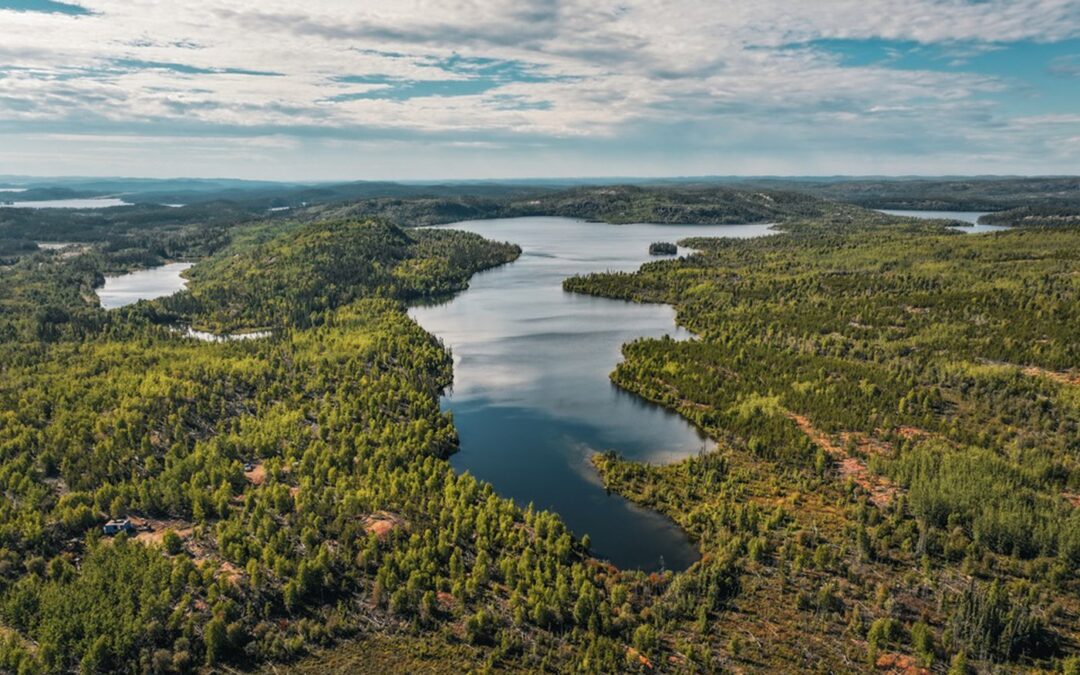
Photo: Triton drilling rig set up south of foot bay on the Donaldson Lake fault 12 km east of Uranium City. / Courtesy of Tritin Uranium
By Nicole Goldsworthy
Local Journalism Initiative Reporter
SaskToday.ca
More than four decades after uranium mining helped build Uranium City, exploration crews are again drilling in the historic Beaverlodge uranium district, this time to determine whether the area could support a new uranium project.
Triton Uranium Corp. is advancing its approximately 46,000-acre Atlas Project, combining new exploration with decades of historical drilling and mining information from the area. The property is located within or adjacent to several areas where uranium was previously mined.
Scott Evans, Triton’s president and director, told SaskToday in a phone interview that the Atlas Project remains in the exploration stage and no decision has been made to develop a mine.
“We’re talking about taking an old historic mining area, trying to bring it back to life,” Evans said.
For that to happen, Evans said Triton first has to establish how much uranium is present and then determine whether it could be economically mined.
“The goal of the project obviously is to prove we have uranium,” Evans said. The second question, he added, is whether “it makes economic sense to remove it.”
Triton’s latest technical reports put the broader uranium potential at up to 46.56 million pounds of uranium oxide, or U3O8, but that number is not a current mineral resource estimate. Triton describes it as low-grade, open-pit uranium potential within satellite occurrences and exploration-target areas across Atlas.
The company’s disclosure states that exploration targets are based on available geological information and conceptual modelling and do not represent mineral resources. More exploration would be required to determine whether mineral resources can be defined.
The company said Triton does have a current mineral resource at its Red Rock deposit, but it is considerably smaller. Red Rock has an indicated mineral resource containing about 531,000 pounds of U3O8 and a smaller, less certain inferred resource containing about 27,800 pounds. Those figures represent uranium oxide estimated to be contained within the mineralized rock, not the amount that would necessarily be recovered through mining.
The indicated resource covers about 276,700 tonnes of mineralized rock averaging 0.087 per cent U3O8, while the inferred resource consists of 20,946 tonnes grading 0.060 per cent.
The estimates are contained in technical reports prepared by Stantec Consulting Ltd. and dated July 27, 2026.
While Triton still has considerable exploration work ahead, Evans said the company isn’t starting without information.
“Normally when you start one of these projects, you have no infrastructure and you have no data,” he said. “You’re starting with nothing.”
According to Evans, Triton inherited information from approximately 1,700 historical drill holes and 18,000 previous samples. The records provide direction for current exploration, but historical results cannot automatically be classified as current mineral resources.
“It gives us an outline,” Evans said.
Evans estimated the historical data covers roughly 10 per cent of Triton’s property, while the company says significant portions of its land position remain underexplored.
There is also a long record of uranium production surrounding the project. According to Triton, the Beaverlodge uranium district produced approximately 77.8 million pounds of U3O8, including about 50.4 million pounds from the Ace-Fay-Verna mining complex. Other historic mining centres, including Dubyna and Cinch-Cenex, were within or adjacent to Triton’s current land position.
Those historical production figures describe the wider district and do not establish how much uranium is present on Triton’s property. That is one of the questions the company’s current exploration program is intended to answer.
Triton is testing targets through a 10,000-metre drilling program, with additional drilling planned for winter 2026-27. The results will help determine whether additional mineral resources can be established and whether further technical and economic assessment is warranted.
For Uranium City, the renewed exploration carries particular historical significance. The townsite was established in 1952 as uranium development expanded in the area, and Eldorado Mining & Refining Ltd. began production in 1953. Mining and milling operations ended in 1982, followed by a sharp decline in population.
Uranium City had 2,507 residents in 1981. By the 2021 census, that number had fallen to 91.
Evans said his long-term vision, if uranium development returns to the area, includes more people living in Uranium City and increased economic activity. For now, those remain possibilities dependent on Atlas advancing far beyond exploration.
The project’s current footprint in the North is much smaller. Evans said Triton has about two or three northern contractors working for the company in the area, with current activity primarily involving drilling, exploration and technical work.
Uranium City’s remoteness would also be a consideration if the project advances. The community is about 760 kilometres northwest of Prince Albert and has no all-season road connecting it with southern Saskatchewan.
Evans said Triton’s role is to identify and advance projects rather than necessarily operate an eventual mine. Should Atlas reach that stage, he said, a larger mining company could become involved.
For now, the drills are being used to answer the more immediate question: whether Triton can establish additional uranium resources across the Atlas property. Even if it can, further work would still be needed to determine whether those resources could support an economically viable mine.