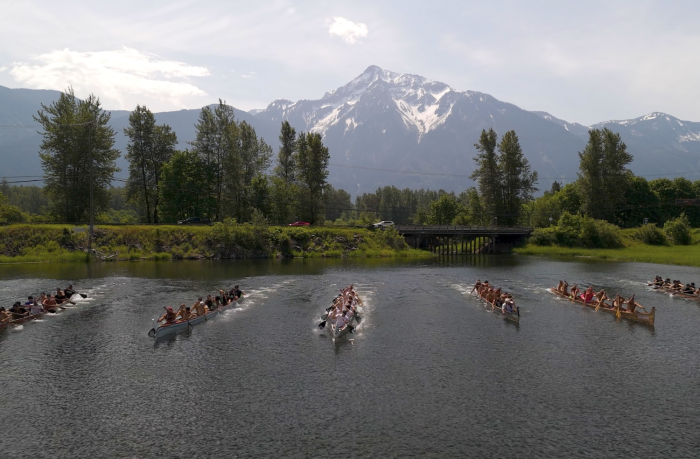
Photo: An image from the docuseries Racing Waters that will air on APTN / Windspeaker.com
By Sam Laskaris
Local Journalism Initiative Reporter
Windspeaker.com
When Luke Marston was talking about his passion to his friend, little did he know that the conversation would lead to a television series.
Marston, a member of the Stz’uminus (Chemainus) First Nation in British Columbia, is a producer of the docuseries Racing Waters, which will premiere on the Aboriginal Peoples Television Network (APTN) on Sept. 13.
Though the first season has yet to air, it’s been announced that Racing Waters has been renewed for a second season. Season one consists of nine 22-minute episodes.
Racing Waters follows the world of First Nations war canoe and outrigger racing. The majority of the scenes feature members from the Island Brave Canoe Club, representing Snuneymuxw First Nation in B.C. But several other canoe clubs that compete in the Pacific Northwest racing scene are also included in the series.
Marston said he was talking to his friend Mike Wavrecan about war canoe racing. Wavrecan had produced Moosemeat & Marmalade, a documentary series that ran on APTN for six seasons.
“I ended up talking with (Wavrecan) about it, and I was just saying ‘We should do a documentary on this’,” Marston said. “And then we pitched that to APTN. They really liked the idea and we ended up doing a promo.”
Originally, Marston, who is a paddler himself, wanted the series to focus on a team from his own First Nation. But he said since some Stz’uminus crew members found it challenging to train on a consistent basis, he pivoted and decided to focus on the neighbouring Island Brave Canoe Club, a powerhouse squad.
“The original idea was that we should do a documentary,” Marston said. “And then we really quickly realized that there was so much content there and so much to kind of unpack that we figured that this would be a great series. So, it just really quickly evolved.”
Marston said war canoe and outrigger races are extremely popular on the West Coast.
“The mainland races are obviously the biggest ones and the island races are a little bit smaller,” he said. “But it’s a big, big circuit that’s been going on for a long time.”
And he’s thrilled that he was able to document this sport.
“It’s just an exciting thing and I’m happy for all the youth that are a part of it,” he said. “It’s a great opportunity for us to lift up the youth that live this healthy lifestyle. There are no drugs and no alcohol tolerated within the sport. It’s all about mind, body and soul.”
Marston is confident Racing Waters will appeal to all viewers.
“I think it’s just a real kind of insight into a little bit of what our culture is about, like just as far as canoe racing goes,” he said. “There’s a lot of teachings that are in there that we share and people can kind of get an understanding of what’s important to us and why canoeing is so important to us and how we’re connected to the water and to the land.
“I think it’s a little bit of a glimpse into our culture and who we are as people.”
Marston said he is not surprised to see the series has been given a second season.
“It’s so interesting and visually it’s just so great,” he said. “With our people we just love canoe season. We wait for it to come every year. Everyone talks about it. Everyone knows who the best paddlers are.”
Season One includes many personal stories of the Island Brave Canoe Club, including the health struggles a team star encounters prior to a major competition in Brazil.
Marston felt it was important for the series to include information on what is happening in the paddlers’ lives off the water.
“I think that when you watch the sport on its own it’s interesting and it’s visually stimulating,” he said. “But I think as you find out who the racers are and you get to a chance to kind of cheer for them and see what goes into being a paddler. The race is a race, but you don’t get to see how hard it is on a day-to-day basis.”
Marston believes these added details enhance the series’ appeal.
“You really get to see what the racers and what paddlers go through on a daily basis just to make it to the weekend to race,” he said. “Your health has to be on point and there’s a lot of things like cultural obligations. Pretty much all the people that race they are very culturally committed as well with other things like singing or dancing. So, it’s a busy, busy schedule for people who are paddlers.”
Windspeaker.com