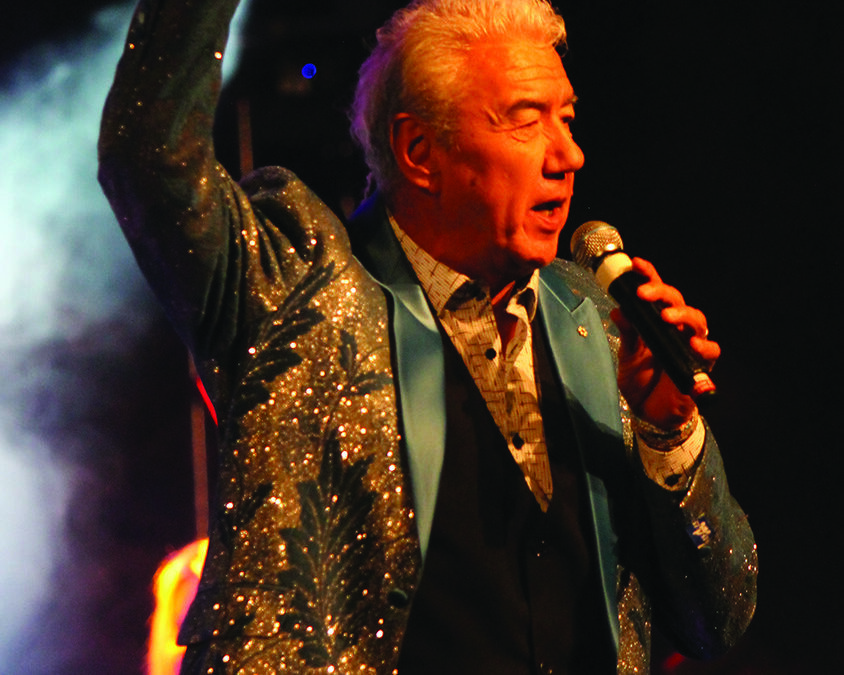
Photo: Tom Jackson performs at the Empress Theatre in Fort Macleod in this 2020 file photo.
By George Lee
Local Journalism Initiative Reporter
The Macleod Gazette
Actor, musician and humanitarian Tom Jackson wants governments in Canada to help Indigenous communities become more resilient in the face of increasingly ferocious wildfires.
Jackson, a veteran actor of Cree and Métis descent known for TV roles in North of 60 and Sullivan’s Crossing, said action is needed now to improve fire prevention and upgrade infrastructure.
“To solve these issues effectively needs political will. Otherwise, it doesn’t have a hope,” the actor born on One Arrow First Nation in Saskatchewan told The Macleod Gazette last week.
“But there is political will out there,” continued Jackson, a companion in the Order of Canada and the founder of the Huron Carole, a touring Christmas concert series and charity fundraiser. “And I don’t want to beat anyone over the head with it, but there’s hope and there’s a commitment out there, too.”
Homes should be safe foundations for everyone, he said. “We all know how it is to be alive in our home but not to die in our home.”
Housing improvements are one part of a multi-pronged approach needed to address prevention before the next round of wildfires approaches the doorsteps of Indigenous Canada, Jackson emphasized.
Better prevention, infrastructure and emergency planning need to meld with Indigenous-led land and forest management to reduce wildfire risks and improve community safety, he said.
Prolonged drought, higher temperatures, strong winds, insect damage and a changing climate are making wildfires in Canada more frequent, dangerous and difficult to combat.
The Business of Saving Lives
Jackson has a history in affordable housing going back three decades and is today director of engagement for a company called ZS2.
“When I sit in a boardroom with the executives from ZS2 and I ask them, what do we do? they all say, ‘we save lives,’ ” Jackson said. “So if you want to know what ZS2 does, it saves lives.”
Headquartered in Calgary, ZS2 is involved in projects with federal backing because of its decarbonization focus while delivering fire- and mould-resistant building systems. The company’s panels feature insulation sandwiched between magnesium cement boards.
They’re comparatively light but also long-lasting and mighty, according to the company. A set of prefabricated Z2S panels can be assembled quickly with small crews on small building envelopes, its promotional material emphasizes.
ZS2 has played a role in the rebuilding of Jasper, where the 47-unit, upgraded replacement of Sunwapta Apartments used the company’s panels.
Jackson and his wife and business partner, Alison Jackson, started in the housing industry with a manufacturing plant for affordable homes 30 years ago in Calgary.
“It’s hard for people to imagine this if they know my professional career from their living rooms,” Jackson acknowledged. “They don’t expect to hear that I’m somebody involved in housing.”
Numbers Behind a Crisis
A crisis in getting affordable and safe housing built in Indigenous territories continues today, he said.
A 2023 study by the Assembly of First Nations estimated baseline spending of more than $135 billion was needed to close the housing portion of a $350-billion infrastructure gap on First Nations in Canada by 2030.
Indigenous individuals make up about five per cent of the country’s total population. The subset of First Nations individuals sits at under three per cent, and about 40 per cent of them live on reserves, Statistics Canada data say.
Yet roughly half — more than 40,000 — of all wildfire evacuees in Canada in 2025 were First Nations citizens, various organizations and outlets have reported.
About 25,000 Alberta residents were evacuated in the 2024 wildfire season, which saw the destruction of nearly a third of the buildings in Jasper municipality.
Almost 7,000 or nearly 28 per cent of Albertan evacuees in 2024 were from First Nations communities.
Alberta Government Responds
“Protecting our communities, forests and critical infrastructure from the threats of wildfire is a top priority for Alberta’s government,” the province’s Department of Forestry and Parks said in an emailed statement.
Responding to a news release from a Toronto public relations firm on Jackson’s call to action, the statement said: “We continue to use all available tools and technology to assess wildfire risk, predict where wildfires may start and respond quickly to protect forests, infrastructure, communities and all Albertans, while also focusing on how we can lessen the impacts of future wildfires.”
The province spent more than $1 billion fighting and responding to wildfires in 2023-24 when 2.2 million hectares burned. Almost four times the size of Prince Edward Island, the damaged area from wildfires represented a major jump from the previous record of 1.3 million hectares.
Alberta launched a wildfire mitigation strategy earlier this year, taking what it calls a “whole-of-society approach” to reduce risk.
Through the strategy, the department supports proactive planning, FireSmart initiatives, fuel management and stronger community preparedness.
At national and provincial levels, FireSmart is designed to help homeowners, communities, and industries reduce their vulnerability to wildfires.
Alberta’s wildfire mitigation strategy came out of “extensive engagement, including with Indigenous communities, who are essential partners in wildfire mitigation,” says the emailed statement.
“Alberta works closely with Indigenous communities, municipalities and emergency management partners on wildfire preparedness, mitigation and response. Indigenous firefighters and contractors contribute valuable local knowledge and response capacity during emergency operations.”
The department also works directly with First Nations communities “to complete hazard reduction burning and other mitigation projects, supported by dedicated federal funding.”
The statement continues: “Additional funding helps Indigenous communities assess wildfire risk, implement FireSmart plans, complete fuel reduction projects and improve preparedness through community fireguard programs.”
‘Shoulder to Shoulder’
Working together makes sense to Jackson.
“Let’s make sure that we’re walking shoulder to shoulder with people who can actually make the difference, and that people who say they’re going to give you $5, give you $5,” he said.
“Let’s collaborate. Let’s not just try to make all our decisions on our own. There are a lot of brilliant minds out there and there are a lot of programs. And I applaud a number of them within the federal government.”
His message to elected officials in Alberta?
“You have to make sure that when you lead, the people you’re leading are going down the right path,” Jackson said. “So engage in the conversation about the why, not the what. We know that the what is solvable.”
A leadership approach worth emulating came to Jackson recently through a conversation with Prime Minister Mark Carney.
“I told him I had a gift for him. He said, ‘I hope it’s advice.’ ”