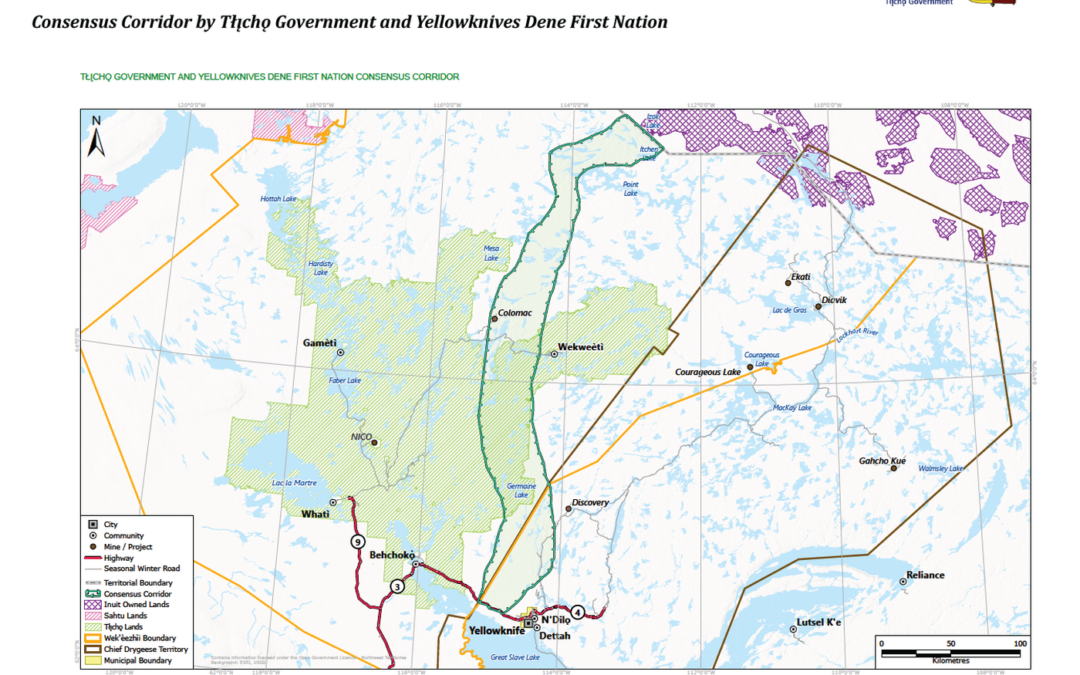
Photo: A map of the consensus route for the proposed Arctic Economic and Security Corridor, which aims to connect Yellowknife to the Grays Bay Road and Port in Nunavut, crossing the Slave Geological Province. (Map courtesy of ERM International Group Limited, via Tlicho Government/Yellowknives Dene First Nation)
By: Kody Ferron
Local Journalism Initiative Reporter
Yellowknifer
The Tlicho Government and Yellowknives Dene First Nation have reached an agreement regarding the potential routing of the Arctic Economic and Security Corridor.
The AESC is a proposed all-season road that will stretch across the NWT’s Slave Geological Province, connecting the territory to the Nunavut border and the Grays Bay Road and Port.
The proposed corridor is roughly 400 km long.
Prime Minister Mark Carney travelled to Yellowknife in March to announce that he would be referring the project to Canada’s Major Projects Office.
An Aug. 12 joint news release from the Tlicho Government (TG) and Yellowknives Dene First Nation (YKDFN) states that the corridor will be an Indigenous project, co-led by the TG and YKDFN, in partnership with the GNWT. Federal support will also be required.
The news release emphasizes that the proposed locations where corridor would run — roughly 30 km wide — is not yet a final route. Further engineering, environmental and regulatory work will determine the ultimate path to reach Nunavut.
Caribou, long-term prosperity for Indigenous and Northern communities and Indigenous leadership of the project were some of the top priorities for the groups involved in determining the proposed route.
“For the Tlicho Government, connecting communities was a strong priority as well,” reads the news release. “The consensus corridor reflects this.”
Tlicho Grand Chief Jackson Lafferty noted the shared values and priorities between the two First Nations during the mapping out of a path for the corridor.
“Reaching [consensus] took compromise and respect,” he said. “It is exciting to show Canada how we can lead and design major projects as Indigenous nations. Next, we are looking forward to hearing from our citizens and other Indigenous groups now that we have a project defined.”
Yellowknives Dene First Nation chiefs Ernest Betsina and Fred Sangris issued a joint statement on the success of the consensus corridor.
“Work does not end with identifying a corridor — it begins with listening, learning and working together,” reads the statement. “Now we turn to our members and our neighbours. The strongest outcomes will come from bringing our knowledge, perspectives and priorities together, and from ensuring that the people most affected have a meaningful voice in what comes next and that mitigations to protect the water, lands and wildlife are carefully thought through.”
NWT Premier R.J. Simpson said the consensus agreement marks an important moment for the Arctic Economic and Security Corridor.
“The future of the Northwest Territories will depend on governments working together to advance major opportunities, with Indigenous governments as leaders and partners from the outset,” he said. “That is how we build stronger relationships, make better decisions and create lasting benefits for the territory and the people who call it home.”
Strategic Infrastructure, Energy and Supply Chains Minister Caroline Wawzonek said the corridor will be a “nation-building” project that will support economic development across the North.
“It will establish land access into one of Canada’s most important critical mineral regions, where known mineral potential is significant but much of the area remains underexplored,” she said. “It will also create Canada’s first land-based link to Nunavut’s Arctic coast.”