
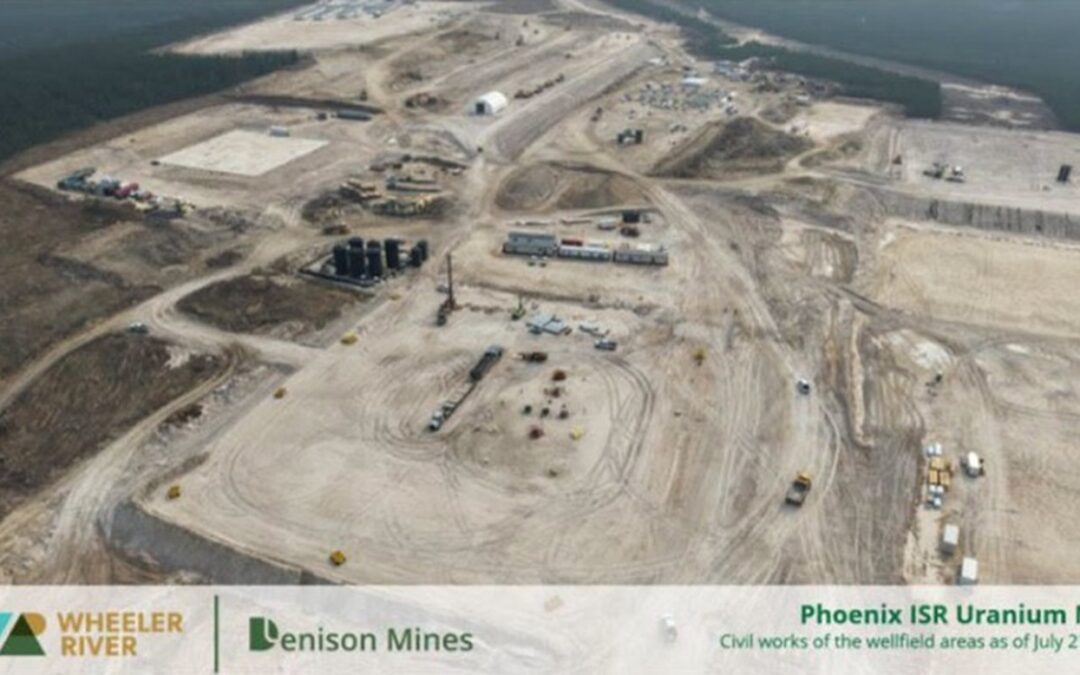
Photo: Phoenix ISR Mine site
By: Nicole Goldsworthy
Local Journalism Initiative Reporter
SaskToday.ca
Denison Mines is reporting strong early progress at its Phoenix uranium project in northern Saskatchewan while generating nearly $92 million through uranium sales to help finance construction without issuing new shares.
The company said full-scale construction is underway at the Phoenix in-situ recovery (ISR) uranium mine after site preparation began in March. By the end of July, more than 20 per cent of overall site civil work had been completed, while civil subgrade work for the process plant and wellfield areas was nearly finished, according to the company’s Aug. 12 news release.
Denison also announced the start of freeze-wall installation for Phase 1 of the project, a key milestone for the mine. Chris Beaudry, Saskatchewan minister of energy and resources, said a freeze wall is a ring of frozen ground built around a mine site to act as a barrier, essentially creating an underground ice curtain.
Contractors drill a series of wells in a perimeter pattern and circulate a refrigerated fluid through them, which freezes the surrounding soil and rock solid. That frozen barrier stops groundwater from moving in or out of the work area.
Construction activity is expected to accelerate through the remainder of the summer months, supported by a second shift and an on-site camp capable of housing nearly 400 workers, Denison said.
Beaudry said the Phoenix project represents a $700-million investment expected to create more than 300 construction jobs and about 150 permanent positions once production begins, which is currently targeted for 2028.
Financially, Denison reported selling 750,000 pounds of uranium during the second quarter at an average realized price of $122.16 per pound, generating $91.6 million in gross proceeds. The uranium was originally acquired in 2021 at an average cost of $36.67 per pound, resulting in a gain of approximately $64.1 million, or 233 per cent.
President and CEO David Cates said the uranium sales are part of a long-term financing strategy designed to support the development of the Phoenix project while limiting shareholder dilution.
As of June 30, Denison held approximately 1.1 million pounds of uranium, including physical holdings and inventory from its share of McClean Lake production.
The Phoenix mine is part of Denison’s Wheeler River project in the Athabasca Basin, one of the world’s premier uranium-producing regions. The company holds an effective 95 per cent interest in the project and received final regulatory approvals to begin construction earlier this year.