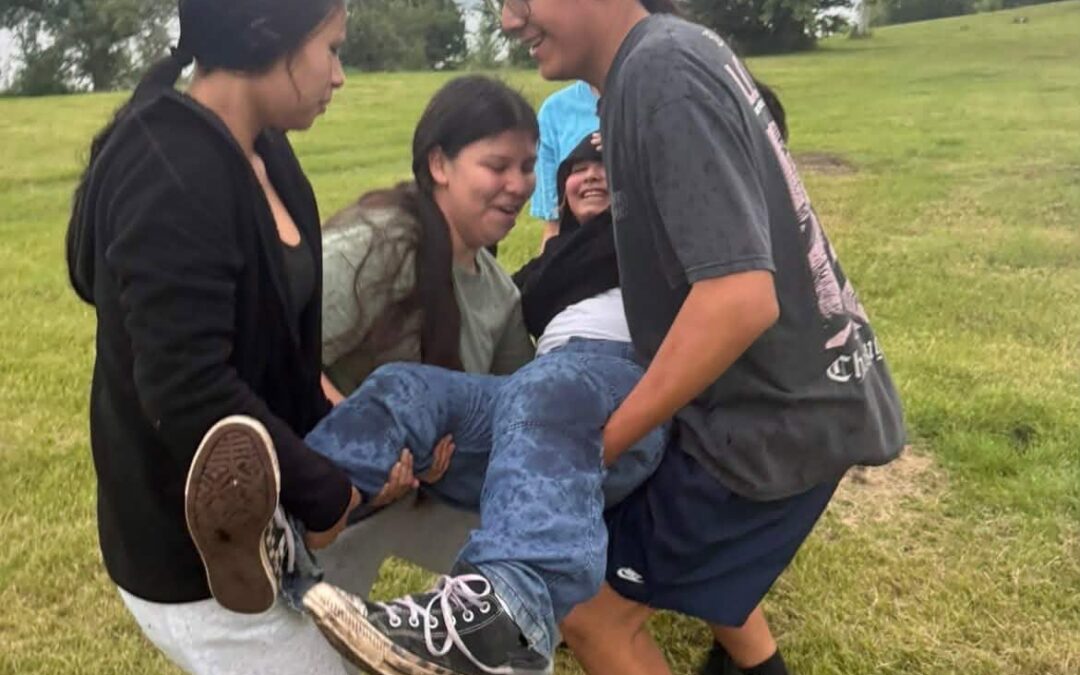
Photo: The Iron Rangers practising a ‘Ranger down’ scenario (photo supplied from the File Hills First Nation Police Service Facebook page)
File Hills First Nations Police Service, the first and only self-administered standalone First Nation Police Service, have reestablished the Iron Nations Rangers youth program.
Constable Kelsey Starblanket is leading the program which invites youth from the reserves to interact with police and expose the youth to some scenarios that police officers deal with.
This program started on July 3rd with 13 participants and grew to 20 Iron Rangers. It runs over six weeks every Friday for youth ages 12 to 17.
“It’s fun to be involved in the Iron Rangers,” said Brandon Starr, a 16-year-old attending the program. “We’ve been doing scenarios with Kelsey, Tyson and other police officers. “It’s pretty easy.”
Starr has been chosen as the right marker, where he represents the Iron Rangers. He is responsible to clean the staff that is used for marching.
He plans on continuing with the program during the school year even though he is not sure about a future in policing, and said, “I did take a forensic class in school. I did like that.”
The program was offered in the past, but the organizers felt the age of the youth attending was too young to work through the intense drills.
“There’s going to be another program on another reserve running simultaneously to this one that starts on Wednesday on Little Black Bear,” said Cst. Starblanket.
Some of the program goals are to remove the barriers of how youth view the police and potentially recruit future applicants to the police force. They hope to continue the program throughout the school year.
The training includes traditional games, drills and role play where the Iron Rangers experience real-life scenarios that police address on a regular basis.
“It gets them competing in a healthy way, not being too aggressive,” said Cst. Starblanket. “We’re trying to build our kids up as a team.”
When he is not on duty, Cst. Starblanket is attending classes to become a teacher. He is going into his last year of education to complete a Bachelor of Indigenous Education degree. He built the curriculum for the Iron Rangers program.
“I explain if you’re ever interested in becoming a police officer, you got to follow orders,” said Cst. Starblanket. “You’ve got to think, decide and act all within a matter of seconds.”
Mock scenarios, like “Ranger down” allow the youth to experience real-life situations.
“Your backup just advised that they’ve been injured and we need to go respond to where they are,” said Cst. Starblanket. “We raced to where they were and found them. I explained one of them has a head injury, and a leg injury, so which one should we leave and which one should we carry.”
The Rangers were able to think about the situation and decided to leave the one with a head injury and monitor until Emergency Medical Services (EMS) arrived, while a group of Rangers carried the one with the leg injury about 800 meters.
“It was really fun,” said Cst. Starblanket. “It started raining, after we debriefed, I explained to them this is exactly what it’s like policing.”
Cst. Starblanket wants the Rangers to learn that police respond to situations that are out of their control, like the rain, to save a life.
Incorporating cultural traditions is another way Cst. Starblanket teaches the youth.
“At the end of our session, we have a roundtable discussion,” said Cst. Starblanket. “We’ll go clockwise because in our First Nation ways and traditions we always go clockwise, we do things in a circle.”