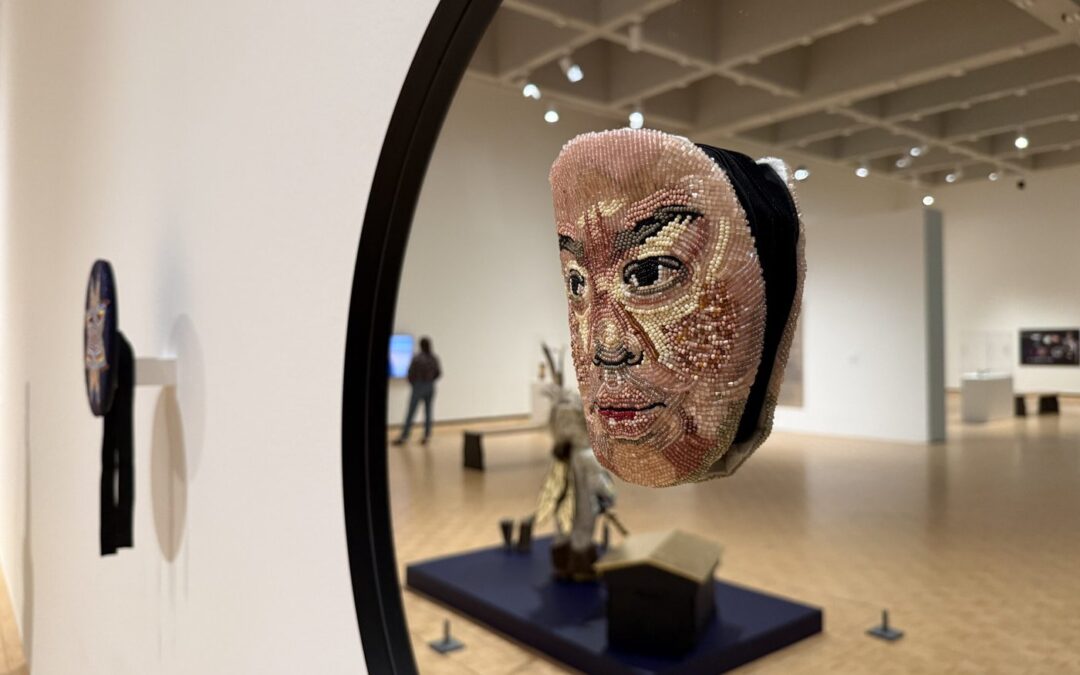
Photo: A beaded mask mounted on a mirror by Kylie Fineday of Sweetgrass First Nation. The mask is a self portrait, inspired by the artist’s own queerness and idea idea of masking. P
By: Brittany Boschman
Local Journalism Initiative Reporter
IndigiNews
A new art exhibition in Oskana kâ-asastêki (Regina) gathers Indigenous 2SLGBTQIA+ artists around a tender and political belief that love, in all its forms, can be medicine.
Love Medicine brings together the work of 22 artists at the MacKenzie Art Gallery, whose collective work asks what love can hold for Two Spirit and Indigiqueer people across generations, communities and forms of making.
The exhibition was curated by Michelle McGeough, a Métis art historian and assistant professor at Concordia University, and opened on June 12. It will be on display until Nov. 1.
“I wanted to create a space where we could talk about these types of things, and talk about what it means to love,” McGeough tells IndigiNews. “Love is in itself a medicine for us.”
McGeough said she hopes people who visit the exhibition see themselves reflected in the works.
Visitors entering Love Medicine are first pulled left, toward French and Anishinaabe interdisciplinary artist Vanessa Racine’s i love you too.
The 2023 work uses two contemporary wampum belts to encode the phrase “I love you” in the mother tongue of both Racine’s parents.
Across the room, iconic Anishinaabe painter Norval Morrisseau’s Androgny rises nearly floor-to-ceiling, its saturated colours commanding attention.
In the centre of the space, Kablusiak’s soapstone works turn intimate objects into questions about bodily autonomy and the shame often placed on sexuality.
Deeper into the exhibition, Siksika interdisciplinary artist Adrian Stimson’s nookaa naamoi-stotoohsin, Child’s Bumble Bee Outfit, is a piece of child-sized regalia that reminds viewers that Two Spirit people hold important knowledge, and is inspired by the Blackfoot Bumble Bee Society.
Another room opens into an immersive space by disabled artist moira williams, with feathered boas and bright pink tinsel curtains that invite visitors to touch, play and move through the work.
The sounds of water brings you into the next room, where Skeena Reece’s Touch Me video performance depicts the intimate care shared between Reece and artist Sandra Semchuk.
McGeough said she arranged Love Medicine in a way that was inspired by the movement of tides to guide visitors through the exhibition.
“The ocean really became the kind of grounding force,” McGeough said.
“This kind of ever-flowing ebb, in and out … all these things come and go.”
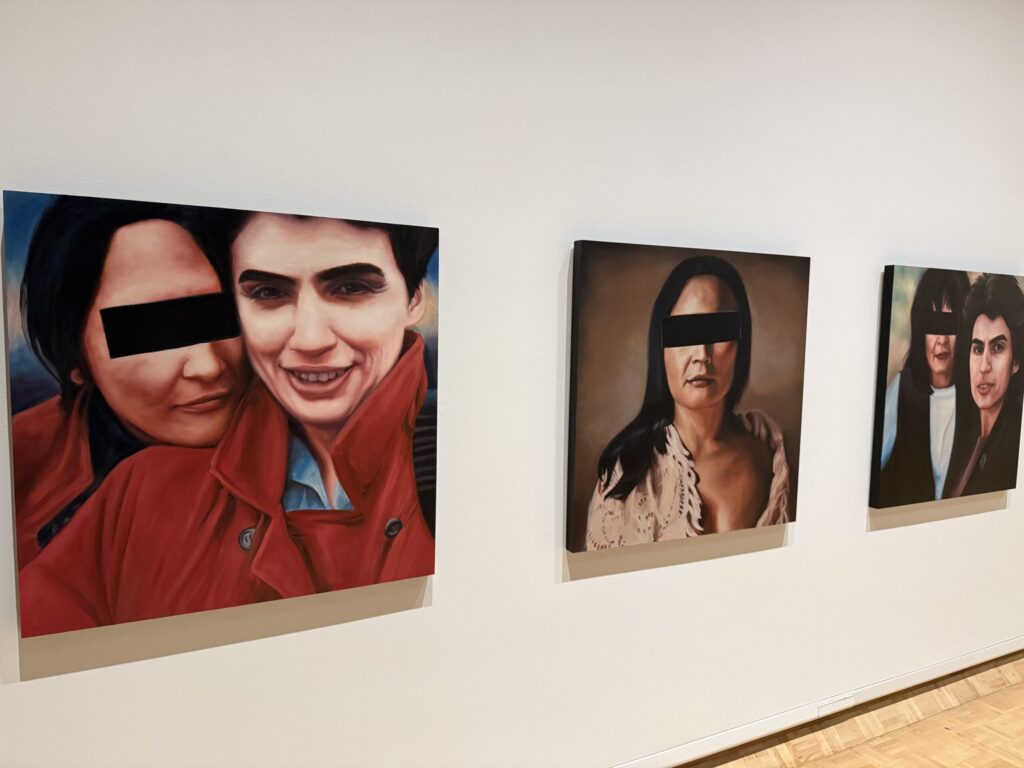
A series of paintings by Red River Métis artist Rosalie Favell titled ‘Living Evidence.’ The paintings are about the invisibility of lesbian relationships and generations of women who had to hide their sexuality.
In 2024, before Love Medicine reached the MacKenzie Art Gallery, a Curatorial Dreaming workshop at the University of Winnipeg — developed by Shelly Butler and Adrienne Huard — brought together experienced and emerging Two Spirit and Indigiqueer curators from across “Canada” to consider what a gallery space could hold for Indigenous queer life.
“I came away from that workshop with a more defined vision of the exhibition,” McGeough said.
But that question extends beyond the walls of a single exhibition.
Colonial institutions helped impose rigid ideas about gender and sexuality, making many Indigenous ways of understanding harder to see in public records and cultural spaces.
The Two-Spirit Archives, established at the University of Winnipeg in 2019, was created as one response to that gap, preserving Two-Spirit and Indigiqueer histories through community-driven archival practice.
Love Medicine responds to these histories of exclusion and violence by asking what changes when Two Spirit and Indigiqueer artists are gathered inside a public gallery on their own terms.
The gallery held an opening celebration on June 11, with a drag performance from Two Spirit Dene performer Chelazon Leroux.
The next evening, curator McGeough sat down at the gallery for a panel talk with guest artists Dayna Danger, Racine and Stimson.
Racine spoke about art as a way back to land and ancestry.
“Through art, we find ways to connect our identities to the land and our ancestors,” Racine said.
“It’s about reclaiming our stories and asserting our presence.”
As the conversation turned toward younger generations, Stimson encouraged Two Spirit and Indigiqueer people to move toward the parts of themselves they may have been taught to hide.
“Don’t be afraid of who you are and celebrate that,” Stimson said.
He also urged young artists to stay curious about the forms their work might take.
“Don’t be afraid to try these things, to understand them, to take them apart,” Stimson said.
John Hampton, the executive director and CEO of the Mackenzie Art Gallery, said in a statement that the exhibition brings “a spirit of care, community and healing” to the gallery.
“Two Spirit communities are one of the most targeted groups in our society today, but they also carry the strongest medicine, serving an essential and honoured role in this territory for time immemorial,” they said.
“I feel like we are in need of a return to that healing power of love and of art, and I thank the artists for that gift.”