
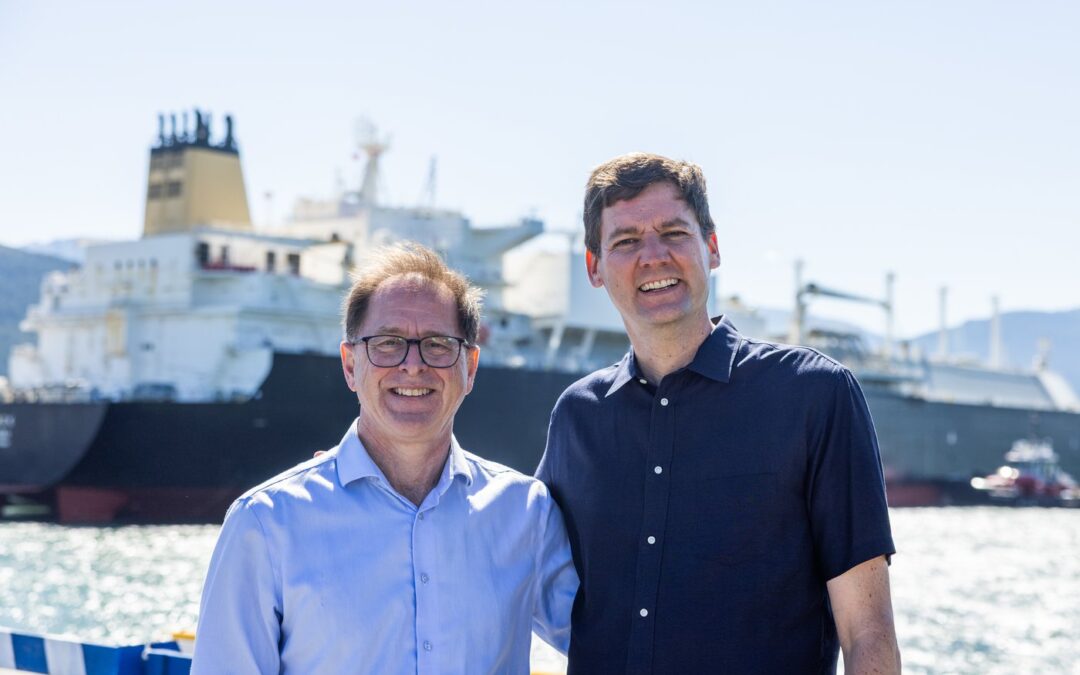
Photo: Premier David Eby joined Minister Adrian Dix for a tour at LNG Canada, in Kitimat, BC, on July 29, 2025.
Canada’s National Observer
BC’s push to study two major hydroelectric dams is reviving old fights over rivers, salmon and Indigenous rights — and environmental groups say the province is getting ahead of itself.
Energy Minister Adrian Dix said Monday the province is “seriously” re-examining two large hydro options: Site E on the Peace River in Treaty 8 territory, as well as another connected to the Homathko River, which flows into Bute Inlet northeast of Powell River, near the Discovery Islands.
Neither project has been approved. The work now is technical: finding out whether the sites could help meet future electricity demand, which the province expects to rise 20 per cent by 2030 and 50 per cent by 2050.
BC is trying to find more power to electrify homes, vehicles and industry by further capitalizing on some of the cleanest energy in Canada. Other provinces face harder tradeoffs: Alberta heavily relies on natural gas for electricity, while Ontario is expanding and refurbishing nuclear plants, which have their own set of risks, to meet rising demand.
“We are gathering the information we need to make the well-informed decisions on how best to meet the province’s energy needs,” Dix said.
But critics say the announcement lands in a province with a long and painful hydro history.
“It really rings alarm bells,” said Joe Foy, a longtime Wilderness Committee campaigner. “They’re starting the same process that ended up steamrolling Indigenous rights at Site C.”
In the 2000s, companies sought rights to develop private run-of-river projects on BC rivers and streams, diverting water to generate electricity without creating large reservoirs. Some projects were built and others, including a major proposal in Bute Inlet, did not after public opposition.
Site C — now called the John Horgan Dam — sits within the same river system now being eyed for Site E. It became one of BC’s most contentious energy projects, opposed by Treaty 8 First Nations, farmers and landowners who warned the Peace River dam would flood farmland, burial and cultural sites, wildlife habitat and areas used for hunting, fishing and gathering. Legal challenges failed to stop the project and construction began in 2015, But even before the reservoir was filled in 2024, cost of the project had ballooned from $8.8-billion in 2014 to $16 billion in 2021.
Looking at Site C’s final cost, along with the social costs of flooded farmland, displaced residents and impacts on First Nations rights, “it’s really questionable as to whether it’s worth it,” said Aaron Hill, executive director of Watershed Watch Salmon Society.
There are also big questions over who will benefit from new power. BC Hydro says Site C produces about 5,100 gigawatt-hours of electricity a year, enough to power the equivalent of 500,000 homes. But BC’s growing demand for power is increasingly tied to industrial growth, including LNG, not just households, Foy said.
“These so-called green energy projects are linked to the filthy fossil fuel industry,” he said. “They’re together. They’re the horse and the cart. And we need to walk away from both of them.”
The province should not start by asking whether the projects are technically possible, Foy said. It should start by asking whether Indigenous governments want that work to happen at all. “If they’re going to go in there and do technical work without getting consent off the get-go, then they haven’t learned a damn thing,” he said.
Dix said future consultation on both projects would include First Nations. He said Homalco First Nation is the main proponent of the Bute Inlet project, while other northern BC First Nations have shown interest in hydro development.
But support from some First Nations does not remove the need for the province to work with Indigenous governments as full partners from the beginning, especially where projects could affect multiple territories and communities, Foy said.
Canada’s National Observer contacted the Homalco Nation, Treaty 8 First Nations, the Union of BC Indian Chiefs and other Nations for comment, but had not received responses by the publication deadline.
While details of the projects remain limited, the scale of the proposals is enough to warrant scrutiny, Hill said.
“Big hydroelectric dams have pretty severe ecological impacts,” Hill said. “As an advocate for the health of our rivers and our fish here in BC, it is really concerning to hear that we’re talking about two new major hydroelectric projects.”
BC does need to deal with rising electricity demand, Hill said. But the province should compare large dams with other ways to produce or save power, including conservation, smaller hydro projects, wind, solar, geothermal and battery storage.
He pointed to BC’s run-of-river boom under former premier Gordon Campbell, when hundreds of water licence applications were filed across the province. Such projects are often described as smaller than large reservoir dams, but many still divert river water into pipes for kilometres before returning it downstream. They often require roads, transmission lines and other infrastructure through remote areas.
A Homathko dam would need close review for its effects on salmon, Hill said, including whether it could block migration or change the flows and sediment that shape downstream habitat. Even dams built above salmon-bearing stretches can affect fish downstream by changing the timing, volume and temperature of water moving through the river system.
Hill also raised concern about how project risks are studied. Companies or agencies trying to build major projects often hire the experts to assess the impacts, he said. That can make communities and advocacy groups feel they must prove what could be harmed rather than seeing the government independently test whether a project should go ahead.
While the province has framed the review as part of a push to secure clean electricity, Hill said large dams can have climate impacts of their own. Cement production, a key part of concrete, is estimated to account for about eight per cent of global carbon dioxide emissions. Reservoirs can also release methane when flooded plants decompose, though emissions vary widely depending on the landscape, climate and project design.
The goal should be finding “the highest quality and quantity of electricity for the least amount of environmental and social harm,” Hill said.
Sonal Gupta / Local Journalism Initiative / Canada’s National Observer.