
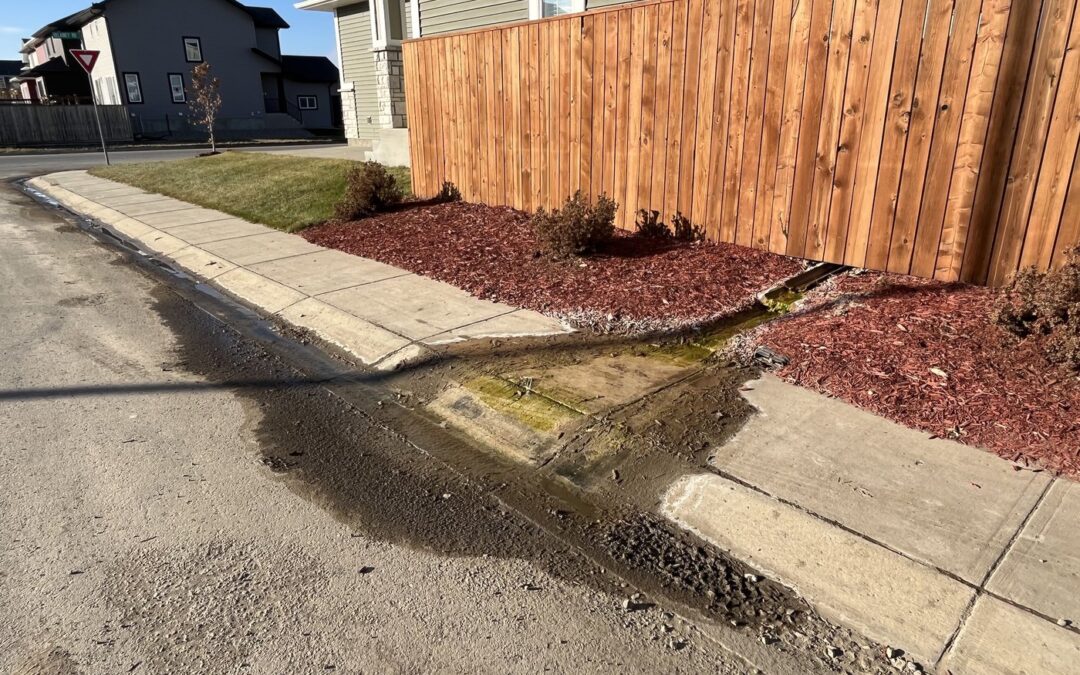
Photo: Sump-pump water is spilling across sidewalks, creating mud, algae and winter ice.
By: Sonal Gupta
Local Journalism Initiative Reporter
Canada’s National Observer
For some residents in Saskatoon’s newer neighbourhoods, owning a home means monitoring the pump that keeps the basement dry.
Sump pumps are designed to keep water out of basements after snowmelt or heavy rain. But in parts of the city, the water below ground sits so high that some pumps run for months, sending water across lawns, sidewalks and streets.
“What we seem to be doing of late is constructing basements into the groundwater,” said Vanessa Heilman, principal geotechnical engineer with Saskatoon Water, at a May 15 meeting of the city’s environmental advisory committee.
Heilman said sump pump concerns now make up about half of the problems handled by the city’s drainage bylaw team.
The problem is increasingly showing up in the neighbourhoods of Brighton and Rosewood, with similar concerns in the Hamptons, Evergreen and Willowgrove, Heilman told Canada’s National Observer.
“It’s definitely ballooned in the past, I’d say, five years,” she said.
That has left residents dealing with soggy yards, bad smells from soaked grass, slippery algae in summer, icy sidewalks in winter and the worry of what happens if the pump stops working.
For years, the issue surfaced as one-off complaints, but more recently, it has become a larger planning problem for Saskatoon, raising questions about what should be known before homes are built, what buyers can find out before they purchase and how costly fixes would be handled. The city is weighing measures for future homes, including more pipes, earlier groundwater testing and different land uses.
A city survey last summer gave officials a partial picture of the problem. Heilman said it did not capture the full scale of the problem, but among 846 respondents, 137 reported problems from pump failure, 54 reported winter backup issues and seven reported summer backups.
Some of the discharged water is also draining into park space, killing grass and increasing the need for mosquito treatment, Heilman added.
People are beginning to ask the city about groundwater before buying or building in Brighton, but some data belongs to developers and cannot always be shared, she said.
Now, the city is reviewing how new homes are built in high groundwater areas to stop the problem.
Grant Ferguson, a professor in the School of Environment and Sustainability at the University of Saskatchewan, said a sump pump running all the time is a warning sign. “Sump pumps should only be operating during extreme weather events,” he said. “They’re not designed to be running 24/7 for months at a time.”
Homes relying entirely on a sump pump are vulnerable, he said. If it breaks, freezes or loses power, the water has nowhere to go. “You go away for the weekend and suddenly your sump pump fails and you come back and your basement’s full of water,” Ferguson said.
Heilman said part of the problem traces back to a 2004 policy change. Before then, many home drainage systems were connected to the sanitary sewer system. During heavy storms, this contributed to sewer overflows and basement backups. The city banned those connections in new homes, requiring instead that water be pumped outside.
At the same time, Saskatoon’s outward growth has brought development farther from the river, where groundwater levels are higher, particularly in clay-rich soils where water drains slowly.
Robert Halliday, a Saskatoon-based water resources consultant and engineering hydrologist, said he has long heard about water problems in Rosewood and believes Saskatoon should look closely at how neighbourhoods with known water issues were planned and approved, including whether the problem was understood before homes were built.
Developers are already required to submit a hydrogeological study early in the planning process to look at groundwater and soil conditions, Heilman said.
But those studies can come long before a neighbourhood is finished, she added. Large developments can take decades to build, while underground water levels change by season and year. By the time a more detailed geotechnical study is done, roads, major pipes or earlier phases of the neighbourhood may already be set, making some fixes harder. “Groundwater isn’t consistent,” Heilman said.
The city is considering several fixes for future neighbourhoods, including requiring each property to have a storm connection, although Heilman said that would be expensive for developers and could face pushback because it would mean putting many more pipes in the ground.
Another option is a small drain on each property directed through a pipe to the storm sewer. Developers would only be exempt from that requirement if they could show water does not sit close below the ground.
The city is also considering earlier groundwater testing, so developers know where extra drainage or different land uses, such as parks, commercial buildings or homes without deep basements, may be needed.
Other prairie cities handle the problem in different ways, Heilman said. Calgary and Edmonton use stormwater connections that allow water from sump pumps to drain into the storm sewer. Winnipeg allows some pump water to connect to the sanitary sewer for a fee, though Heilman said that model is not perfect because one home may pump far more water than another.
Saskatoon plans to speak with home builders, developers and their consultants this summer before recommending changes for future neighbourhoods.
Halliday said the city needs to understand how rain, snowmelt and groundwater interact before choosing fixes for future neighbourhoods. A small drain or stormwater pond may help in one area, but not necessarily in another. “There’s no guaranteed one-size-fits-all solution to this problem,” he said.
Ferguson said it is hard to know whether Saskatoon will become wetter or drier overall, but climate change could bring more extreme weather and sharper swings in underground water levels.
“What might have been a high water table in the past and a relatively rare event, that could be more common going forward,” Ferguson said.
There is federal funding available for cities to help reduce flood risk and improve wastewater and stormwater capacity, including through the Disaster Mitigation and Adaptation Fund and the Canada Housing Infrastructure Fund (CHIF).
However, the city said, so far, funding has gone to established neighbourhoods and infill areas, not the newer neighbourhoods seeing many sump pump complaints.
Heilman said there is no current plan to fix the problem for residents already living with it in places such as Brighton. “There’s not really a silver bullet option here that fixes everything for everyone,” she said. “This is a difficult issue.”