
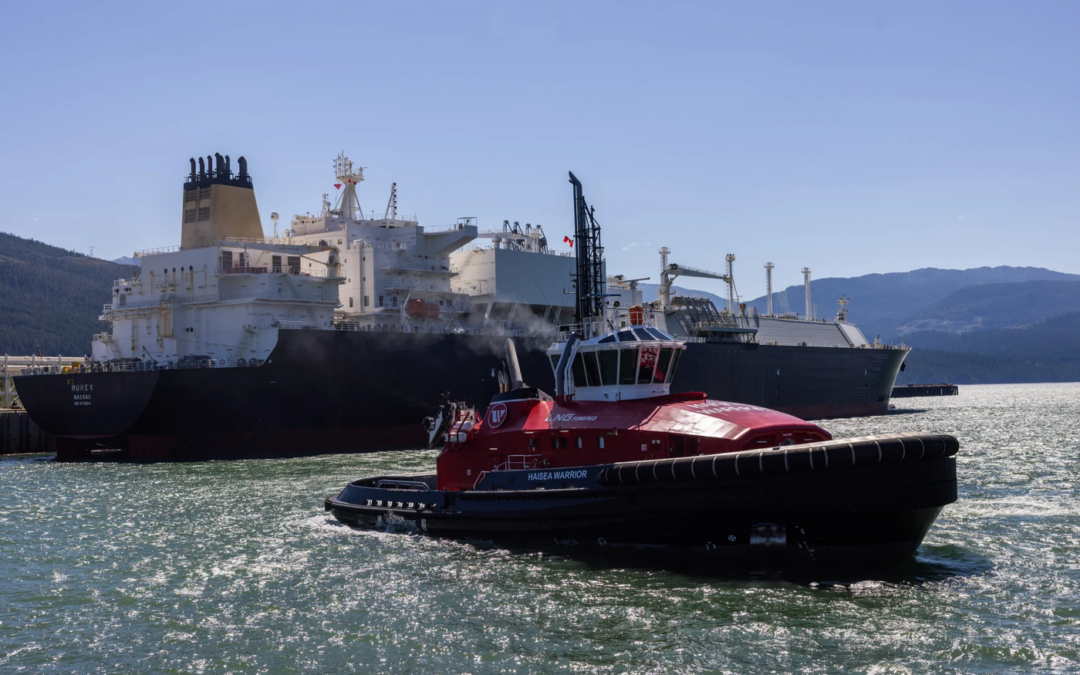
Photo: Tugboats move near an LNG carrier at LNG Canada in Kitimat, BC, during Premier David Eby’s tour of the facility on July 29, 2025.
By Sonal Gupta
Local Journalism Initiative Reporter
Canada’s National Observer
A BC citizens’ group and its lawyers are warning Ottawa it could face Charter challenges if it uses public money to support new or expanded fossil fuel projects, including major LNG developments in British Columbia.
Ecojustice lawyers, acting for Citizens for My Sea to Sky, recently sent a legal letter to federal ministers and Crown corporations, including the Canada Infrastructure Bank and Export Development Canada. The letter says new subsidies or financing for projects such as Ksi Lisims LNG, LNG Canada Phase 2 or a new oil pipeline, could violate Canadians’ constitutional rights — on the basis that public financing for these projects would worsen the climate crisis and increase risks to Canadians’ Charter-protected rights, including the right to life, security of the person and equality.
“The subsidies drive the project; the project [drives] the emissions; the emissions drive the harms and the risk of harms,” said Ecojustice lawyer Charlie Hatt.
Lawyers involved say the impacts of climate change are already being felt across Canada.
Patrick Canning, another environmental lawyer who advised the citizen group, pointed to the 2021 BC heat dome that killed more than 600 people, the 2016 Fort McMurray wildfire, worsening wildfire smoke drifting across parts of the country and related health effects such as asthma attacks.
He also pointed to the death of a nine-year-old BC boy whose asthma attack was linked to wildfire smoke, and to research estimating that tiny toxic particles from Canadian wildfires contributed to 82,000 deaths worldwide.
Ecojustice says those harms raise Charter questions, including the right to life and security of the person under Section 7 and equality rights under Section 15.
Canning pointed to a 2022 federal report on climate and health, which documented deaths and illnesses linked to climate change.
“There’s no question that the federal government is well aware of the serious impacts,” he said. “They should be ready to explain why they are funding those harms.”
Canning said while no Canadian court has yet ruled on whether fossil fuel subsidies themselves violate the Charter, recent climate cases suggest courts are increasingly open to hearing rights-based climate claims. “You can’t really argue that climate change isn’t real anymore.”
In Ontario, the Mathur lawsuit has become a major climate-rights case, with young people claiming the province’s weakened climate targets violate their Charter rights by putting their health, safety and futures at risk.
Canning said proving the BC case would rely on government health studies, expert evidence linking a project’s emissions to climate harms and recent precedents like the Mathur and La Rose cases, where Canadian courts ruled that Charter claims tied to government climate action can proceed.
The Ecojustice letter says, in addition to the climate impacts, the projects and related infrastructure face legal challenges and lack consent from Indigenous nations and peoples.
While the legal theory remains untested in Canada, Canning pointed to a UK case involving a challenge to the British government’s decision to help finance a major LNG project in Mozambique through its export credit agency. Climate groups argued officials failed to properly assess whether the project aligned with the Paris Agreement or fully considered its climate impacts. But the courts ultimately dismissed the case.
More than 3,000 climate-related cases have been filed worldwide, up from 884 in 2017. Most are still in the Global North, but cases from the Global South are slowly increasing.
Hatt said the Canadian argument is not limited to LNG. It could also apply to public support for oil pipelines or other high-emitting infrastructure if government financing helps those projects proceed.
Before advising the citizens group on their legal options, Ecojustice is monitoring whether federal financial institutions provide subsidies or other public support to fossil fuel projects, Hatt said.
No formal response from the federal government has been received, he added.
Canada’s National Observer reached out to federal ministers and Crown corporations but did not get a response before the publication deadline.
The warning comes as questions grow about the financial outlook for BC’s LNG industry.
Earlier this year, Shell and Mitsubishi were considering selling stakes in LNG Canada, even as the project’s owners considered a Phase 2 expansion. Shell was looking for buyers for up to 30 per cent of the project, while Mitsubishi hired RBC Capital Markets to review options for its 15 per cent stake.
Thomas Green of the David Suzuki Foundation said those market signals make it harder to justify public investment in new LNG projects. He said global demand is shifting as countries move toward renewable energy, batteries and heat pumps, while Canada remains a relatively high-cost LNG producer, meaning projects such as Ksi Lisims LNG and LNG Canada Phase 2 could be undercut by cheaper global competitors.
“A few years ago, building LNG import terminals may have looked sensible,” Green said. “Now it looks very dubious.”
Projects unable to stand on their own financially may only move ahead if governments “start shovelling out subsidies,” he said.
LNG projects could leave taxpayers exposed twice: first through subsidies, loan guarantees or public financing and later, through cleanup or decommissioning costs if projects become stranded assets, said Green.
“As ordinary Canadians struggle with costs of living, it’s a weird time to ask the average person to contribute more, so rich fossil fuel companies can take on a risky project that probably shouldn’t go ahead,” he said.
Sonal Gupta / Local Journalism Initiative / Canada’s National Observer.