
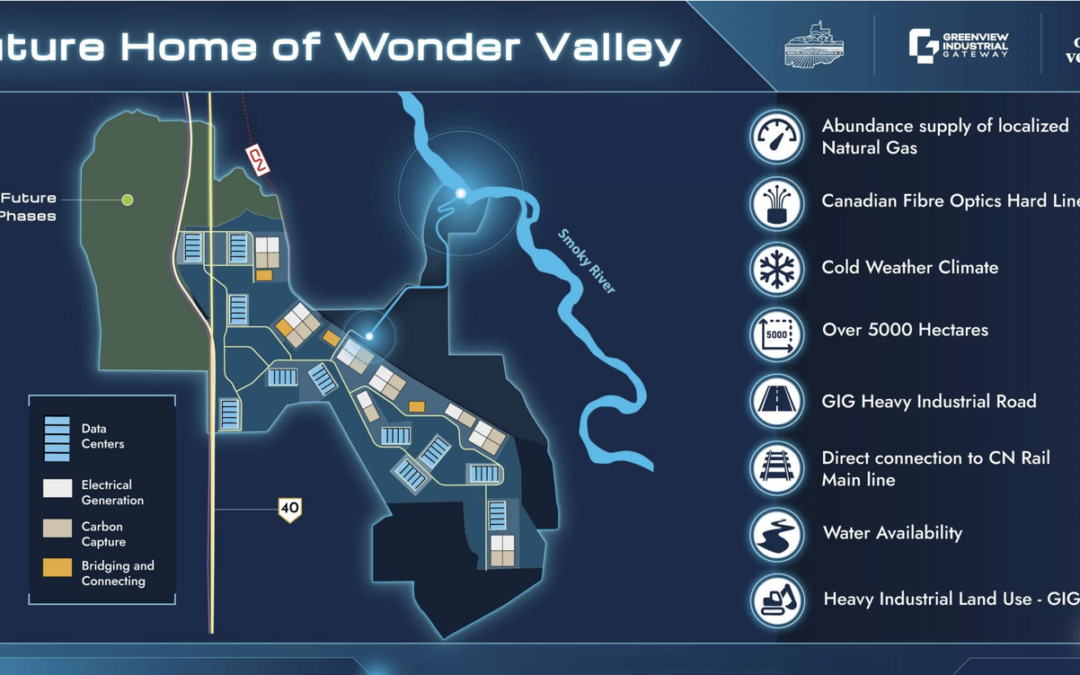
Photo: O’Leary Ventures says it found the perfect spot to bring the world’s largest data centre, called Wonder Valley, to northern Alberta, just south of Grande Prairie in the Greenview Industrial Gateway. An appeal of the water license brought forward by Sturgeon Lake Cree Nation was dismissed in April.
By: Chris Zwick
Local Journalism Initiative Reporter
Town & Country News
Sturgeon Lake Cree Nation (SLCN) is not directly affected by the water license granted to the Wonder Valley data centre project south of Grande Prairie and does not have standing to appeal.
The ruling related to the project proposed in the Greenview Industrial Gateway (GIG) came in a written April 17 decision released by the Environmental Appeals Board (EAB).
The decision written by EAB chair Barbara Johnson recognized the First Nation’s interest in the license being issued for the Smoky River but ultimately dismissed its appeal, saying there was no evidence provided that the nation or its members would be adversely affected by the license.
“The board finds (SLCN) has a direct or personal interest in the area near the point of diversion for the (water license) and in the quality and quantity of water in the Smoky River and the Smoky River Watershed that could be adversely affected by the decision of (the province) to issue the licence.
“In contrast, (the MD of Greenview) has provided evidence that the licence is anticipated to have a negligible impact on the Smoky River and the Smoky Watershed, and fish habitat as demonstrated by (Fisheries and Oceans Canada’s) Fish Habitat Summary,” the decision went on to say.
The appeal
The main contention was the 10-year water license granted April 2025 by the province that allows the GIG to pump six million cubic metres from the river every year. To note, Environment and Protected Areas also issued a preliminary certificate for up to 24 million cubic metres per year until 2034. This gives the GIG a spot in the line to collect from the watershed but is not an actual license to start pumping.
The other is what SLCN chief Sheldon Sunshine sees as a wilful lack of consultation — he found out about the project through a media release. He said he’s surprised by the EAB decision, considering the size of the project, but the dismissal was not all that unexpected.
“We’re disappointed, of course, but with the significance of that project, it was actually surprising,” he said. “But again, we kind of expected something of that nature. The province and these groups are adamant that they’re going to push this thing through. So, we kind of expected it.”
SLCN argued its members still use the area to hunt, fish, trap, gather and exercise their treaty rights and rely on the river for drinking water. Indigenous consultations are the government’s duty under Treaty 8.
MD of Greenview Reeve Ryan Ratzlaff said he was “a little disappointed at the appeal in the first place.”
“For the volume of water that we were applying for license on, in the grand scheme of things, it was a very small amount that is regularly approved through Alberta Environment,” he said, adding there has been little opposition to other projects on the river that used far more water.
The EAB ultimately agreed with the MD, and ruled in favour of the requested dismissal, saying the Nation provided no evidence their traditional uses will be affected negatively by the project.
The MD of Greenview and Ministry of Environment and Protected Areas’ “evidence was that the impact to the Smoky River from the diversion authorized by the licence would be temporary and negligible, representing approximately 0.0556 per cent of the yearly flow rate of the Smoky River and less than 1 per cent of the daily flow of the Smoky River,” the decision read.
As a result of that finding “the board did not consider whether the grounds of appeal raised by the (SLCN) were within the board’s jurisdiction.”
“The board can consider evidence of constitutional rights as evidence of a right to access or use an area or resource. However, the board is not a constitutional decision-maker … and does not have jurisdiction to consider constitutional questions including the adequacy of consultation.”
Foregone conclusion?
“We were anticipating that something like this would come along and of course we’re not happy about it, and we’re going to do everything in our means to address it,” said Sunshine, who also shared he recently met with Minister of Environment and Protected Areas Grant Hunter. He said he got the sense the project was going to happen one way or another.
“The messaging that we got is that they’re limited in their scope, based on Supreme Court of Canada, so our expectation is that there’ll be, as we’ve seen over the last several months here, with Canada, working with the province and trying to streamline their processes. We’re anticipating the worst as always,” said Sunshine.
He reiterated as he has in the past that the SLCN is not against the development but feels the duty to consult was overlooked.
“We’ve been running across that with the ACO (Aboriginal Consultation Office) process and the AR (adequacy review) processes. In recent months, we’ve been doing a lot a lot of work and finding that those things are failing our people, not only our people, but average Albertans, right when you have drought conditions throughout the province,” he said. “It really is hard to believe that a project of this magnitude doesn’t require an environmental impact assessment through the province.”
The independent news site the National Observer reported in April the province would be waiving an environmental assessment of the project because it will use standard water and power systems.
Reeve Ratzlaff sees it a different way.
“The environmental assessment, in some ways, Greenview did it when we started designing the GIG years and years and years ago. We had to get a bunch of approvals in place for heavy industrial parks, major petrochemical processing facilities,” he said.
“I think that’s part of the decision to forego that, but that doesn’t mean they don’t have to get all their environmental permits. I would like to say that it’s more of an acknowledgement of the work that’s already been done on this site.”
The Impact Assessment Agency of Canada has requested information from the developer and will consider if a federal assessment is necessary. Many more technical assessments on the impact to the air and water will also have to be completed to receive the appropriate permits.
Ratzlaff said technology is moving so quickly that the 24-million cubic metre preliminary certificate may never have to be used.
“When they first came to us, they were talking that, at full design build out, they would need the full 24 million cubic meters of water that we have the preliminary license for. As technology is changing, they’re looking at this 6 million cube water license like it will do for the life of the project,” he said.
What is it?
The Wonder Valley project, once built, will be home to the world’s largest AI data centre and is backed by celebrity billionaire Kevin O’Leary’s O’Leary Ventures, which entered a partnership with the MD of Greenview in late 2024, after expressing intent to purchase the land.
On his O’Leary Digital platform, the TV dragon hyped Wonder Valley, saying his team “has sourced what we believe is the most compelling site in all of North America to generate over 7.5 gigawatts of low-cost power to hyperscalers over the next five to 10 years.”
Data centres are the backbone of modern computing infrastructure. Essentially, entire buildings filled with processing and storage units that increase their capacity exponentially as needed. The facilities are used to provide cloud storage solutions and train artificial intelligence software to solve problems using the breadth of online human knowledge and learn from it.
The Wonder Valley campus, as it’s called in the promotional video on the same platform, is meant to be self-reliant, producing its own power thanks to an abundance of natural gas in the region. The data centre buildings will be mixed in among administrative offices and amenities to serve those who work there, giving more of a community feel than anything industrial.
“Given existing permits, proximity to stranded sources of natural gas, pipeline infrastructure, water and a fiber-optic network within just a few kilometers of the Greenview Industrial Gateway, we will be in the ground and up and running sooner than any scale project of its kind,” O’Leary said.
Ratzlaff is just as hyped to see the project progress further, as it will bring a new industry into the region and the professionals and support who will help it be successful.
“That’s the exciting part for the region; it’s the skills and the knowledge and the diversity of jobs that this is going to bring with this. It’s just going to give so much more opportunity.”