
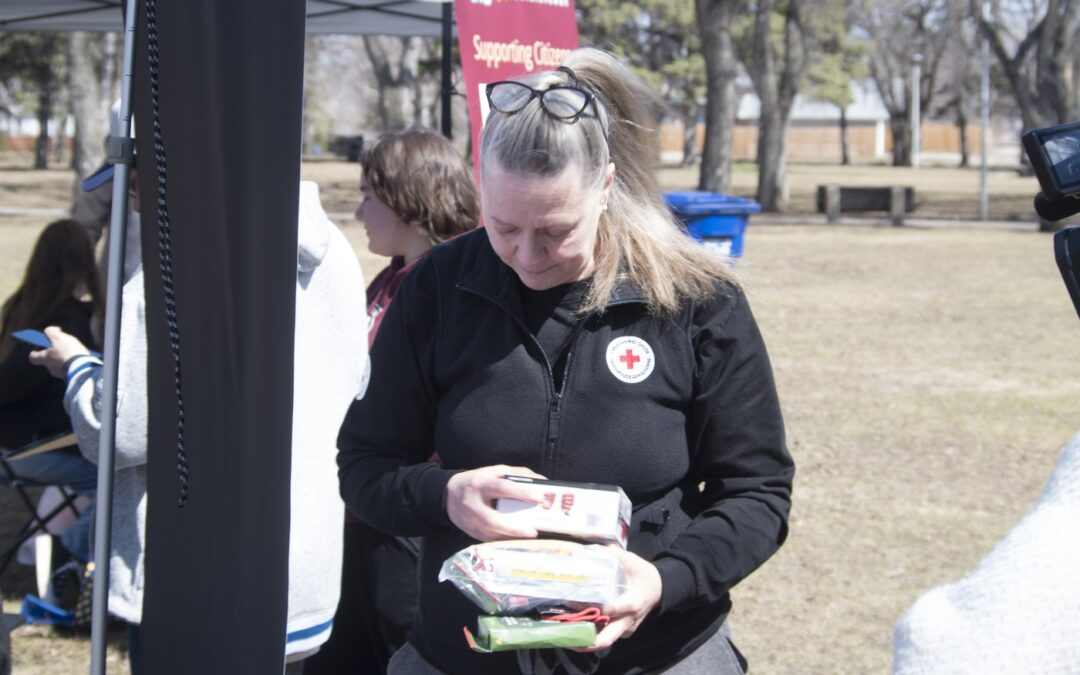
Photo: Jason Kerr/Daily Herald The Red Cross’ Georgiana Matharu shows off some of the items residents should have in their Emergency Preparedness Kit during a barbecue in Kinsmen Park on Friday.
By: Michael Oleksyn
Local Journalism Initiative Reporter
Prince Albert Daily Herald
The Metis Nation-Saskatchewan (MN-S) and the Canadian Red Cross (CRC) had a barbecue for Prince Albert residents at Kinsmen Park on Friday to celebrate National Emergency Preparedness Week, and ensure residents know what to if forced to evacuate.
“We wanted to have it here in PA as PA is the gateway to the North,” said Colbi Kuppenbender, Climate Emergency Specialist with Metis Nation-Saskatchewan. “Last year we had a lot of wildfires and obviously many Northern residents made their way to PA during the evacuations.”
The National Emergency Preparedness Week started on Sunday, May 3 and lasted for the whole week leading to the barbecue on May 8.
The 2025 wildfire season was one of the most difficult on record. The province dealt with more than 500 fires, which led to evacuations in more than 50 communities.
“In the light of that we just want to be a little more prepared for the upcoming season and just get our faces out there and show that if stuff is going to happen, we are going to deal (it) and if Metis citizens need help we are here to help them,” Kuppenbender said.
In addition to the barbecue, emergency responders were on scene to help answer questions, along with Red Cross and MN-S representatives. Kuppenbender said the goal is to help people understand what services are available should they find themselves in an emergency.
They also gave away emergency kits and supplies to those who needed them.
The event was sponsored by the Red Cross, and the MN-S did the planning and organizing.
“We want the people out there to know that Metis Nation can help anyone not just the citizens only but everyone in need,” Kuppenbender said.
The MN-S just started offering emergency management planning. Kuppenbender said they were “thrown into it” last year when the evacuations started happening.
The MN-S opened the Batoche evacuation site, and are available to do so again should the need arise.
In total, the Batoche site hosted 150 to 200 evacuees for nine days. The MN-S also had staff members offering counselling services and support to between 500 and 600 evacuees who stayed at hotels in Prince Albert, Regina, and Saskatoon.
“It was quite stressful,” Kuppenbender said. “I think it was stressful for everyone involved with emergency management last year with the evacuation of La Ronge but overall it was positive. We heard lots from the communities (saying) they felt really welcomed and that having Metis Nation there was really positive. They felt comfortable going to them. They hadn’t really felt that before. They were really happy with the counselling services that were provided, so it was just an overall positive experience.”
Kuppenbender added that they plan to assist evacuees staying in hotels again this summer, should the need arise. She said they’ve already spoken with the Saskatchewan Public Safety Agency (SPSA), who have given them the go-ahead to help out.
The organizers learnt from last years’ experience that it is important to have a plan in place beforehand, and also show residents how they can be involved in their own communities.
“People are very interested in it (emergency preparedness), how they can be prepared and what they can do to get ready with their love ones to make sure they come of it complete and as safe as possible,” said Georgiana Matharu, Leading Government and Strategic Relationships for Canadian Red Cross in Saskatchewan, Manitoba and Nunavut.
Matharu was one of several Red Cross representatives providing advice and knowledge at Friday’s event. She said being prepared means knowing the risks, making a plan to deal with it, and making a kit, but good communication is the most important part. On Friday, Matharu and other Red Cross reps encouraged residents to do just that.
“You can make a wonderful plan, but if nobody knows about it, it’s not really going to be very helpful,” she explained. “The biggest piece is talk about it with your friends, talk about it with your family, (and) know where that kit is. It’s no good tucked away in the basement. It needs to be somewhere where you can quickly grab it and get out of the house.”
Additional tips for emergency preparedness include always having gas in your car, keeping a spare set of keys somewhere outside the house, and having a contact outside of the area you live in that you can call in an emergency.
“These are simple things but they are very effective,” Matharu said. “The Emergency Preparedness Kit is just a starting block. It’s the basic tools.”
The kits contain basic tools like water canisters, and a whistle. However, Matharu suggested residents “bulk” it up by adding baby diapers, gloves, glasses, and other items. There are also clean-up kits and flood kits to assist in different circumstances.
Matharu said Friday’s barbecue was a great opportunity to get their message out.
“If a family goes away from this thinking ‘we should be sitting down together and making a plan’ they can go on redcross.ca and pull off the household plan and start filling it in,” she said. “(It’s) simple things, like if a child is at school, how do they get re-united with mom and dad or their care-giver if the emergency happens while they’re at school. Today, we are really looking at sharing information in a safe environment.”
She also advised on getting information from trusted sources like the media, cities, towns, band councils, and the organizations in charge providing services instead of relying on rumors on social media.
“Make sure the source of information that you are relying on is trusted,” she said.
–with files from Jason Kerr/Daily Herald