
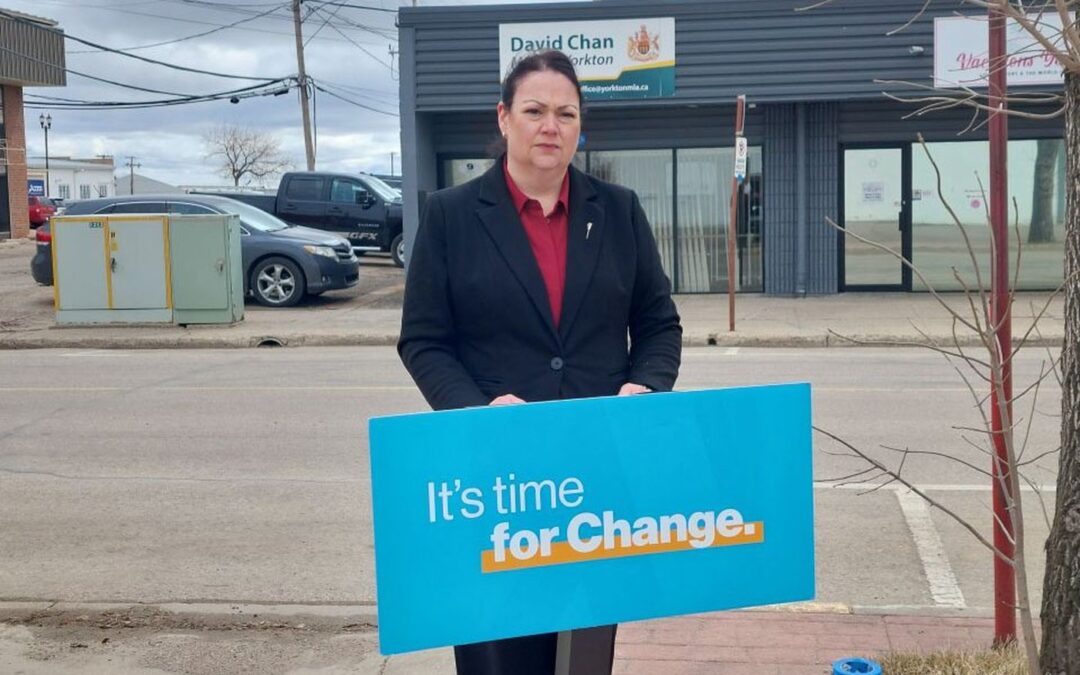
Photo: Jacqueline Roy, Shadow Minister for Women’s Health, outside MLA David Chan’s office in Yorkton. / Andrea Moss, Local Journalism Initiative Reporter, SaskToday.ca
By: Andrea Moss
Local Journalism Initiative Reporter
SaskToday.ca
The homelessness and addictions crisis in Yorkton has escalated from a looming threat to a “full-blown emergency” that is outstripping the provincial government’s response, according to NDP Shadow Minister for Women’s Health, Jacqueline Roy.
Standing in solidarity with local frontline workers, Roy is urging the Moe government and Yorkton MLA David Chan to provide immediate funding for mental health and housing. She noted that the city’s only 20-bed shelter, Bruno’s Place, is currently overwhelmed, leaving the community’s most vulnerable with nowhere to turn.
A “Perfect Storm” at Bruno’s Place
Roy characterized the current situation as a “perfect storm” created by decades of underinvestment. In Yorkton, the gap in services has forced non-profits and the local food bank to shoulder additional burdens.
She quoted Angela Chernoff, coordinator of Bruno’s Place: “We have parole officers calling last minute looking for shelter spots. We’ve seen clients with brain injuries from drug use, more people struggling with mental health issues, and more persons displaced by rising rents.”
Roy said that Yorkton remains a “desert” for essential services, lacking a local drug treatment facility, transitional housing, and sufficient psychiatric beds.
The government’s response
MLA David Chan responded by acknowledging the complexity of the issue, stating that homelessness and addiction are not caused by a single factor.
“Addressing them requires a coordinated approach involving healthcare providers, municipalities, law enforcement, and community-based organizations,” Chan said. He pointed to the provincial government’s 2026-27 investment of $674 million into mental health and addictions. According to Chan, this funding will help add nearly 200 treatment spaces by the end of the fiscal year, building on the 800 already in operation.
The debate over Bill 48 and privatization
The tension between the parties is perhaps most evident regarding Bill 48 (The Compassionate Intervention Act). The NDP argues that the legislation needs major amendments to prevent the “outsourcing” of care to for-profit companies such as the Edgewood Health Network (EHN).
Roy accused these private providers of “swooping in like vultures” to profit from a weakening public system. “It is another example of the Moe government putting profits over people,” she claimed, noting that nearly one person per day died in Saskatchewan last year due to drug overdoses—a failure she described as “moral.”
Chan defended the model, stating that public-private partnerships are intended to reduce wait times. “The goal is not private delivery for its own sake; the goal is ensuring people can access the care and treatment they need when they need it, without paying out of pocket,” Chan said.
Seeking permanent stability
Roy concluded that Yorkton deserves a government that doesn’t leave local charities “holding the bag.” She is calling for a comprehensive provincial plan that focuses on permanent housing stability and robust public mental health care rather than temporary measures.