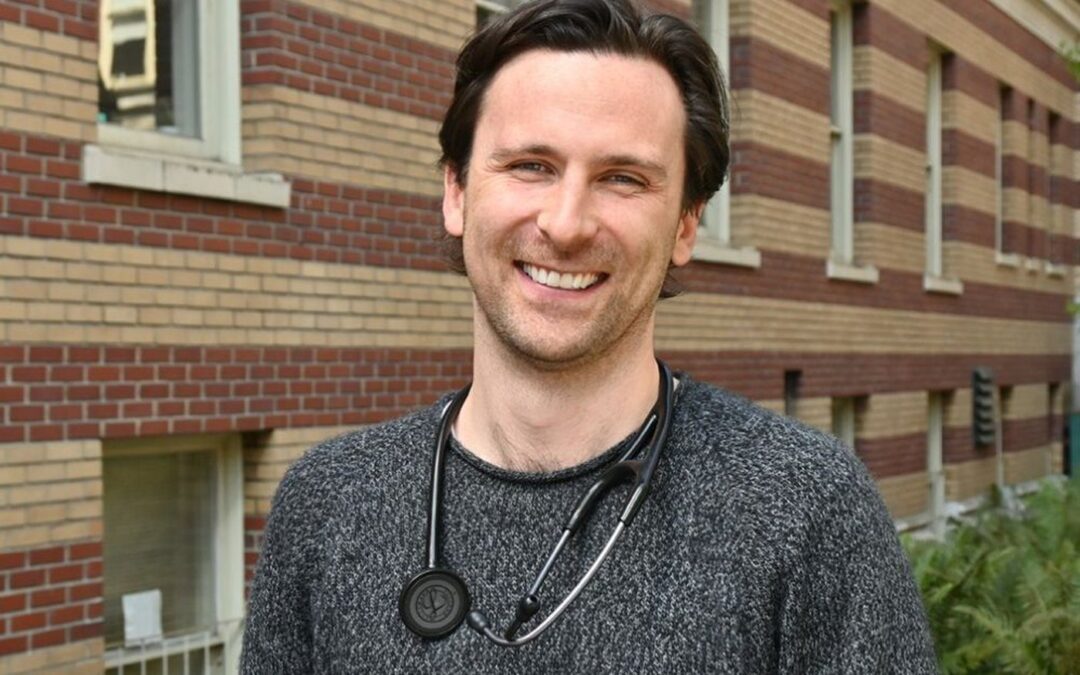
Photo: Cardiologist Dr. Miles Marchand, a member of Syilx Okanagan Nation, is bringing specialist heart-health care to remote Indigenous communities. / Michelle Gamage, Local Journalism Initiative Reporter
The Tyee
An Indigenous-led health care solution called One Heart at a Time is bringing specialized heart-health care to remote Indigenous communities.
The program was created by Dr. Miles Marchand, a preventative cardiologist and cardiac rehabilitation specialist with Vancouver General Hospital, St. Paul’s and Carrier Sekani Family Services, and member of the Okanagan Indian Band (Syilx Okanagan Nation).
The premise is simple: bring cardiac specialists — and the tools they need to do their jobs — to remote communities rather than asking community members to leave their community every time they need to see a specialist.
The execution is challenging, mainly due to how remote the communities of Takla Landing, Yekooche, Saik’uz, Nadleh, Burns Lake and Stellat’en are. These are the communities One Heart at a Time partnered with to run its pilot project last fall.
B.C.’s main cardiology centres are in the greater Vancouver area, Victoria and Kelowna — which is an incredibly long way to travel for people in remote communities.
Travelling from Takla Landing to Vancouver, for example, requires a five-hour drive down a logging road in a vehicle with all-wheel drive and radio capability, where the driver has to radio in their location every kilometre and yield to oncoming logging trucks. There is no cell service in the area. Once they get to Prince George, they have to take an hour and a half flight to Vancouver.
Each community will generally have a health centre and variable access to health-care providers, sometimes with a regular nurse and visiting family doctors, Marchand said. To access things like a pharmacy, a specialist, or specialized testing, patients will have to leave the community.
B.C.’s health care system is designed to support urban health care, which means the more remote a community is, the more challenging it is to access health care, said Dr. John Pawlovich, a rural family doctor and medical director for Carrier Sekani Family Services.
Rural communities are even being left behind with online health care, which requires cell service or broadband internet, he said. Many remote Indigenous communities don’t have that infrastructure, he added.
“Your postal code will determine your ability to access digital health, pharmacies, doctors, physiotherapists, dentists and so forth,” Pawlovich said. It also determines how quickly you can access health care in an emergency.
Patients wait for “shockingly long amounts of time to get transported,” and might be flown to Prince George only to realize they have to take a second flight to Vancouver, Victoria or Kelowna, he said.
“It separates families and adds stress,” and often requires sick or recovering people to travel on dangerous roads to access care or get home, Pawlovich continued.
It’s “common” for patients to face so many barriers when trying to access care that they do without, which lowers people’s life expectancy in these communities, he said.
Bringing specialists to the community
Marchand says when he first visited Takla Landing as a resident doctor, he only had a stethoscope around his neck. He worked for Carrier Sekani Family Services, visiting member communities for years, before starting One Heart at a Time in 2025.
That provided a sharp contrast to working in Vancouver where every test a patient could need is “at your fingertips,” he said.
“A lot of making cardiac diagnoses really relies on these tests and without being able to make a diagnosis it’s really difficult to treat people,” he said.
Marchand says his “lightbulb” moment for creating the program happened when trying to treat a patient with a significant heart murmur who needed an echocardiogram of his heart to diagnose a serious valve problem. But there were too many barriers and logistical challenges for the patient to get to Prince George for a test.
He was “getting worse and worse in the community, but without diagnosis it’s difficult to initiate this specific treatment,” Marchand said.
The patient ended up needing to be transported to St. Paul’s Hospital by helicopter and requiring surgery.
If the patient could have accessed the test more easily he could have started treatment sooner and wouldn’t have gotten so sick, Marchand said.
It was clear something needed to be done to bring care to communities, rather than requiring people to travel to access care. The seed for One Heart at a Time had been planted, and was beginning to sprout.
Anti-racist health care
In addition to facing geographic barriers, people from Indigenous communities often face wide-ranging anti-Indigenous racism in health care. This, too, can prevent people from seeking or accessing care.
Deborah Page, an Elder, language co-ordinator and member of the Saik’uz First Nation, says she was recently sent to Vancouver by her family doctor to access heart-health tests.
She drove an hour and a half to get to Prince George, flew to Vancouver, navigated the city’s transit system — as well as the confusing corridors of St. Paul’s Hospital — and never saw a specialist.
“I flew all the way down there. You would have thought I would have met a doctor, had someone listen to my heart. But I never met them, I don’t even know what they look like,” she said.
Page says she’s still “spry,” and can drive and navigate a new city, but added that she could understand people feeling overwhelmed by the process.
As an added burden she says there was a miscommunication between Carrier Sekani Family Services and herself, where a plane ticket was double booked. Page says she’s lucky she could spend an unexpected $1,200 to fly last-minute to Vancouver, but may not get reimbursed due to the miscommunication.
Melanie Labatch, a councillor for the Saik’uz First Nation and a registered nurse, says it’s important to keep humanity in health care.
“This is very personal work — it’s their body, their life,” she said. “A doctor should come, see you face to face and talk to you. Health care is not just technical.”
Making patients travel to access health-care services adds an extra burden for Indigenous peoples and creates gaps in service, Labatch said. This all feeds into why being Indigenous is considered a social determinant of health in Canada, she added.
Bringing care to the community overcomes those barriers and improves cultural safety, Marchand said, “because we’re showing patients that we actually care and value their health enough to come to them, for one thing, but also providing it in these clinical spaces in their own community where they feel inherently safe.”
He added, “this kind of Indigenous approach to care really combats the status quo and reimagines how cardiovascular care can be delivered.”
Page agreed. She says she accessed One Heart at a Time last fall and it was “awesome.”
The One Heart at a Time team was composed of a cardiologist, a family physician, someone to run an echocardiogram and a stress test, and a medical office assistant for administrative supports.
The team isn’t able to provide CTs or MRIs, Marchand said.
Thanks to the One Heart at a Time team bringing the specialists and equipment to her, Page said getting to the appointment was incredibly easy — she could take a short break from work, walk across the road and see a specialist, she said, adding that the specialist spoke to her, and listened to her and her heart.
The pilot project’s results
The results of the 2025 pilot project are pretty incredible.
Over nine days in the fall of 2025 the team visited six communities and did 104 cardiology consultations. The team completed 81 echocardiograms, 65 stress tests, 52 electrocardiograms and 77 point of care blood tests for patients who had been referred to cardiac evaluation by their family doctor.
Marchand says this is a similar case load to what he has on a regular day in Vancouver.
More than one-third of the patients they saw had been referred to a specialist but were unable to attend that visit, and over one-third had previously had a cardiac test ordered that they were unable to attend, Marchand said.
“About one in three patients had a new cardio-metabolic diagnosis as a result of the program,” he said. “That’s a big clinical impact. We had changed their clinical management in more than 80 per cent of the patients that we saw.”
This highlights how patients aren’t able to access the care their doctor says is important, he added.
The pilot project also saved patients some serious travel time.
“In nine days we saved patients 70,000 kilometres, or 960 hours, of driving,” Marchand said. “You can imagine the impact this can have when we expand to other communities, or just into the longer term.”
These calculations don’t consider how most patients will need to leave their community to access care multiple times for different tests, and pay out of pocket to stay overnight in places like Prince George.
“So that burden is actually bigger than even what those calculations show,” Marchand said.
Patients also really liked the program.
Of the 104 patients seen, Marchand said: 99 per cent said they wanted to see the program continue; 96 per cent said they felt culturally safe; 96 per cent said they were able to get care they would otherwise have difficulty accessing; and 93 per cent said the program had a positive impact on their health.
Scaling up the program
Now that the pilot project has proven the concept, Marchand says the program will be able to be scaled up thanks to funding and support from Doctors of BC, the Dilawri Cardiovascular Institute, Providence Health Authority and the VGH and UBC Hospital Foundation.
To scale up Marchand said he wants to commit to visiting the communities One Heart at a Time is already operating in at least twice a year, and expand the program to other Indigenous communities.
Page and Labatch were delighted to hear the program was coming back, and said they wanted the program to be permanent.
“My medium-term dream is to outfit a sprinter van as a clinical space where we can have the equipment retrofitted in the vehicle so patients have clinical spaces standardized in the vehicle,” Marchand said. The Dilawri Cardiovascular Institute has committed funding to do this, he added.
One day, care for lung disease, kidney disease, thyroid disease, diabetes and cancer could be delivered in a similar way, he said.
Patients can still travel to urban centres for care if they prefer — although in urban centres wait times to see a cardio specialist can be around 14 months, Marchand said.
It’s “really exciting and powerful” to have an Indigenous-led and Indigenous-centred program informing how B.C. cares for rural and remote communities around the province, whether they’re Indigenous or not, he said.
Two limitations for how much the program can scale up will be funding, because scaling something to a provincial level will require provincial funding, and time, because it takes time to create relationships and pathways for each individual community, Marchand added.
There’s also the larger trend of the emptying out of small-to-medium-sized communities as mills close and banks, hospital maternity wards and pharmacies pack up and move away, Pawlovich said. This further restricts access to health care for these smaller communities, and for the bulk of B.C.’s resource workers who live in these small-to-medium-sized towns.
“It’s the right of Canadians to have reasonable access to health-care resources,” he said, “and over time the concentration of health-care resources into centralized centres has really, really disadvantaged these communities.”
Marchand says his team is gearing up for its second circuit and will be visiting communities starting in May.