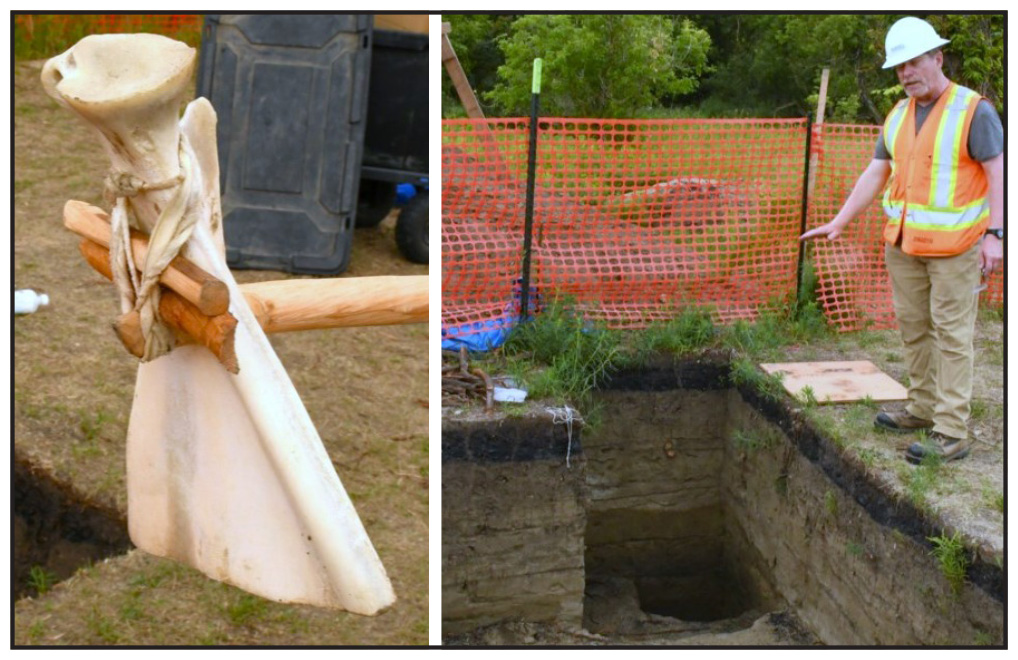
Photos left to right: A reconstructed bison scapula, based on artifacts recovered at the Garratt Site in Wakamow Valley, is believed to have been used as a digging or gardening tool. Archaeologist Alan Korejbo overlooks the Garratt Site in Moose Jaw’s Wakamow Valley during excavations in 2024. Photos by Jason G. Antonio.
By Aaron Walker
Local Journalism Initiative Reporter
Windspeaker.com
An archaeological presentation in Treaty 4 territory revealed findings that could reshape the understanding of First Nations’ life on the Prairies, suggesting plant cultivation long before European contact.
The April 17 presentation at the Moose Jaw (Saskatchewan) Public Library was led by archaeologist Alan Korejbo of Respect Heritage Consulting. He directed excavation at the Garratt and Davies sites in the Wakamow Valley, named for former landowners Bill Garratt and Paul Davies.
Early 2023 assessments, including more than 100 shovel tests, confirmed a high density of archaeological material, building on discoveries made by Davies in the 1950s.
Located at what is locally known as “The Turn,” named for the river’s meandering shape through Wakamow Valley, the site has yielded more than 200,000 artifacts dating back millennia.
At a separate event earlier in the month, Federation of Sovereign Indigenous Nations Senator Bill Strongarm of Kawacatoose First Nation spoke about Wakamow as a place of gathering.
“It’s a place where our First Nations got together as they made their way to Cypress Hills… that place has an ample supply of water and game, so that’s where everybody went,” Strongarm said.
Excavations at Wakamow in 2024 covered about 72.25 square metres, with testing extending to a depth of 3.4 metres. Korejbo said the depth reflects the site’s floodplain setting, where repeated flooding buried materials under layers of silt and sand.
“People have been in this area around Moose Jaw for at least the last 12,000 years,” he noted.
Excavations at the Garratt Site were carried out as part of required archaeological assessments tied to the 2024 Highway 363 slope rehabilitation project, which also provided the necessary funding. Nearby, in Tatawâw Park along the same river, earlier testing also identified artifacts, reinforcing the valley’s long-standing significance. The park reflects these connections. Its Plains Cree name means “there is room for everyone — welcome.”
What emerged from the recent dig went beyond expectations.
“We found that, yes, there was a huge site underneath in the area where they were doing the construction,” Korejbo said, noting the valley forms part of a broader archaeological landscape. Stone-lined hearths, bison bones, and well-preserved pottery fragments, some of which can be reassembled into near-complete vessels, deepen the story.
“This isn’t just a kill site or a butchering site. This is a site where people stayed — families stayed here. Men, women, young and old.”
Korejbo said the pottery may point to connections with groups farther south and east, where horticultural practices were established. It suggests knowledge of plant cultivation was shared.
The pottery found at Wakamow Valley, radiocarbon dated to around 1095 CE (Common Era), includes designs linked to Blackduck culture, an Indigenous society in the Great Lakes/Boreal Forest region of Minnesota, Ontario and Manitoba distinguished by its earthenware. Clay pot use often coincides with a culture transition from hunting and gathering to land cultivation and attachment to a location.
“The pottery here was phenomenal,” Korejbo said of the sites in south-central Saskatchewan, noting that both exterior decoration and interior residue were well preserved…
Knowledge of plant cultivation is established among First Nations groups to the east and south, including the “Three Sisters” agricultural system practiced by Haudenosaunee and other Great Lakes nations, as well as horticultural traditions in the Dakotas, southwestern Manitoba, and along the Mississippi and Missouri river valleys.
Given long-standing trade connections, researchers suggest this knowledge may have spread along those networks, providing a plausible pathway for plant cultivation to reach the northern Plains.
Analysis of residue inside the vessels identified corn and wild rice, offering insight into the diet 1,000 years ago. Additional plant remains recovered through soil analysis, including wild onion, goosefoot, amaranth, grasses such as wild rye, and possible traces of beans, point to a diverse diet beyond bison and other game. Many of these plants require processing, supporting knowledge of harvesting, grinding, and cooking plant foods.
The presence of wild rice is notable. Korejbo said environmental mapping suggests its natural range may have extended close to Wakamow, raising the possibility it was locally sourced.
Researchers also uncovered a wide range of associated tools, including bone tools, a possible stone hoe, and a mano used for grinding plant material. Several complete and broken bison scapulae were identified, some of which have been shaped and may have been used as digging tools. A radiocarbon-dated bone fragment from a scapula cache dates to around 1073 CE.
Korejbo noted the number and variety of bone tools at the sites are unusually high, with many showing signs of processing, burning, and modification.
“There’s more bone tools here than I’ve ever seen in any other project I’ve ever worked on,” he said, pointing to evidence of tool-making alongside food preparation and daily activity.
These findings suggest localized cultivation. Korejbo said tools such as scapula hoes indicate people may have worked the ground, offering preliminary evidence of a mixed hunting and horticultural strategy.
Even so, he emphasized that further analysis is required before firm conclusions can be drawn.
“We’ve got corn, we’ve got digging tools, and we also know that people on the Plains still knew how to plant (at the time of European contact),” Korejbo said. “To say they were possibly planting things at the Garratt Site, it’s not a far stretch.”
Historical accounts and oral histories place the valley within wider travel routes used by First Nations moving across the Plains. In the 1800s, Lakota Chief Black Bull is believed to have established a camp at the nearby Davies Site, while the same corridor later became part of Métis travel and trade networks.
Korejbo pointed to records of a Métis trail through the valley, along with a small “hotel” or stopping place dating to the 1840s, reflecting its role as a gathering place along buffalo hunting routes.
The findings arrive within a broader historical context following the signing of Treaty 4, when First Nations were encouraged — and often pressured — to adopt agriculture as a means of subsistence, with the bison population decimated by over-hunting in the fur trade economy.
While treaties promised tools and instruction, delivery was often inconsistent. Later policies such as the Peasant Farming Policy by Indian Affairs in the 1880s, which strictly restricted First Nation farmers on the Prairies to small-scale, hand-tool agriculture to prevent competition with white settlers, further limited a First Nations agricultural economy.
The legacy of those unmet promises continues today with the 2025 federal “cows and plows” settlement for failed agricultural commitments made between 1871 and 1921 under treaties 4, 6, and 10. Compensation to resolve 53 claims totalled more than $6.9 billion.