

Photo: Detail of a painting of shelter namesake Bruno Matt by Russell Thomas of Birdsong Studios, Okotoks, Alta., inspired by a photo by Mitch Hippsley of Photography by Mitch.
By Andrea Moss
Local Journalism Initiative Reporter
SaskToday.ca
The rise of homelessness has been identified as a growing problem across Canada, and Yorkton is no exception.
Bruno’s Place, a 20-bed low-barrier emergency shelter serving the Parkland region, supported 171 clients last year and provided more than 12,000 meals to people in need. While staff are taking a moment to celebrate the successes of the last quarter, says the facility’s co-ordinator Angela Chernoff , the realities remain complex.
Between January and April, Bruno’s Place — named for Bruno Matt, a homeless man who had a significant and positive impact on many people in the communities of Yorkton and Kamsack in the 80’s and 90’s — served 58 clients. Of those, three individuals secured housing, three entered treatment programs, four were reunited with family, and two found employment. Although employment does not necessarily mean individuals no longer rely on shelter services, said Chernoff, Bruno’s measurable success rate in 2026 exceeds 20 per cent.
Chernoff describes this as “a phenomenal statistic for us.”
She goes on to explain that despite these successes, the shelter is currently housing between 13 and 17 clients per night — significantly higher than the typical seasonal average, when occupancy would usually be closer to half capacity. This increase is attributed to an extended winter, as well as a rise in referrals from corrections and the Royal Canadian Mounted Police. In the past, many of these individuals would have transitioned into halfway houses or sober living facilities, but long waitlists have limited those options.
Chernoff confirms that there have been no formal discussions addressing how this added burden is being absorbed by Bruno’s and other non-profit organizations. While informal conversations have taken place regarding client guidelines, much of the responsibility continues to fall on frontline workers.
Broad and diverse needs
Chernoff says, unlike larger urban centres, which often have multiple shelters catering to different levels of need, Bruno’s Place serves a broad and diverse clientele. This includes individuals experiencing relationship breakdowns, those referred from corrections, hitchhikers, and individuals being released from the Pine Unit. Staff must adapt to a wide range of situations while also maintaining strict security protocols due to funding tied to non-medical detox beds, ensuring the shelter remains a dry environment.
“We are not just a night shelter,” Chernoff emphasizes. Bruno’s goes beyond providing beds, offering case planning designed to prevent clients from becoming stuck in the system. The shelter acts as a safety net, but its goal is to help individuals transition back into stability by connecting them with the services they need. This work becomes even more challenging when clients present with violent tendencies or untreated mental illness.
The shelter coordinator stresses that the community needs to better understand the service gaps in Yorkton. There is a critical need for social detox programs, treatment facilities, increased psychiatric care beds at the Pine Unit, transitional housing, and sober living options. Expanding these services would create “faster pathways” for individuals, reinforcing her point that Bruno’s is often the “last stop.”
She also wants the public to understand that “Bruno’s Place doesn’t create homelessness.” Instead, she points to broader systemic issues, including a significant reduction in social support programs. Since the summer of 2021, income assistance programs in Saskatchewan have reportedly been reduced from over 20 programs to just two. While the provincial Government of Saskatchewan states that most Saskatchewan Income Support (SIS) clients successfully manage their finances, Chernoff says this does not reflect what she sees on a daily basis.
Frontline workers, explains Chernoff, are witnessing the consequences of a growing skills gap. While policies aim to promote independence, many individuals lack the financial literacy needed to manage rent and bills effectively. This gap, combined with rising living costs in a post-pandemic economy, has contributed to increased homelessness.
The shelter coordinator went on to say another factor specific to Yorkton, is the shortage of rental housing. Available units are often occupied by temporary workers tied to infrastructure projects. While these projects benefit the local economy, they also limit housing availability for vulnerable residents. As a result, staff at Bruno’s are often forced to tell clients that there are no suitable rental options in Yorkton, particularly for non-seniors, and that they need to look outside the community.
Chernoff underscores the importance of Bruno’s Place by stating, “how much worse it would be in our community if we didn’t exist. We get scapegoated a lot.”
Compounding the issue, the organization is facing a $50,000 shortfall in its 2026 budget and will need to increase fundraising efforts to continue its work, says Chernoff.
According to Statistics Canada, 12.1 percent of households reported experiencing some form of homelessness in the past. Additionally, a 2025 report by Canadian Debt Relief found that 70.1 percent of Canadians would be unable to cover an unexpected $500 expense without borrowing.
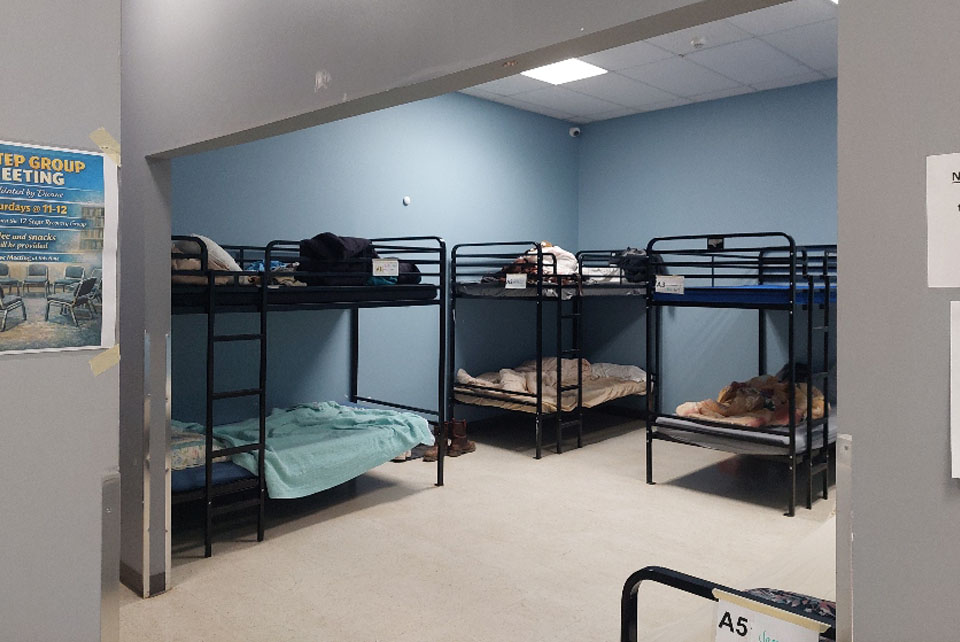
An area in the interior of Bruno’s Place.