
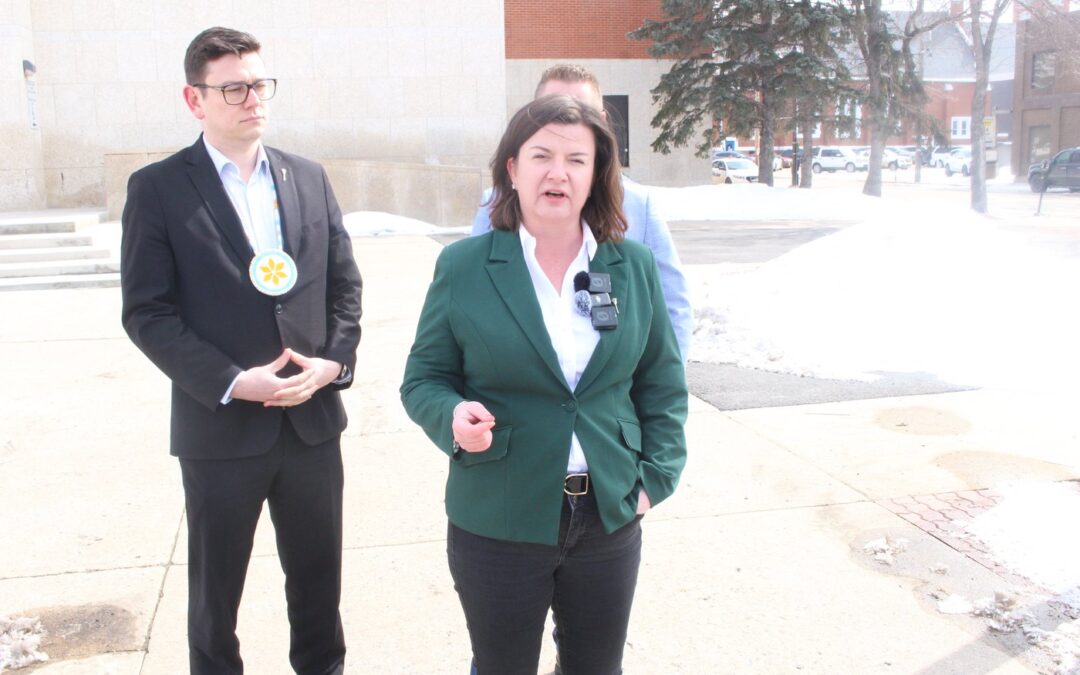
Photo: Michael Oleksyn/Daily Herald (L to R) Jordan McPail, Sally Housser and Darcy Warrington of the NDP were in Prince Albert to promote the new Grid and Growth Plan on Friday.
By Michael Oleksyn
The opposition NDP was in Prince Albert on Friday as part of a province-wide push to take the NDP’s new Grid and Growth Plan directly to communities.
Grid and Growth is the NDP’s new 2026 plan around SaskPower and energy use in the province.
“It’s a practical, made in Saskatchewan approach to lowering power bills, creating good jobs, and building a stronger, more self-reliant electricity system for Prince Albert and for across Saskatchewan,” said Sally Housser, Shadow Minister for Energy and Resources and MLA for Regina University.
She said they have been talking to families, workers and people running small businesses and hearing the same thing.
“People are doing everything right, working harder and harder, and falling further behind,” Housser said. “You hear it in the way people talk about their day-to-day (lives), managing their grocery bills, trying to keep up with housing, making sure their kids have what they need. Then the power bill comes in and it’s just one more blow to the household’s bottom line.”
According to modelling commissioned by the Saskatchewan NDP and conducted by the independent Energy Super Modelers and International Analysts (ESMIA) the government’s power plan could saddle Saskatchewan with $25-$35 billion in SaskPower debt. At the same time, SaskPower says it will cost $2.6 billion just to keep aging coal plants running which Housser said is nearly triple what people were told less than a year ago.
“The NDP’s Grid and Growth Plan offers a different path. It offers reliable natural gas. It offers expanded lower-cost renewables now and far into the future, and it shows that we’re going to build the grid for growing communities like Prince Albert and keep nuclear on the table for when it makes sense,” Housser said.
“It starts with a simple idea. Let’s respect the people paying power bills. It focuses on lowering costs, building more energy here at home, creating jobs, and strengthening the electricity grid for growing communities like this one. It’s about using the strengths we already have in this province our resources, our workforce, our expertise, and putting them all together to work for people.”
In a press release, the NDP argued the government plan doubles down on coal and growing dependence on American imports, while their plan keeps jobs, investment and power production in Saskatchewan.
They stated that the plan would also generate more than $33 billion in economic activity by accelerating investment in generation, transmission and infrastructure. That means more jobs, business growth and stronger communities across the province.
It would reduce reliance on imported electricity while building more power here in Saskatchewan — making the system more stable, secure and self-sufficient.
During the press conference, Housser was flanked by Forestry and Northern Affairs critic Jordan McPhail, and Highways and Transportation critic Darcy Warrington.
Housser said that in consulting on the plan, the NDP talked to industry, crowns and individuals. She said that industry is one of the largest users of electricity.
“I think it was over a year ago when the Sask party first floated the idea of refurbishing the end of life coal plants, I think that was January of 2025, and that came as a surprise to everybody,” she said.
“This was not something that had been well canvassed with any of the people that it was going to affect, sso we want to take this seriously. We want to take the politics out of developing power.”
She said that the idea is more for the future of the province.
“We can’t think about the importance of this in just four years of election cycles. We have to think about it in decades, so when it emerged that they’ve made some of these decisions without any real serious consultation, the Saskatchewan NDP said, ‘well, we’re going to do the work of the government then. We’re going to take this seriously. We’re going to do the math and see what is the best option for the people of Saskatchewan,’” Housser said.
Minister Responsible for SaskPower, Jeremy Harrison, said in an emailed response to the Herald that the NDP plan is not a serious plan.
“It’s exactly why the NDP are not taken seriously when it comes to managing Saskatchewan’s energy security,” Harrison said.
“It does not include any actual costing, it is based on an unrealistic reliance on wind and solar, and most significantly for SaskPower households, it contains no commitment to keep the carbon tax off your power bills.”
He said that the plan to dismantle coal power plants would dismantle nearly one-third of our province’s baseload generation.
“(That’s) dependable, around-the-clock power that keeps the lights on,” Harrison said. “(They would) replace it with intermittent sources that simply cannot do the same job.”
Harrison added that wind and solar energy do have a role, but they do not produce power on demand, and they cannot replace reliable baseload generation.
“Pretending otherwise is not leadership — it is willful disregard for how an electricity system actually works,” Harrison said.
“The result of that approach is obvious: a less stable grid and increased reliance on imports from outside Saskatchewan and ultimately, higher costs — at minimum doubling power rates for families and businesses. “Their plan would put Saskatchewan completely at the mercy of external jurisdictions to keep our grid functioning. That is not energy security — it is energy dependence.”
Harrison said the NDP plan would also mean the immediate loss of at least 1,400 jobs and the devastation of two communities that rely on these facilities.
“Those are real people, real families, and real consequences — all ignored in favour of an ideological pursuit,” Harrison said.
“The economic damage doesn’t stop there. No serious investor would commit billions of dollars in a jurisdiction where power is unreliable and unaffordable. Projects like the proposed $12 billion Bell data centre depend on stable, dispatchable power. Under the
NDP’s approach, those opportunities disappear — along with the jobs and growth they would bring,” he added.
“Extending the life of existing coal-fired generation ensures reliability, avoids $21 billion in unnecessary capital costs, and provides a stable bridge to the future, including nuclear generation powered by Saskatchewan uranium.”