
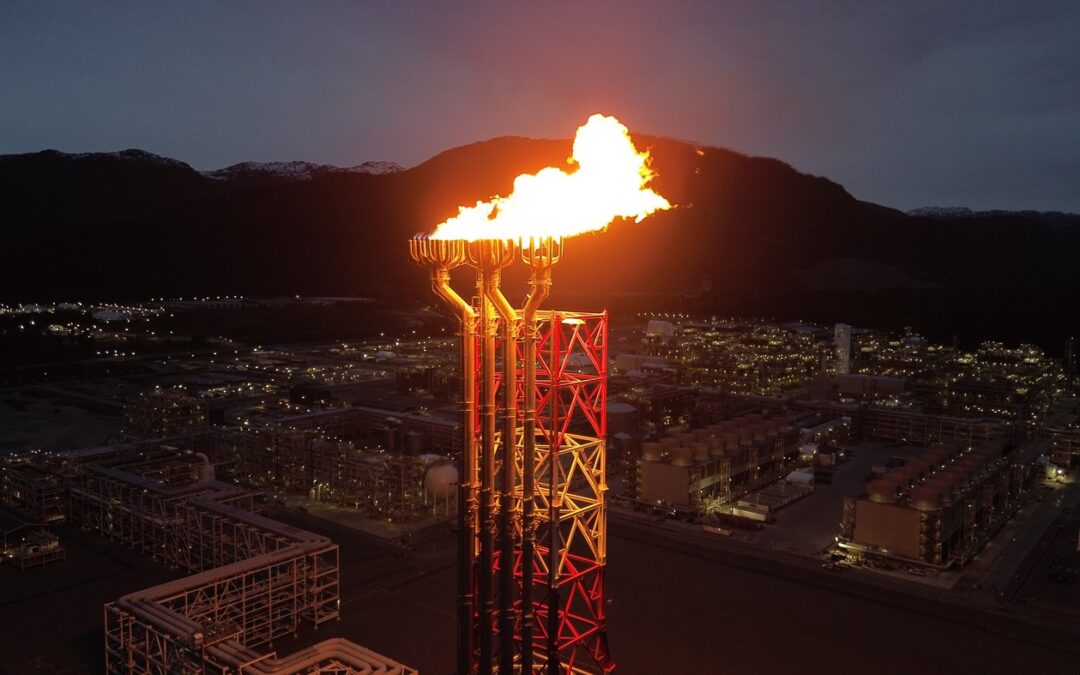
Photo: A flaring stack at the LNG Canada plant in Kitimat. LNG Canada has been burning off more than 15 times the amount of gas its permits allow.
By Sonal Gupta
Local Journalism Initiative Reporter
Canada’s National Observer
BC’s energy regulator is weakening oversight at a time when it should be making it stronger, according to environmentalists, Indigenous leaders and public‑health experts in the province.
The BC Energy Regulator (BCER), a Crown corporation funded largely by the companies it oversees, recently lowered levies for LNG Canada, Woodfibre LNG and the Coastal GasLink pipeline. The fees are collected “to meet [BCER’s] regulatory obligations and recover expenses,” the regulator says on its website.
LNG Canada’s annual levy fell from $900,000 to $600,000, Woodfibre’s from $2.5 million to $1.4 million and Coastal GasLink’s per‑kilometre charge dropped from $1,700 to $420.
Jesse Stoeppler, co‑executive director of the Skeena Watershed Conservation Coalition and a member of the Wet’suwet’en and Gitxsan Nations, said that when projects pay less in levies, there is less money available to fully staff inspections, compliance officers and enforcement. He added regulatory bodies have repeatedly signalled that their capacity is constrained relative to the costs of keeping up with these projects, even before the levy cuts. “So, reducing that even more will increase the risk, and ultimately leave northern and remote communities having to face that risk directly,” Stoeppler said.
Tim Takaro, a physician-scientist and professor emeritus in the Faculty of Health Sciences at Simon Fraser University, said he was shocked when he learned the province was planning to cut levies on these major projects. He said the regulator has been under‑resourced for years, and companies should be charged higher fees, not lower ones, to keep up with the complex, high‑risk nature of these projects.
He pointed out that LNG Canada has been flaring gas well above its authorized levels —burning up to 15 times more gas than expected — and that the company knew about those excess flares for four months before notifying the regulator, which then took more than a month to tell the city.
The Shell-led joint venture, which includes international partners like Petronas, has said it will take three years to fix the problem.
Kitimat residents have reported worsening respiratory symptoms during flaring events that release particulate matter, benzene, sulphur dioxide and nitrogen oxides. Benzene is a carcinogen and long‑term exposure raises risks for cardiovascular and neurological diseases.
Takaro said BC health officers have already called for an independent, cumulative health‑impact assessment of the entire gas‑industry chain but instead of funding better science and monitoring, the province is moving in the opposite direction with fee reductions.
Tracey Saxby, executive director of North Shore environmental group My Sea to Sky fears Squamish residents will face the same health and environmental risks seen in Kitimat when the Woodfibre LNG plant begins operations in 2027, warning levy cuts of more than 40 per cent will mean fewer inspectors, weaker enforcement and greater exposure to unchecked air pollution and poorly modeled flare impacts.
This is not the first time the regulator is adjusting levies.
In 2023, the BCER lowered levies for LNG Canada and the Coastal GasLink pipeline, giving the pipeline about $16 million in tax breaks over 25 years and the LNG plant millions more over its lifespan. Experts warned that these cuts reduced the funds available to properly oversee fossil fuel projects.
‘Gross regulatory failure’
The BCER oversees energy projects such as well fracturing, pipeline construction, LNG facilities and emissions limits. It can fine companies, halt work or revoke permits if they violate rules designed to protect the environment, climate and public safety.
But it is criticized for its dual mandate of facilitating the efficient development of energy resources while also protecting the environment and Indigenous rights.
“It becomes a fox in the henhouse that’s in charge of the oversight,” Stoeppler said.
Saxby said the regulator’s funding model is “deeply conflicted” because it’s largely financed by the same oil and gas companies it’s meant to oversee. “There’s a problem when the regulator is so reliant on industry to pay for them to do their job … there is a revolving door between the BC energy regulator and the oil and gas industry.”
She said that dynamic leads to “gross regulatory failure,” where enforcement is weak or nonexistent and companies are repeatedly allowed to exceed pollution permits without consequences. Saxby pointed to FortisBC’s operations in Howe Sound, where wastewater discharges have exceeded permit limits for more than a year without fines, as evidence the regulator is failing to enforce environmental protections.
While levies fell for some projects, the regulator raised fees for the Prince Rupert Gas Transmission pipeline (from $200 to $760 per kilometre) and the Eagle Mountain pipeline (from $200 to $2,180).
Saxby said these increases show the regulator was underfunded, because the Eagle Mountain pipeline that runs between Coquitlam and Woodfibre near Squamish had its fees rise more than 10 times, proving, she said, prior charges were too low to cover the costs of regulating intensive, high-risk projects like this gas line that often had to tunnel through sensitive terrain.
“At the very moment when people are starting to understand the risks and realities of this project, the province is stepping back oversight,” said Wet’suwet’en hereditary chief Na’moks, whose territories are directly affected by the Coastal GasLink pipeline and LNG development pathway, in a press statement.
“That undermines our rights and the responsibility to protect our lands and waters.”
Canada’s National Observer reached out to the BCER for comment and clarification on the levy reductions, but the regulator did not respond by the time of publication.