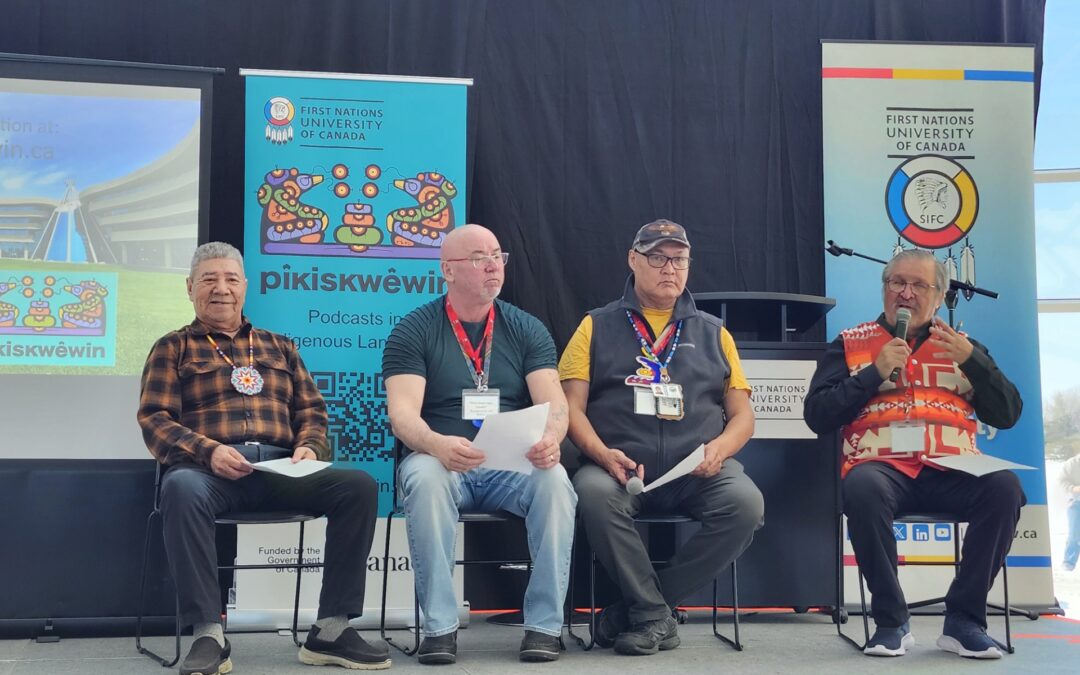
Photo: (left to right) – Robert Merasty, Vince Natamogan, David McIntyre and Abel Charles / Photo by: Danielle Dufour
By: Danielle Dufour
The Pikiskwewin (in Cree meaning language, word, expression) conference hosted by the First Nations University of Canada brought together a host of radio broadcasters and others to talk about Indigenous language revitalization.
“I’m standing in the shoulders of giants,” said Vince Natamogan a Michif speaking radio broadcaster from Pinehouse Lake First Nations.
Natamogan grew up in a trapline and recalls listening to the voices at 6 o’clock.
“Something comes on, a beaver or a plane, and it was our voices,” said Natamogan. “Where did that come from? That’s an alien out of that little radio.”
The voice he heard was one of those giants, Robert Merasty, a Cree and Michif speaking Indigenous broadcaster from Ile-a-la-Crosse who co-founded the Missinippi Broadcasting Corporation (MBC).
“I didn’t want to be a broadcaster,” said Merasty. “That was not my goal.”
Merasty grew up learning Cree and Michif as a child.
“My dad told me Robert, you’re not going to be a traveler or a Bishop, you are going to go to school,” said Merasty.
Unfortunately, Merasty ended up in Indian residential schools for 13 years and witnessed extreme racism and violence.
In 1972, Merasty was offered an opportunity to work with Northern News reaching audiences travelling and on the traplines.
Merasty has dedicated his life to language preservation and works at preserving Indigenous languages through radio.
Abel Charles is a Woodland Cree radio broadcaster with MBC from Lac La Ronge Indian Band.
“We are all gravitating back to the land, that land-based education where our language is,” said Charles. “I know that’s where our healing is.”
Cree was the only language he heard out on the trapline during the first 10 years of his life.
Charles recalls the only English exposure he had growing up was through a transistor radio that he and his family would listen to.
After entering residential school and seeing people on television telling their stories, Charles was inspired to tell stories too. His grandfather encouraged him to get into radio.
David McIntyre is a Dene radio broadcaster with MBC from the English River First Nation in Patuanak.
“My first stint with radio was way back when I was young,” said McIntyre.
McIntyre grew up speaking Dene with his family.
“I was an early riser, and my late mother would always ask me to make a fire, and I was adding chip wood, we had that Sony Transistor radio, and my late mom would always say to put it on,” said McIntyre. “That’s where I first heard radio.”
These panel experts identified challenges with translating English to Indigenous languages.
“All news sites in Canada use the metric system,” said Natamogan. “While we speak in Cree, Imperial, I have to do a real-time conversion.”
Natamogan also noted the challenges in talking about medical terminology like vaccines, diseases and viruses.
“You have to walk around the meaning itself, because the English language is so precise, and Cree language is pre-industrial,” said Natamogan. “Imagine the challenges you have to bring pre-industrial language into your translations of English term and phrases … and making sense of the world (to the listener).”
Charles noted the difficulty to translate technological terms, such as Artificial Intelligence (AI), ChatGPT.
Even though the challenges exist, the ability to provide information to Elders in their languages is important.
Natamogan recalled an Elder saying to him, “I can see the world through your eyes.”
These broadcasters are hopeful that a new generation of language keepers will join the ranks of broadcasters to preserve these Indigenous languages and pass them on to the next generation.
For more information about the Pikiskwewin Indigenous language podcast project, please visit: https://www.pikiskwewin.ca/