By Shari Narine
Local Journalism Initiative Reporter
Windspeaker.com
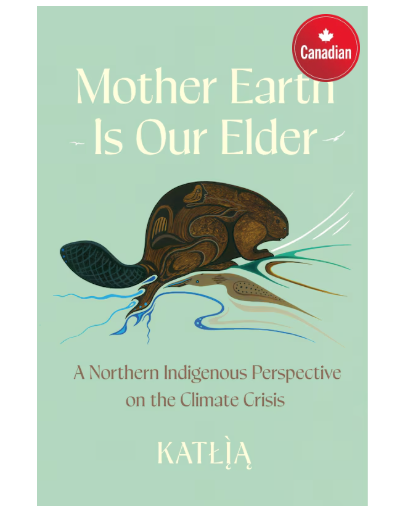
Mother Earth is Our Elder: A Northern Indigenous Perspective on the Climate Crisis blends author Katłįa’s perspective as a woman from Dënéndeh with the stories and wisdom of Dene Elders and knowledge carriers from across the Northwest Territories.
It’s very much a collective effort, although Katłįa, also known as Catherine Lafferty, did the “heavy lifting” over a three-year period travelling throughout N.W.T. to gather stories.
“Copyright is different for (First Nations), right? It’s a collective ownership. And, unfortunately, because of the mainstream publishing industry, the copyright is in my name, but it’s more of a collective,” she said. “This book wouldn’t have been what it is without the generous sharing of the knowledge carriers and Elders.”
Mother Earth is Our Elder weaves in Dene stories while examining how “human-made” climate change and global warming is impacting the earth.
“Indigenous stories hold analogies of the natural unspoken laws of Mother Earth,” writes Katłįa. “But the truth is that stories expose powerful messages and there are forces in this world that do not want us to have that power.”
Katłįa hopes her book can help Indigenous people connect and reflect on their own Indigenous teachings and use them as a “starting point to going and talking to their Elders and knowledge carriers and documenting these things.”
Katłįa shares stories told directly to her, as well as stories found in other books, including the Book of Dene.
She interacted with the storytellers often to ensure what she recorded was what they wanted to share. In the end, three people changed their minds about putting their stories in print. While she was disappointed, because “I really loved what they had to say,” she also understood their decision.
“I’m hoping people will make the connections about our prophecies that I’ve touched very subtly on because some folks were sort of not sure…(that) that knowledge should be out there in the world. There’s a very fine line of what you can share and what you can’t share,” she said.
Of the stories that were included, she noted that “some of them are told symbolically and subtly.”
She says that’s important for non-Indigenous readers to understand.
“I really want them to read it with an open mind and not be so literal and logical thinking, and think in terms of more of a spiritual context and believing in what can’t be seen and believing in stories that might seem very outrageous but believing that those stories are not literal. They’re very metaphorical,” she said.
She points to the beaver, which is featured prominently on the cover of Mother Earth is Our Elder.
“I’m hoping people will make the connections because the beavers appear throughout,” she said, in multiple stories.
One beaver story comes from the Book of Dene and is called “The End of the World.” According to the Dëne Sųłıné, it is Beaver who dives down during the great flood and brings up the dirt from the bottom and then the water begins to recede.
Another beaver story has Yamǫòzha, a medicine man, chasing three giant beavers, capturing them and skinning them. As he cooked them, the oil from their meat went into the earth. This is the site of Le Gohlini (Norman Wells) where Imperial Oil began drilling for oil in the 1920s.
Katłįa writes that it has become the responsibility of Indigenous people to lead the way in this fraught time of human-made change.
“The term human-made change puts the accountability back where it belongs: in the hands of those who have gotten us into this mess in the first place…,” she writes.
“We’ve always been given the direction from Creator to protect the land and water. And we are also the last ones left with those rights outside of capitalism and colonialism to actually assert our rights to protect the land and water,” she told Windspeaker.com.
Indigenous people are acting as gatekeepers, she adds, pushing industry away or ensuring Indigenous oversight on development.
Mother Earth is Our Elder is not a call to action, says Katłįa. She offers it as a way for people to look at the “state of emergency” facing the earth from a different point of view and to consider the Dene laws and Dene spirituality.
In Mother Earth is Our Elder, Katłįa takes a hopeful stand when she writes Mother Earth is going through “one more cycle…cleansing herself…reincarnating herself.”
“Death necessarily doesn’t always have to be a bad thing, and the death of the world as we know it…could really just be change,” she said.
It’s Katłįa’s hope that Mother Earth is Our Elder will spark so much interest with other Indigenous peoples that they will gather their own stories and there could be “a huge forum (and we) just share these stories to see where we are connected.”
Mother Earth is Our Elder: A Northern Indigenous Perspective on the Climate Crisis is published by McClelland & Stewart. It will be released April 7. It can be ordered through https://www.indigo.ca/en-ca/mother-earth-is-our-elder-a-northern-indigenous-perspective-on-the-climate-crisis/9780771018572.html