
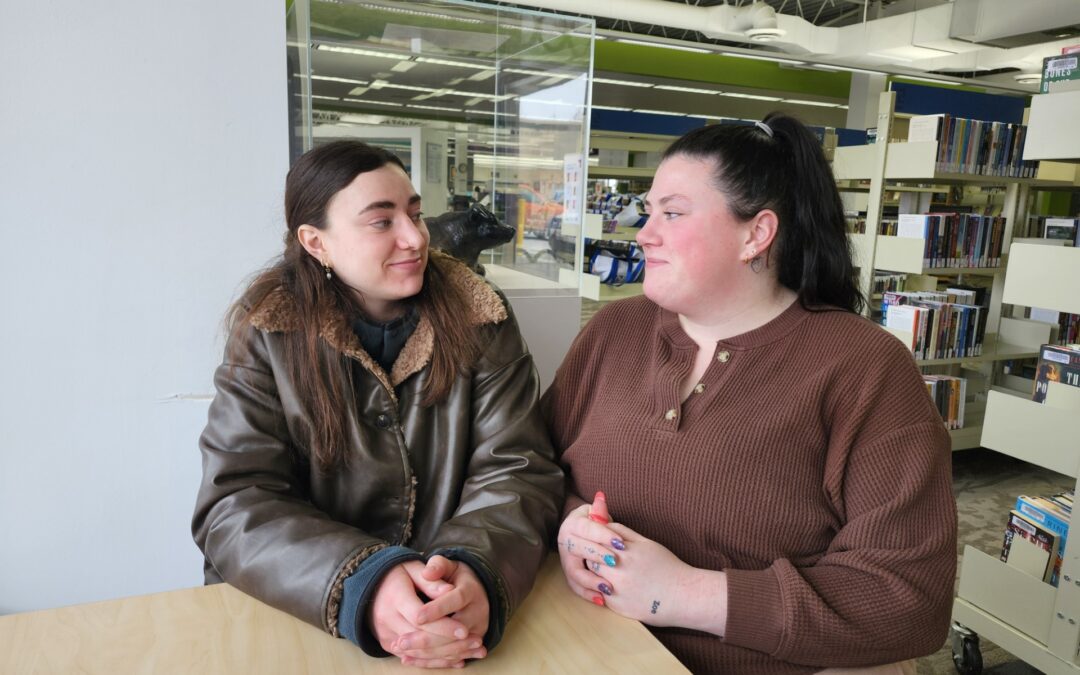
Photo of Janelle and Lauryn Gellvear – Photo by: Danielle Dufour
By Danielle Dufour
Janelle Gellvear, a 27-year-old from Saskatchewan, was diagnosed with a severe degenerative disk disease and spinal stenosis when she was 22 years old.
“I don’t feel like chronic and invisible illness experience is represented in media coverage,” said Gellvear. “I think that is part of why it can feel so lonely and like no one understands. It adds another difficult layer to the illness because it feels like we have to do research (again) if we want to find a story to relate to, or something to feel seen and heard.”
The Government of Saskatchewan Ministry of Health reported almost 430,000 Saskatchewan residents or one-third (33.3%) of the population had at least one of 15 chronic illnesses in their lifetime (2022/23).
The Top five chronic illnesses people in Saskatchewan are experiencing are high blood pressure (hypertension), asthma, osteoarthritis, diabetes 20+ years, and COPD.
The exact cost for managing a chronic illness is unknown because there are many variables, including the type of chronic illnesses and treatment or medication, if needed.
When Gellvear was in grade seven, she noticed she was having a lot of problems with her spine.
“I would describe it as a pop and crazy burning, throbbing pain sensation … I had a bunch of incidences like that all throughout high school which definitely impacted my ability to learn and focus in class.”
A disk pinched a nerve and eventually fully herniated, resulting in numbness and weakness in her left leg, leaving her with limited mobility.
“I’ve had two back surgeries, and I’ve tried cortisone injections, all of the therapies, physio, massage, lymphatic drainage,” said Gellvear.
She is trying to live a normal life now but thinks back to her younger years when she was in so much pain and the doctor wouldn’t take her symptoms seriously.
“Doctors know everything, whatever they tell me is right,” said Gellvear. “Your X-rays look fine, there’s nothing wrong.”
Gellvear wishes she had more medical support in the early stages of her illness and that she was more of an advocate for herself.
She had to withdraw from post secondary school in October 2019.
“At the time I didn’t know what was going on inside my body and was really struggling with the mental side of not knowing and continuing to force myself through my unknown pain like it was normal,” said Gellvear.
Her illness has affected her professionally too. She works in a physically demanding role.
“That’s almost like a mental thing too, where it’s like I can’t perform my best, because my body isn’t keeping up with me,” said Gellvear. “But then at the same time, I can’t not work because I need to pay rent, buy groceries, bills.”
Janelle has been absent from her current job a total of eight months in the last four years.
“Although I was still working, I was forcing myself through the excruciating pain because I didn’t know what else to do,” said Gellvear. “I had to leave work early many times because I just could not continue masking the pain and took myself to the ER (Emergency Room) but didn’t get any help there.”
Working reduced hours has caused her to be financially impacted as she has struggled to get support from the provincial and federal governments.
“That has tremendously impacted me financially which adds another layer of doom and stress to chronic illness,” said Gellvear. “Fighting for that help financially is so hard when you’re exhausted at the end of the day from just fighting your own body.” Her mental health has been impacted.
“I’ve definitely gone through some passive suicidal ideation,” said Gellvear. “I’ve never had a plan to commit suicide or anything, but I have wanted to die, and I think that a lot of people with chronic illness can 100 per cent understand that.”
“You get to a point where it’s like what is the point of my life right now,” said Gellvear. “I have no help, I’m in so much pain, where do I go from here?” Her relationships have been affected.
“I isolate a lot now and especially after workdays … I just don’t have the capacity physically, mentally for any kind of socialization, I’m just so tired,” said Gellvear.
Gellvear copes by watching her “special” TV shows that help her brain to relax and escape by distracting her pain.
“My dog definitely helps with the mental side of things even just like snuggling her for bit at home helps so much with the mental,” said Gellvear.
Gellvear uses Cannabidiol (CBD) to help manage her daily pain.
“Other than that, I just kind of ride the pain wave and deal with it,” said Gellvear.
Gellvear finds swimming helps to take some pressure off her spine.
“I’m often just literally laying on the floor on my heating pad,” said Gellvear.
“It’s hard for me to find the balance between too much walking or not enough walking,” said Gellvear. “But I can’t be completely sedentary or super active because both of them will put me into a flare, so it’s hard to find the middle ground.”
Gellvear recently started the Thrive Chronic Pain Clinic course.
In the past she has found it difficult to find good medical support.
“I’ve heard so many times from medical people ‘Oh, you’re too young for this’, or “There’s nothing else I can do’,” said Gellvear. “There’s just no real help it feels like.”
She felt like her first back surgery was treated like a quick fix, but her situation quickly worsened shortly after.
Her second back surgery took place in Germany and Gellvear expressed that the level of care she received there made her feel safe and supported.
“I’ve never felt that help and support in Canada before,” said Gellvear.
She does not think people understand about invisible illnesses and suggests there is a stigma placed on her.
“Especially being a young woman,” said Gellvear. “People look at you and it’s like there’s no way you’re in pain. You’re functioning fine from the outside, but people with invisible illness learn to mask it so well because if we gave in to our pain, we’d be rolling on the floor crying. It would be impossible to live if we gave in to that pain.”
Masking her pain has made her mental health much worse.
“It feels like society doesn’t want to accept or something that invisible illness is real,” said Gellvear.
Gellvear wants others to know that living with chronic illness is real and that people should be more compassionate and not invalidate those suffering from long-standing chronic illnesses.
“I think that people just need to be more understanding of how real and significant chronic invisible illnesses are for the people who are living it every day,” said Gellvear.
Gellvear encourages other chronic illness sufferers to embrace things that you can hold on to.
“For me, it’s my dog, and my sister,” said Gellvear. “Support is so important.”
Gellvear is hopeful to gain more awareness herself about what is happening inside her body, and she is hopeful that medical practitioners will provide her with resources that will help her condition going forward.
Lauryn Gellvear is Janelle’s younger sister. They grew up in Rouleau, Saskatchewan.
She too has been impacted by Janelle’s chronic illness.
“I just remember in high school where her back would really, really hurt and she wouldn’t even go to school,” said Lauryn tearfully. “I would think how bad can your back hurt … because I was three years younger than her. I’m not having any of that pain yet, but she could barely walk.” When Lauryn got older, she soon understood.
“The doctors weren’t doing anything, and I was still living at home, but she was moved out,” said Lauryn.
Janelle had to move back home as she couldn’t manage on her own.
“We got close and she would tell me how she was actually feeling. I couldn’t do anything,” said Lauryn. “I can’t take that pain away.”
Lauryn tried to help Janelle cope with the pain by offering to massage her back.
“That’s the only thing I could do,” said Lauryn. “I would see her cry, which was a big thing, because she would never show emotion in front of me.”
Soon after, the sisters moved out together and Lauryn really saw first-hand how Janelle was affected, from her job to her mental health, and not socializing with friends.
“She would tell me how she was feeling … and I am a big worrier,” said Lauryn. “I would worry about her constantly.”
Lauryn recalls going to the hospital with Janelle when she was experiencing excruciating pain.
“The doctors are literally like here’s some Tylenol, we can’t do anything,” said Lauryn. “Just to see that, it’s just so heartbreaking.”
Lauryn felt helpless and has lost faith in the medical system. She questions if going to a doctor is even worth it when she is experiencing pain and has chosen to seek medical help when she’s needed it.
After Janelle’s surgeon in Canada advised there was nothing they could do to help her outside of a spinal fusion, Janelle learned about a family friend who recently had an artificial disk replacement surgery in Germany.
With the town of Rouleau’s support, the family set up a GoFundMe campaign raising $50,000 for Janelle’s artificial disk replacement surgery in Germany.
During the surgery, the doctors found out that Janelle also required fusion on another disk. This surgery and following care cost a total of $70,000.
“It has helped me and impacted me, and I just can’t say enough how grateful I am for the community, and my family too, with this journey,” said Gellvear.
After the surgery, Janelle had a lymphatic vessel that was leaking and building fluid in her abdomen. She had to be rushed back to the hospital to have another surgery the following day to get rid of the fluid build up.
Although Janelle expressed that the surgery did provide some relief, she continues to deal with extreme pain due to her spine severely degenerating.
Lauryn was home in Canada when Janelle when to Germany for her surgery.
“I didn’t really have anyone to comfort me,” said Lauryn. “I don’t ever want to sound selfish, but she was halfway across the world and I was so worried.”
Lauryn too experienced acute back pain, but she began to see the difference in her pain compared to Janelle’s and started to feel guilty for sharing this with her sister.
“I felt really bad for telling her if my back hurt or if I was in any pain,” said Lauryn. “She would reassure me you can be in pain … it’s fine, but even now I still feel bad if I tell her my back hurts.” Seeing Janelle’s chronic illness took a great toll on Lauryn’s mental health too.
“I don’t tell Janelle much (about my feelings of worry),” said Lauryn.
The sisters are now trying to support one another.
“It just helps to be an outsider on the chronic illness thing and to have someone to open your eyes to it,” said Lauryn. “I only thought chronic illness was an older person thing.”
Lauryn wants others to know that chronic illness can be invisible, and you might never know what an individual may be going through.
Janelle continues to deal with intense pain and weakness in her hands and shoulders, and numbness between her shoulder blades.