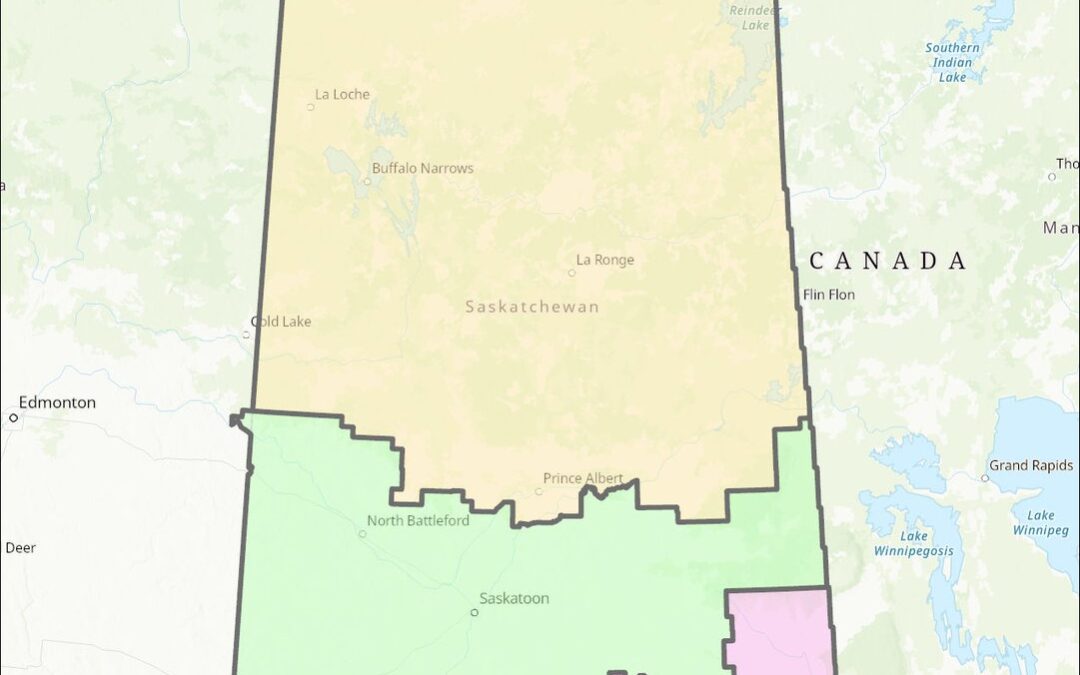
Photo: Submitted Photo The RCMP Districts as served by the RCMP.
By Michael Oleksyn
Local Journalism Initiative Reporter
Prince Albert Daily Herald
Earlier this week the RCMP released statistics on family or intimate partner violence.
In 2025, Saskatchewan RCMP responded to more than 9,800 victims of family and intimate partner violence, continuing a trend of persistently high levels of both types of interpersonal violence.
Prince Albert Council of Women President Chrissy Halliday said she was not shocked to see the statistics when asked about the report.
“Unfortunately, I’m not surprised. We know that family violence and interpersonal violence has been increasing since 2020, and it’s actually been increasing at a very alarming rate,” Halliday said.
“Now, when we look at these kinds of statistics, we’re also looking at the fact that these are reported cases. These are cases that RCMP or victim services or community members have become involved in.”
Family violence refers to any violence committed by spouses, ex-spouses, parents, children, siblings or other family members.
Intimate partner violence refers to violence committed by current or former spouses or romantic partners. In 2025, officers responded to 5,191 family violence victims, which accounted for 30 per cent of all violent crime victims, and 4,708 intimate partner violence victims, which made up 27 per cent. Spouses and ex-spouses are included in both categories.
Both intimate partner and family violence saw decreases from 2024, when Saskatchewan RCMP responded to 5,269 reports involving family violence victims and 4,808 reports involving intimate partner violence victims.
“We know that there’s also a lot of family violence and interpersonal violence that goes unreported every single year,” Halliday said. “Unfortunately, over the last number of years, we’ve been seeing a growing trend in society as a whole where there’s a real fight to put women’s rights on the back burner and there’s a real fight to put women back 100 years.”
These numbers contribute to Saskatchewan’s high rates of interpersonal violence. In Saskatchewan RCMP jurisdiction, family violence occurred at a rate of 925 victims per 100,000 population and intimate partner violence at a rate of 839 victims per 100,000 population in 2025.
In 2025 RCMP reported 925 victims per 100,000 population, in 2024 it was 939, in 2023 it was 910, in 2022 it was 882 and in 2021 it was 854. For Intimate partner violence, in 2025 RCMP reported 839 victims per 100,000 population, in 2024 it was 857, in 2023 it was 820, in 2022 it was 844 and in 2021 it was 846.
Saskatchewan RCMP’s North District accounted for over 50 per cent of family and intimate partner violence victims. For Family Violence the North District had a reports of 2,698
victims or 52 per cent and for Intimate partner violence it followed a similar pattern with 2,385 victims or 51 per cent.
“We’re looking at the 2025 stats, yes, it did go down, but it went down like 14 victims per 100,000 population so we’re looking at it went down on a reported case of about 28 victims in all of northern Saskatchewan,” Halliday said. “That is still not a good number at all.”
She said that one solution is encouraging victims to utilize Victims Services.
“I actually just came out of a community networking coalition meeting and there were people there from victim services and mobile crisis and North Central and victim services and they are a huge resource,” Halliday said. “They do such a good job with education and connecting families and individuals with resources that they need.”
Another important part is education on the subject.
“We know that particularly family violence and interpersonal violence is circular within a family. If I grew up watching my mom be abused, I become accustomed to believing that that is an okay thing,” she said.
“Therefore, when it happens to me, I can’t even recognize that it’s abuse that’s happening to me or violence that’s happening to me. That’s where a lot of those unreported cases come in.
“We need to start with I would say even as young as Kindergarten, to be honest with you, where we’re teaching people autonomy over themselves, over their bodies, over their actions, and that actions have consequences,” Halliday added. “This goes both sides. We need to educate young women, but we also need to educate young men on what is acceptable behaviour.” Halliday said the RCMP are very responsive to the issue.
“The RCMP have expanded over the last number of years with having people who are not in uniform working in Northern Saskatchewan, and I do believe in Central and Southern. Of course, I always focus on the North because I’m part of the North.
“People that are not in uniform go into communities and do education on everything from drugs, gangs, violence. I think they’ve been seeing a success rate with that and I hope that it continues.”
Halliday said that she is aware the Federal Government is trimming positions but hopes to see these positions stay because they are new and having some success.
She also said people experiencing either family violence or interpersonal violence can take a while to report the issue.
“We know the cycle happens at least 26 times usually before it’s reported. That’s an average rate,” she said.
She said that people who do not have a safe person to report to will not report it. She said that by having educated members working in communities and building those connections, it can allow for more growth and for more to be reported, which will look bad statistically for a couple of years, but then it can also help bring those statistics down over time,”
The RCMP is also alarmed by the numbers according to a release
“These numbers show that both family and intimate partner violence continue to have a significant impact in our communities,” Cpl. Rob King, Saskatchewan RCMP interpersonal violence co-ordinator said in a release.. “Even with a slight decline, the levels remain high,
and we remain committed to working with community agencies to ensure people affected by these types of violence stay safe and connected to the support they need.”
The RCMP Family Violence Initiative Fund is an annual program that supports community partners working to prevent and respond to family violence. Eligible applicants, including non-profit organizations and government agencies, can apply for up to $25,000 in project-based funding. Projects must focus on awareness and education, prevention initiatives, or supports for victims of intimate partner or family violence, while strengthening relationships with local RCMP
The fund is available to applicants across Canada. Applications for the 2026 – 2027 funding cycle are open until March 27, 2026. More information about the fund and how to apply is available on the program website.