
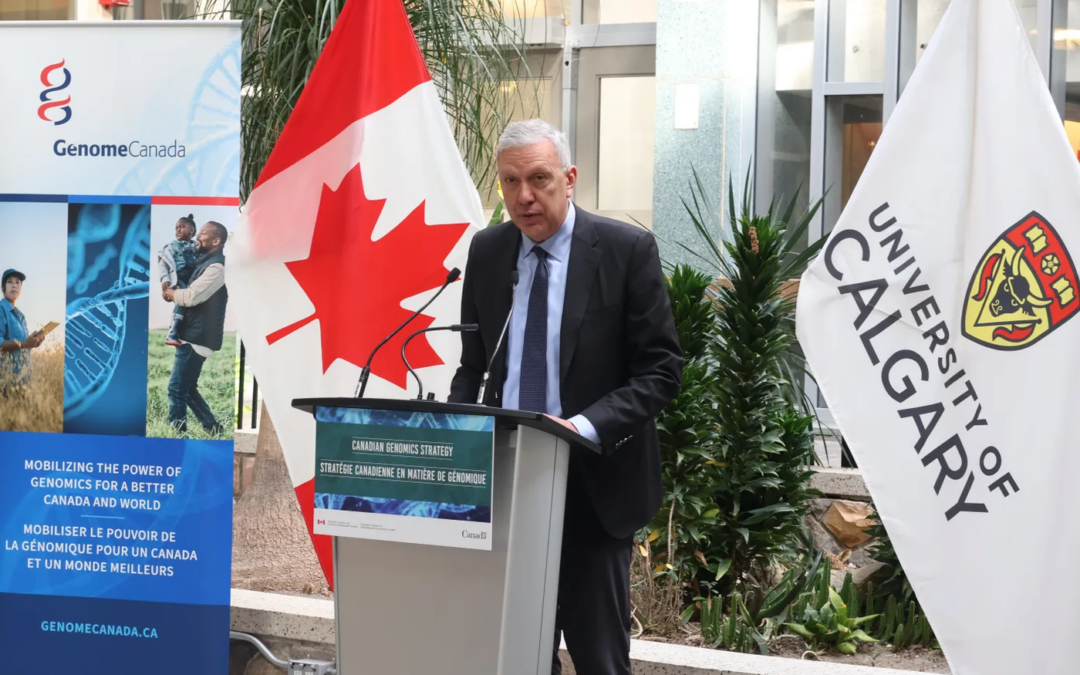
Photo: Dr. William Ghali, vice-president (Research) UCalgary, making genome funding announcement. KAIDEN BRAYSHAW/LIVEWIRE CALGARY
By Kaiden Brayshaw
Local Journalism Initiative Reporter
LiveWire Calgary
Between research combating thyroid cancer, energy storage and hardy plants, the University of Calgary has three new government-funded projects on the go, which are expected to impact Canadian markets later this decade.
The federal government announced more than $20 million in funding for genomics and biotechnology research Wednesday at the University of Calgary, supporting dozens of projects aimed at translating cutting-edge science into practical solutions for health, energy and the environment. Along with government cash, the projects are expected to recruit $45 million worth of private investments.
The projects are said to span from Al-powered precision cancer care to helping farmers create drought-tolerant canola crops and designed to accelerate adoption of genomics in sectors critical to Canadian health and economic competitiveness, according to a Genome Canada press release.
Dr. William Ghali, vice-president of research at UCalgary, said that with government funding, UCalgary researchers will be able to use innovative genomic tools to achieve remarkable things.
“Our researchers are developing heat and drought resistant canola seeds and producing cutting edge thyroid cancer treatments,” he said.
The three projects funded at UCalgary will cross many industries. Projects include genomic tests that analyze thyroid tumour biology, giving doctors the evidence they need to make smarter, more personalized treatment decisions and reducing unnecessary surgeries for the thousands of Canadians diagnosed with thyroid cancer each year, identifying the genetic basis of heat and drought tolerance in canola and develop molecular markers that allow breeders to rapidly incorporate these traits into commercial varieties protecting Canadian farmers from growing yield losses driven by climate change and research that will help make underground energy storage safer and more reliable by understanding how tiny underground microbes could affect storing clean energy like compressed air and hydrogen in salt caverns.
“These investments from Genome Canada and the Government of Canada will lead to positive economic impacts and solutions for a wide range of challenges we face, and clearly, genomics is at the center of these challenges,” Ghali said.
MP Karim Bardeesy, Parliamentary Secretary to the Honourable Mélanie Joly, Minister of Industry, said that the funding is part of the Government’s broader science and research strategy. Previously, Canada had fallen behind, research-wise, compared to other g7 countries. Investments, including this $20 million commitment, are aimed at righting the ship.
“Frankly, we had fallen a little bit behind, so we made a major investment in the 2024 and 2025 budgets around not only fundamental science research, but the kind of applied research that is represented by this strategy,” he said.
Dr. Rob Annan, President and CEO, Genome Canada, said that a year ago, the organization fielded applications for the now-committed funding.
“We put a call together to work with researchers who put together proposals that are then evaluated both for technical merit as well as potential economic impact through a peer review process involving academic peer review as well as impact peer review,” he said.
“That then leads to the decisions that we’ve made with regards to funding.”
For the funded projects, Annan is anticipating tangible market impact in three to five years.
Considering his experience with the school, Calgary MP Corey Hogan, said that announcing funding not only for the University of Calgary but also making the announcement on-campus, was a full circle moment.
“This is one of the great gems of this country and I am always happy to bring light to the work of the University of Calgary, which is exceptional work. One of the things that’s interesting about today’s announcements is it really is all about impact,” he said, adding that universities in western Canada are at the forefront of taking things happening in the lab and building into things that change people’s lives.
“I am always excited to be back here on campus. It feels so funny, in some senses, it feels like I was here yesterday, and in others, it feels like a lifetime ago, but I’m so excited for the future work that comes from today’s announcement.”