
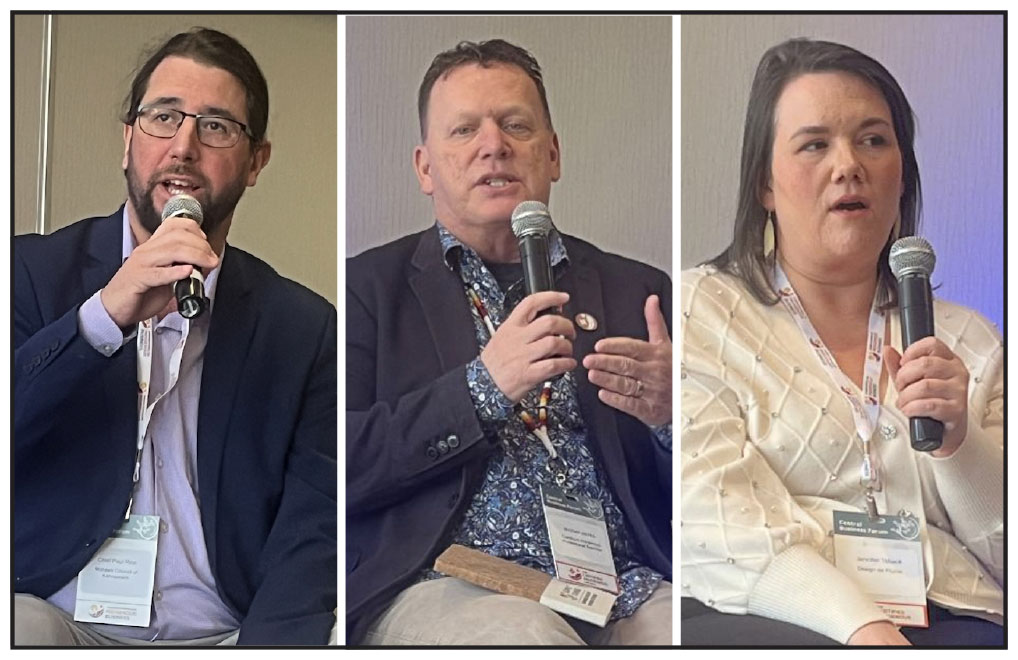
Photo: From left to right: Paul Rice, Michael Jacobs and Jennifer Taback. Photos by Sam Laskaris
By Sam Laskaris
Local Journalism Initiative Reporter
Windspeaker.com
Paul Rice says fledgling small business owners will make mistakes and that’s perfectly fine.
“My mindset is it doesn’t need to be perfect.”
Rice is the chief of the Mohawk Council of Kahnawake, and was a featured speaker at the Canadian Council for Indigenous Business (CCIB) Central Business Forum held Feb. 26 in Toronto.
He spoke on a panel titled “Shifting the Focus: Why Indigenous Economic Development Should Champion Small Business.”
“In business, if you’re trying to be perfect, you’re not going to be in business for very long. You need to make mistakes. There needs to be some leash given. That’s not a great way to put in, but there needs to be some room to breathe. You have to make mistakes. You have to fail forward.”
Rice is also a firm believer in Indigenous communities providing financial assistance to local entrepreneurs.
“It’s always what it comes down to,” he said. “We can do all the breakout panels you want. We can do all the conferences. We can have another business planning workshop. Ultimately, they need capital. They need financing.”
Rice argues those who establish a local business and have some success can end up hiring others.
“That’s less people on the social assistance and the welfare roll,” he said. “Those people may go and inspire other people. It’s an exponential thing. You invest the money. Yes, there’s a return for the business. But there’s also a return for the community and for the Nation from those entrepreneurs.”
Rice said providing funding to some businesses might not be a popular decision at times with some residents.
“The average community member doesn’t see what’s going on behind all of this entrepreneurship,” he said. “It’s about elevating those entrepreneurs. And then the mutual benefit, ultimately, is more jobs, more money, better quality of life, more housing. And when people have those things, that’s really what it’s about for me as an elected chief now, creating that environment, creating that atmosphere for my community to grow.”
Kahnawake is located a 15-minute drive south of Montreal. Because of its closeness to a major city, Rice said his First Nation plays a vital role.
“We’re a big player in that regional economy,” he said. “And that’s a primary driver of why there’s so much entrepreneurship within our territory.”
But the First Nation, through its economic development department, does not own any of the local businesses.
“They do workforce development,” Rice said of the economic development staff. “They do entrepreneurship training. They do financial literacy. They do economic advisory, business protection, business expansion. So, they’re really operating more to support those businesses. And primarily they focus on the small to medium size.”
Besides solo entrepreneurs, Rice said his First Nation does have some members involved in complex business partnerships and in large manufacturing initiatives.
“You want to see entrepreneurship,” he said. “You want to see people going and taking risks. And I believe, not just my people, but we are entrepreneurial in nature.”
Joining Rice on the CCIB panel were Michael Jacobs, a member of Curve Lake First Nation and Jennifer Taback, a member of Shawanaga First Nation, both in Ontario.
Jacobs is the CEO of Cambium Indigenous Professional Services while Taback is the co-CEO of Design de Plume, a Sudbury-based company whose services include graphic design, branding, websites, strategy and marketing.
Jacobs said there are mutual benefits for entrepreneurs and First Nations when they work together. Those benefits are most valuable in equity positions, in spaces where First Nation communities are building their wealth.
“Within that, there’s an opportunity to build economy as well,” Jacobs said, adding a warning. Issues can arise for First Nations keen to use their members in various business ventures.
He said a common problem is that a chief and those on council have to deal with perceived conflicts with family members or people they’ve known for some time.
“How does the economic development side of it cater to that without it looking like you’re being preferential,” Jacobs said. “There’s only going to be a certain number of entrepreneurs within your community.”
While he believes it’s important for First Nations to include as many of its members as possible for business opportunities in their territory, Jacobs said those jobs need to include senior executives and not just apprentices to do jobs.
“If we’re still bringing in apprentices in 5-10 years, we’ve failed,” Jacobs said. “We need to be bringing in our senior people that are going to be decision makers that are going to automatically assume Indigenous inclusion. It’s a real important part.”
As for Taback, she’s glad to have a thriving business but, more importantly, she’s pleased she didn’t have to leave her northern Ontario home to become successful.
Taback started her business 16 years ago.
“Graphic designers were often pulled south,” she said. “And I wanted to stay home. I wanted to stay in Sudbury.”
Taback also provided some advice for small business owners looking to get bigger.
“We did that about three years ago,” she said. “We really did a big organizational sweep. And I said ‘I want to be bigger than I think everyone thinks we can be. I know we can work on larger projects’.”
Envisioning that growth and taking steps to make it happen is key, Taback said.
“If you’re looking at that next level, or even if you’re starting out, think about what Level 2 looks like,” she said. “Ask your bank. Ask your First Nation. Ask everyone around you. Be like, ‘so what happens after I use this $5,000? What happens when I need $50 (thousand),’ because there’s not a ton of resources out there. And I think that when you start asking how, always be prepared.”