
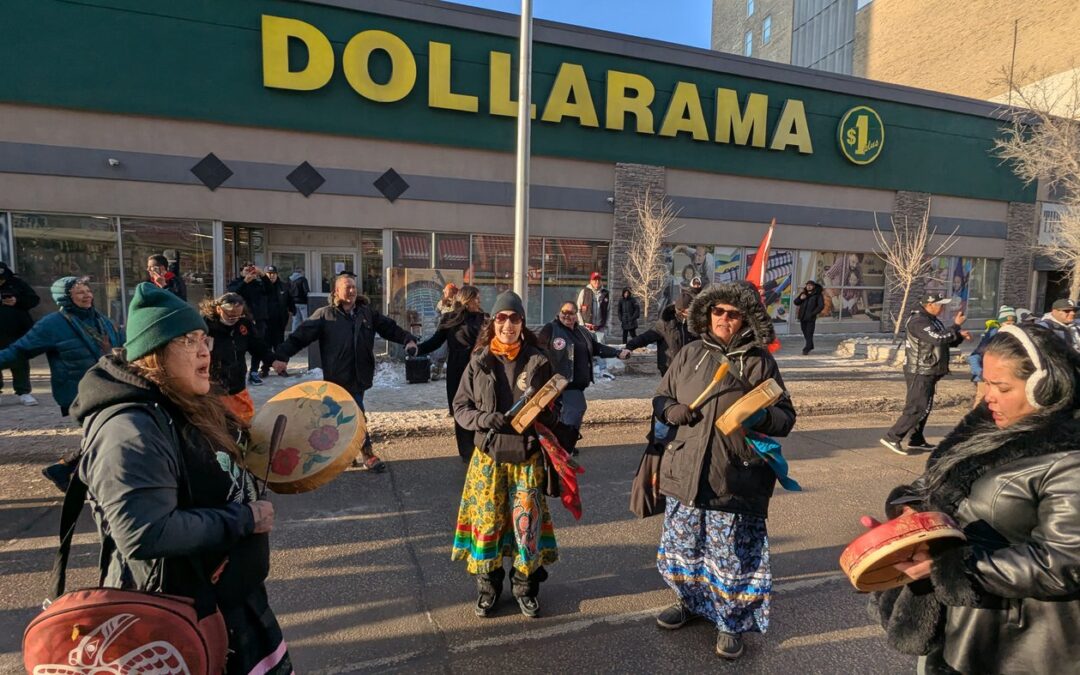
Photo: Women drum during a round dance on Portage Avenue in Winnipeg, at a protest outside a Dollarama discount outlet where a private guard is alleged to have assaulted an Indigenous 46-year-old using brass knuckles. / Crystal Greene, Local Journalism Initiative Reporter
By Crystal Greene
Local Journalism Initiative Reporter
IndigiNews
Content warning: This story details police violence towards Indigenous people. Please look after your spirit and read with care.
The Winnipeg Police Service has announced charges against a security guard alleged to have assaulted an Indigenous man last weekend using brass knuckles — a weapon outlawed in “Canada.”
The 23-year-old Impact Security Group (ISG) guard was arrested Monday, police said, and he faces charges of assault with a weapon, unauthorized possession of a prohibited or restricted weapon, and uttering threats. On Tuesday, the province confirmed the guard’s license had also been suspended.
The 46-year-old victim is accused of shoplifting $95 of merchandise, according to WPS, and he faces charges of robbery and uttering threats. Both parties have yet to appear in court.
Over the weekend, video spread on social media of the violent altercation in a Dollarama outlet which took place on Saturday — sparking a protest outside the store on Monday.
The demonstration outside the store on Portage Avenue near Donald Street spilled onto the road after speeches against security companies and racial profiling, with protesters holding into a round dance.
They posted a list of demands onto the discount store’s locked door, which displayed a “temporarily closed” sign.
Speakers at the rally expressed outrage with how they say Indigenous people have been treated by private retail guards in the city, alleging racial profiling and violence at the hands of employees of several companies, including ISG.
They demanded accountability and government reform of private security operations.
Inquiry, reforms demanded
A Facebook video of the incident viewed by IndigiNews, which has since been taken down, showed an unidentified victim being pinned to the ground by a guard, who punches him repeatedly.
After the second punch with the guard’s right fist, the guard reaches into a pocket to remove what appear to be brass knuckles. Also known as knuckle-dusters, such weapons increase the force of punches.
“Stay down or I’ll f—— kill you,” shouted the guard as he pointed his finger at the man on the floor. “Try me, touch me, you f—— idiot, touch me. You hit me first, threaten me. Who the f— do you think you are?”
In the video, bystanders could be heard speaking up for the man, to which the guard cursed, “F— all of you … You think I give a f—? Cops are coming.”
He then stomps on the victim with his foot, shouting, “Do you think I’m joking here? I risk my life everyday.”
According to the video, the guard then confronts a witness to the incident, saying, “You want to go next?”
Kaapetawayaishete Danko Makwa, an Elder from Sagkeeng First Nation, said the issue is much bigger than the most recent altercation. She said there have been longstanding tensions between the Indigenous community in Winnipeg and retail security officers.
“There’s been violence against our Indigenous, especially the vulnerable,” the Elder said.
“Because Winnipeg is in Treaty One territory, I have a duty to make sure that people from other First Nations are safe in my territory.”
Métis filmmaker Joseph Fourre, speaking at the protest, called for the province to hold a public inquiry into the issue of guards’ interactions with Indigenous people in retail stores.
“It’s always ‘us’ and ‘them’ … as soon as we walk in the door,” he told the crowd.
“That needs to change through education — and we need to have an inquiry.”
Fourre, who founded the Singing Red Bear Foundation to raise awareness of substance use, said he sympathized with the victim. The filmmaker shared that he was once homeless and addicted to heroin — but, after starting his recovery, he became a successful businessperson.
“This outraged me in what I saw on social media,” he said of last weekend’s incident. “Even today, I walk into a store and right away I feel incompetent … it’s just a feeling that they give you.
“We need to come together and create an environment and a society in which this doesn’t happen — and people don’t have to steal to eat.”
Another speaker at the rally identified himself as a professional security guard, and questioned the ISG employee’s actions.
“I am a security guard,” said Mapuche community organizer Victor Mondaca.
“Never once have I ever laid a single hand on an individual. We use our words … A uniform does not place somebody above the law.”
He read out a list of demands, which included immediate termination of the employee, apologize publicly to the victim, and better train staff in “ethical use of force,” “anti-racism” and “nonviolent intervention.”
The list also called on the city to review and suspend any contracts it may have with the company, and for the province to revoke ISG’s licenses “until staff trainings and protocols are reviewed and verified.”
It added that the province should increase its minimum training standards for those licenses.
In an emailed statement on Tuesday, a Cabinet spokesperson said the province’s registrar “has suspended the licence of the security guard in the video.”
The justice ministry “has modernized the licensing and training for security guards,” including by requiring “Indigenous cultural competency training,” the statement said.
“The changes have been created in collaboration with our Indigenous Liaison team and community partners.”
‘How First Nations people are being treated’
The incident sparked numerous public criticisms, including from the province’s major First Nations organizations.
Chiefs advocacy organizations the Assembly of Manitoba Chiefs, the Southern Chiefs Organization, and Manitoba Keewatinowi Omimanak all issued statements condemning the incident.
“What I saw in that video is concerning,” said AMC Grand Chief Kyra Wilson in a statement Sunday.
“The images raise serious questions about use-of-force practices and how First Nations people are being treated in public spaces.”
Meanwhile, community outreach group Morgan’s Warriors announced its members would boycott Dollarama, where they had always purchased goods to hand out during neighbourhood walks.
“We serve the very same people who are often involved in these encounters — people struggling with homelessness, addictions, trauma, poverty, and systemic discrimination,” said a post by the group on Facebook.
“Today, we are drawing a line … It does not sit right with us to financially support a corporation connected to repeated incidents where vulnerable individuals are subjected to violence.”
A spokesperson for Dollarama said in an email that the company “is committed to maintaining a store environment where everyone is treated with respect, regardless of the circumstances.”
“Licensed third-party security firms engaged for security and loss prevention purposes are required to uphold these same standards and we do not authorize the use of force in any situation,” it said.
“Following the incident, we put the security firm on notice while we investigate why protocol was not followed and we continue to cooperate with the relevant authorities in their investigation.”
IndigiNews also contacted Impact Security Group CEO Ron D’Errico for comment, but did not receive a response to voicemails and emails.
The company’s website states that it values “integrity, accountability, and excellence” as well as “maintaining the highest ethical standards.”
‘I see so much profiling’
On Tuesday, a handful of residents gathered to protest outside the security firm’s Winnipeg headquarters, where police warned the small group to stay off the property.
Currently, security guards in Manitoba have a 40-hour training program. Its manual offers just a single page in which “discrimination” and “negative stereotypes” are mentioned in two paragraphs.
One of those outside ISG’s office Tuesday was Patricia BigGeorge, former chief of the Anishinaabeg of Naongashiing (Big Island First Nation) and a former customs officer.
She said security officers, whether government officials or private employees, should be better trained in understanding Indigenous people, history, treaties, and anti-racism.
“They should have more knowledge because we are the first peoples of this country, of the continent,” she said.
“They need to be taught about the history. I see so much profiling — so much targeting on Indigenous people. And when I worked at customs, that’s the same thing that I saw.”
On his Facebook profile, former deputy premier Eric Robinson, now a board member of the Indigenous Peoples Alliance of Manitoba, posted an invite to a March 14 forum event to “discuss security companies and their relationship with Indigenous people in private and public facilities.”
He wrote that security firms and the government were invited to attend, as well.
On Tuesday, at an unrelated press conference, the province’s justice minister declined to comment on an ongoing investigation, but said he’d “seen the video” of the Dollarama incident.
“We stand with our partners in law enforcement to undertake that work,” Matt Wiebe told reporters. “We’ve been working very closely with community and the security guard industry around enhancing training for security guards.
“As we’re leaning into using private security, a lot of companies [and] businesses, they want to use private security because they want to be part of the solution of making not only making their business safer — but the whole community safer.”