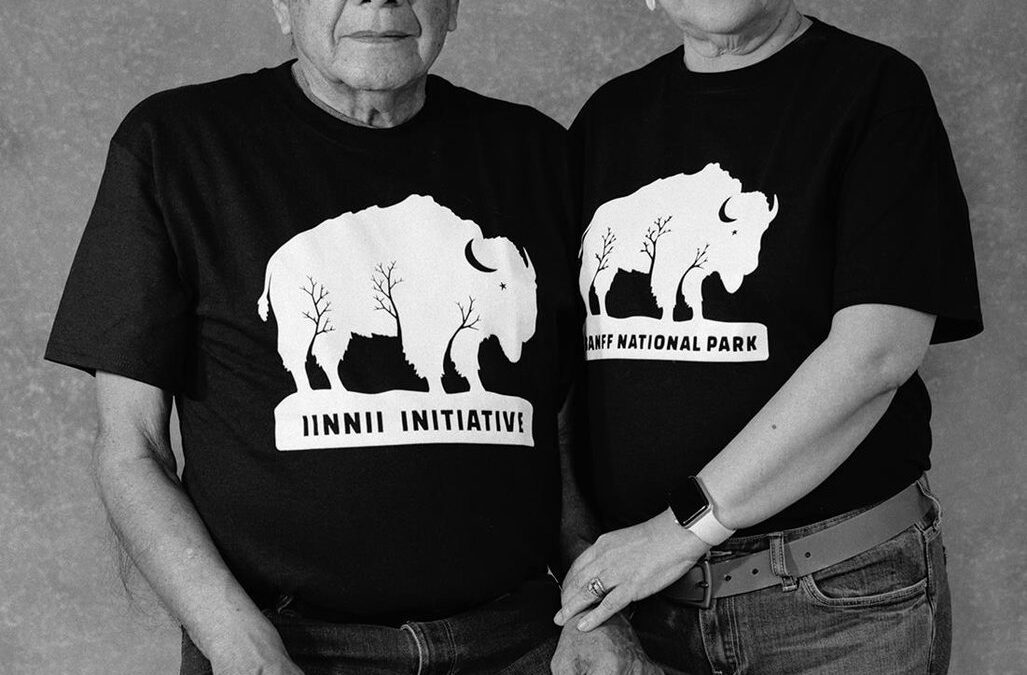
Photo: A portrait of Kainai elder and educator Leroy Little Bear and his wife, Amethyst First Rider, from the Indigenous elders portrait exhibit “All Our Relations.” CRAIG RICHARDS PHOTO
By Leah Pelletier
Local Journalism Initiative Reporter
Rocky Mountain Outlook
From the parking lot of the Juniper Hotel in Banff to the shores of central Alberta’s Lac Saint Anne, Métis photographer Craig Richards sets up a neutral backdrop and invites an elder into the frame.
From there, the elders speak.
“The backdrop … allowed them to speak, to sing and it allowed us to see them,” said Richards, former curator of photography at Banff’s Whyte Museum of the Canadian Rockies.
In his signature black and white style, Richards has photographed over 60 elders from First Nations across Canada in his portrait series All Our Relations: Portraits from the Elder’s Gatherings.
What’s now expanded from coast to coast, all started with the Elders’ Gathering at Banff’s Juniper Hotel, an annual three-day meeting joining Indigenous communities from both sides of the Rocky Mountains to exchange stories and traditional medicines.
“They would discuss how to bring buffalo back to the plains [and] how do we bring salmon back to the rivers that used to just flow with salmon. They’d discuss residential school problems, drug addictions, alcohol and this sort of stuff,” said Richards, adding that the site of the Juniper Hotel carries historical significance to Indigenous peoples who travelled through and gathered on the land for thousands of years.
“Everyone would sort of walk away with knowledge, shared knowledge.”
Initiating the elders’ gatherings over 20 years ago, owner of the Juniper Hotel and former Banff Town councillor Peter Poole first approached Richards with the idea for the portrait series in 2019.
“In its first year, I did 17 portraits,” says the once Canmore-based photographer. “I would use a backdrop and just tell people to bring something that was important or special to their world and it really just took off.”
Exhibiting the project in various galleries, Richards began to include elders from First Nations groups across the country from Nova Scotia to Vancouver.
Accompanying the elders in each frame is an object of meaning to them.
“I didn’t tell people what to bring or even suggest and they brought just absolutely wonderful things,” Richards said. “They brought … sacred pipes, they brought ancient fishing spears, they wore clothes that represented [their] clan, the frog clan,” he added, noting objects that have been brought over the years.
Richards recalls one portrait with painter Joseph Sanchez, the last remaining artist from the art collective, the Indigenous Group of Seven.
“He was in residency at the Banff Centre. … When I walked in, he was smudging the whole room and he burns incense while he paints, he says, ‘to keep his words and his paintings truthful,’” Richards recalls.
In his portrait, Sanchez holds a paintbrush in one hand and braided sweetgrass in the other – an object that gives the artist “power and truthfulness.”
“He wears a necklace that has a little skull … and he said, ‘it was a gift and basically it’s cold on my vocal cords so that all my words I speak are true.’”
Almost as important as the photos themselves are the bios that go along with each, says Richards, noting they detail why each person brought the items that they did.
“In many ways, the bios complement and give so much more depth to the portraits and it unifies a voice right across the country,” he said.
With every portrait in black and white, it’s not the colour or even the objects of meaning that pull the viewer in but instead it’s the eyes of each person.
“What I find in black and white in the portraits is that you are drawn to the eyes and then everything else becomes a part of them and it’s not about bright colours they’re wearing, but everything just becomes a part of who they are,” he said.
A photographic exchange
Photographing elders and community members from the Secwépemc around southern B.C. to the Dene all the way to members of Îyârhe (Stoney) Nakoda, many have sat in front of Richards’ lens, recounting their stories.
There is a brief moment of exchange, collaboration and trust between Richards and each elder as he points his lens.
“In the words of a great Canadian portrait photographer Yousuf Karsh, he said, ‘the true lens of the camera is the heart and mind of the photographer,’” says Richards. “If I can somehow say with those words that … there’s a relationship that develops through the heart and mind of Craig and the heart and mind of [each elder].”
“They have all made my life richer,” he adds.
Richards hopes that in every portrait of the series viewers see “the dignity, the sense of self-worth and the beauty” of each Indigenous person portrayed.
“In all the exhibitions that I’ve had of this … people come up to me afterwards and just go, ‘I’m seeing First Nations people in a different light,’ not that it was ever negative before but it’s in this unified element that goes right across the country,” added Richards.
With 66 portraits now in the series, Richards hopes to continue growing the project, while starting another one capturing sacred places across Western Canada.
“I would like to complement the portraits with some of the sacred places because I think they each give each other stronger meaning,” he said, noting the series would include places spanning Southern Alberta, Saskatchewan and B.C.
Part of the 2026 Exposure Photography Festival – founded by Richards and a group of photographers in the early 2000s – All Our Relations is on display until Feb. 23 at the Juniper Hotel, along with exhibits at the Wild Flour Artisan Bakery and Cafe and Little Wild Coffee and Gelato in Banff.
The Local Journalism Initiative is funded by the Government of Canada. The position covers Îyârhe (Stoney) Nakoda First Nation and Kananaskis Country.