
By: Michael Oleksyn, Local Journalism Initiative Reporter, Prince Albert Daily Herald
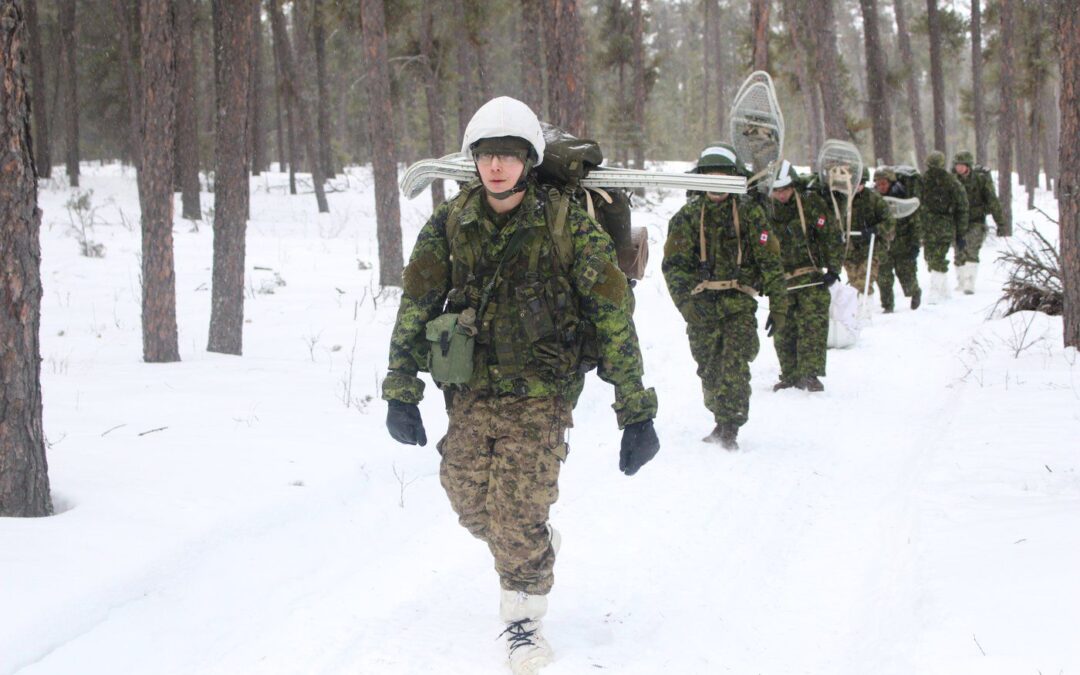
This weekend the North Saskatchewan Regiment and 38 Combat Engineer Regiment conducted foundational Winter Survival Training in the Military Training Area just north of Prince Albert.
The area had been closed since 2011 and recently re-opened for training purposes.
Major Ramsay Bellisle the North Saskatchewan Regiment Attractions Officer described the Prince Albert training area is an Alberta shaped piece of land between the Acorn Road and the Red Wing Road just north of Prince Albert on the West side of Highway 2 across from the RCMP and the Fire Services Station.
“It was closed in 2011 due to local traffic using it as an impromptu dump station,” Bellisle said. “We had different piles of garbage as far as they’d be able to drive in. We’d had people trespassing, patrolling into the area, maintenance of the fence line was an issue.”
Bellisle said some of the material in the dumping area was unsafe. The list of items left behind included everthing from diapers and hypodermic needles.
In 2019, the Commanding Officer (CO) used full-time summer soldiers to do a complete sweep of the area.
Lieutenant Colonel Mike Graver, the current CO of the North Saskatchewan Regiment was the main person to push to get the area re-opened for training. After COVID-19, as things started to re-emerge, he wanted it back in use.
“It’s 10 minutes from the Prince Albert Armoury,” Bellisle said. “It is ideal for small unit training. We’re the main stewards of it. It comes under 38th Brigade out of Winnipeg.
“We regularly patrol it now, at least twice a week. (We) check the fence lines, check to see if there’s been any trespassers, any fence line cuts. The biggest issue we’ve been having are ATVs and recreational, people using snowmobiles, quads, dirt bikes. They’ll cut the fence line, come in, use the trails, and then leave.”
He said people should be aware that they are trespassing because of the signage on the area.
“The guys hung a sign right where they cut it before and they repaired it. They hung a sign, no trespassing. They cut it right there and took the sign with them,” Bellisle said.
The training area is now open for dry training, which means blanks and chalk rounds in rifles for small unit tactics.
The area was officially re-opened with a ribbon cutting in Dec. 2025. Last weekend there was basic winter survival training for the Northern Rangers. This weekend Units of 38 Canadian Brigade group, led by the North Saskatchewan Regiment conducted regular Winter Operations Training.
In addition to the North Saskatchewan Regiment, members of the 38 Combat Engineer Regiment and 38 Service Battalion participated in snowmobile training, chain saw usage and winter operations indoctrination.
This foundational training is the first steps to teach soldiers confidence in their equipment and clothing, and maneuverability in the winter.
Bellisle said the Service Battalion is like the glue that holds the rest of the military together.
“Service battalion is our cooks, our weapons maintenance guys, the drivers, anything that makes the military work. The ones that supply us all. They’re out here doing their basic winter training. Now, half their guys are brand new soldiers, so it’s going to be slow rolling, but they’re going to be working.”
By the end of the weekend the goal was to be able to move with snowshoes, know how much equipment they can carry, what clothes they should be wearing for the mission and setting up and living in a tent.
“When you set up a tent, the standard is to get it done in 10 minutes. Troops at this level, it’ll probably take them 30 to 45 minutes. By the end of, by noon tomorrow (Sunday), they’ll be down to 10 to 12 minutes. (It’s) just constant repetition, moving through the snow,” he explained.
In another part of the training area the 38th Combat Engineers were using chainsaw, which is third level training.
“Some of the trails that overgrown over the years, we need to be able to move our big vehicle, the MSVS up the trails,” Bellisle said. “They’re widening some of the trails, trimming the trees to make sure that we can get down there, all while learning how to use chainsaws.”
The other training, which Bellisle was part of, was snowmobile training.
“We’ve got 14 people that need to learn how to use snowmobiles. (It’s) mobility in the snow, using it up with the Arctic operations,” Bellisle said.
The 38 Brigade Group Arctic Response Company is going north to Cambridge Bay at the end of February and being able to use snowmobiles for long range patrols will be a key item.
“Basic training, doing the snowmobiles, and then those of us doing snowmobile training, we already know how to set up our tents. We’re just not able to participate in the chainsaws,” Bellisle said.
The chainsaw work is also vital because soldiers should be able to down trees to open areas up and also use them for building shelters and creating snow defences.
“Chainsaws are vital for that,” Bellisle said.
For the two days of training there were14 in snowmobile training, 10 in chainsaw training and 32 in the Service Battalion for a total of 56 in all ranks. This comprised four units including the Brigade Group, Engineers, Service Battalion and Regina Rifles.
“Now, the training area is ideal for that size of force to be able to do small unit tactics, moving through the trees,” Bellisle explained.
The training was formally done at Durndurn which is wide open and the opposite of the Prince Albert Training Area. The training area is three kilometers long by one kilometer and a half wide.
“You’re not going to get lost for long. You turn and walk in one direction long enough, you’ll find the fence,” Bellisle said.
He explained that the setup is a great way to teach yourself to reorientate in difficult terrain.
“This kind of terrain, besides the amount of snow, is similar to what the soldiers are training in Latvia,” Bellisle said.
The day was warm with a steady snowfall on Saturday was not perfect but close to ideal.
“The little bit of fluffy snow kind of adds to the ambiance. It is a bit warm to be pulling toboggans and wearing your heavy gear. It is a bit warm for that. Ideally, I would probably say minus 15 would be the really ideal,” Bellisle said.
He said that those weather conditions could also be used to gauge what the ideal winter clothing is for the conditions.
“They’ll be able to set up their tents if someone does get cold or wet. Then again, at the end of the day, it’s 10 minutes from the PA armoury,”
Closed in 2011, this specific training area was recently reopened for use just last month after seven years of hard work from the North Saskatchewan Regiment to maintain and restore it for regular use. This training area is critical to Prince Albert based soldiers and the rest of 38 Brigade for small unit operations in woodland terrain
Bellisle said that the re-opening of the Training area was excellent for the North Saskatchewan Regiment.
“It’s a great opportunity,” he said. “We’re going to be using it a lot more.
“Everybody else could be coming to Prince Albert. We can be running courses—basic training courses, basic infantry courses, different trades training.”
Being 10 minutes from the Armoury it is ideal for letting people know that the Armoury is a base for military operations.
“It’s perfect for branding and people understanding that the PA Armoury is primary reserve and it’s always been active. It’s just now we’re active. They didn’t see it as often,” Bellisle said.
michael.oleksyn@paherald.sk.ca